About Palazzo Rucellai
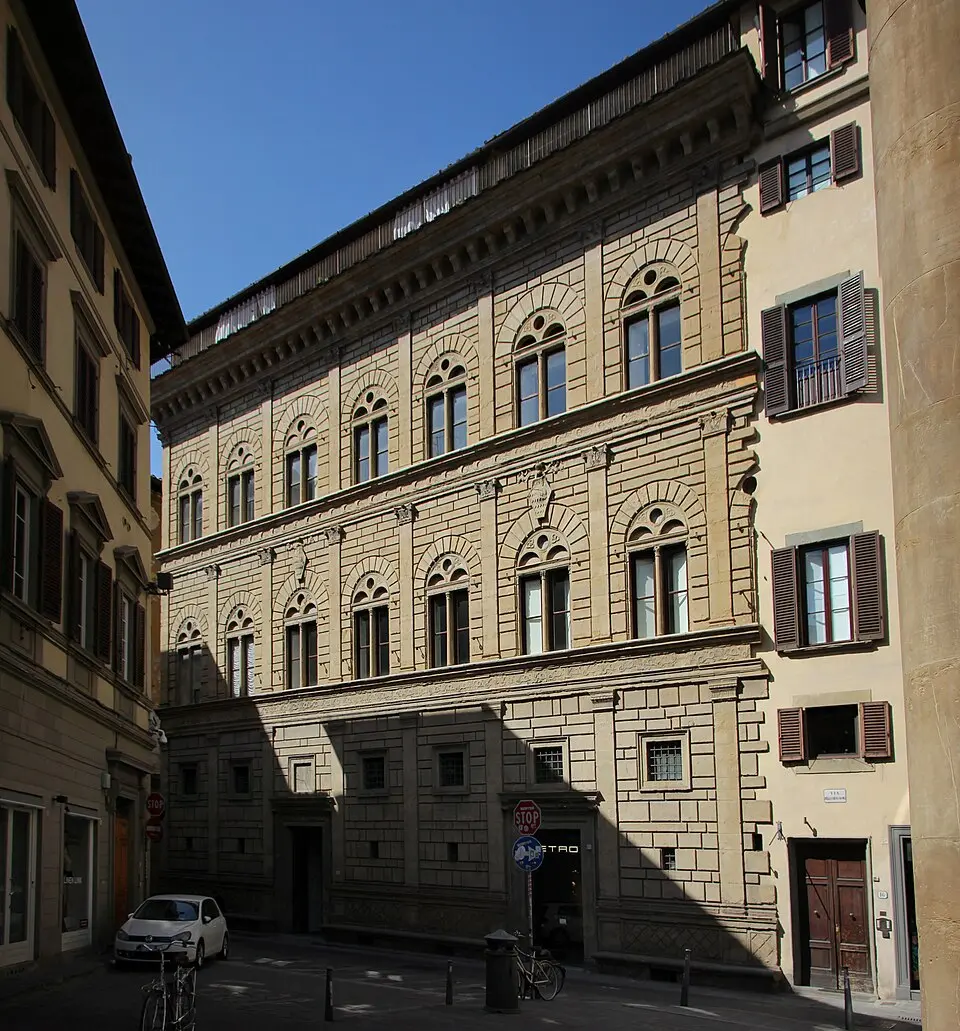
The Palazzo Rucellai in Florence is an outstanding example of Renaissance architecture and a stately residence dating from the mid-15th century. The property was built between about 1450 and 1455 at the initiative of the wealthy textile entrepreneur Giovanni di Paolo Rucellai. By gradually acquiring several neighboring plots and houses, he succeeded in turning what had originally been eight separate buildings into a single unified complex. The distinctive facade, which stretches along Via della Vigna Nuova, was added in front of the existing structures to create a harmonious and monumental impression. To this day, the building belongs to the Rucellai family, underscoring its historical continuity.
The building's history is closely tied to the man who commissioned it. Giovanni di Paolo Rucellai came from a branch of the family that had grown very rich through dyeing cloth. In the tax records of the time, he ranked among the city's largest contributors. Despite his wealth, he was initially barred from public office because of earlier political entanglements. Only in the 1460s did he manage to draw closer to the powerful Medici family, a rapprochement sealed, among other things, by his son's marriage to a niece of Lorenzo de' Medici. This political turnaround later even allowed him to hold the highest office of the Republic. In his personal notes, he describes his building projects as a source of great satisfaction, since they served the glory of God, the city, and his own memory.
The palace's architecture is best known for its facade, one of the first in Florence to feature a system of pilasters and entablature. These vertical and horizontal elements are purely decorative, however, and serve no structural function. The pilasters project only slightly from the wall plane and look like smooth strips set against the lively texture of the masonry around them. The design follows a superposition of different orders: on the ground floor, the capitals recall the Tuscan order, while the stories above show Corinthian features. A strongly projecting cornice crowns the facade, which is topped by a rooftop structure known as the altana.
Inside the building, a rectangular courtyard is lined by loggias on two sides. The arcades are supported by monolithic columns of gray sandstone, adorned with elaborately carved Corinthian capitals. In the frieze above the arches is a coat-of-arms tondo attributed to the architect Bernardo Rossellino. The original Quattrocento interior design has been largely lost, as earlier frescoes and decorations were not preserved. Some rooms were redesigned in the 18th century. Above the second floor is the altana, whose walls are decorated with frescoes depicting scenes from the life of the biblical Joseph.
The attribution of the design remains disputed in art history to this day. While the name of Leon Battista Alberti is often mentioned, since he was also responsible for the facade of the church of Santa Maria Novella, there is no contemporary evidence directly linking him to the Palazzo Rucellai. Giorgio Vasari was the first to name Alberti as the architect, in his biographies. Other scholars rely on tax records and stylistic comparisons to identify Bernardo Rossellino as the designer. Rossellino was also responsible for the facade of the Palazzo Piccolomini in Pienza, which has a similar structure. The debate between these two renowned figures of the Renaissance reflects the complex origins of this architectural masterpiece.
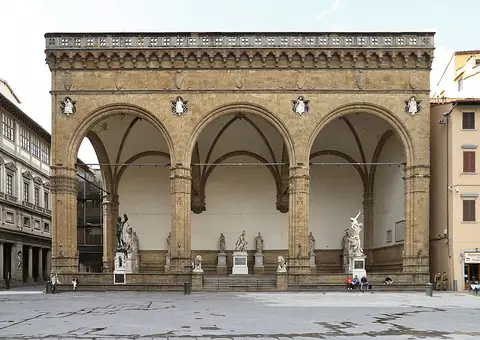
Across from the palace stands the Loggia Rucellai, built between 1461 and 1463. This open structure served as a stately setting for family and business occasions. Giovanni Rucellai had the previous building on the site demolished to make room for the loggia and to create a better view of his new palace. The arcades, which had been walled up in the 17th century, were reopened in the 1960s. On the walls you can see remnants of frescoes showing scenes from the lives of Saint Benedict and Joseph. A continuous stone bench runs along the inside of the loggia.
The Palazzo Rucellai is not only an architectural gem but also a testament to social and political life in the Florentine Renaissance. The close ties between the Rucellai family and other influential houses such as the Medici and the Strozzi shape the history of the place. Today, you can admire the elegant facade and experience the building's historical significance in the context of the city of Florence. The combination of private residence and public display makes the palazzo a fascinating destination for travelers interested in the art and history of the Renaissance.
At a glance
- Category
- Sight › Historic sites
- Rating
- no reviews yet · write a review
- Address
- Via della Vigna Nuova, 18
50123 Florence, Italy - District
- Quartiere 1
- Phone
- +39055219110
- Website
- www.palazzorucellai.org
- —
- Coordinates
- 43.77119° N · 11.24970° E
- Data quality
- confidence 0.94
- Identifier
- ID e1eaf73a-1b1…
Location & surroundings
Toggle layersFAQ about Palazzo Rucellai
quick answersWhat is the Palazzo Rucellai in Florence?
The Palazzo Rucellai is a Renaissance palace in Florence and is considered an outstanding example of a grand residential building from the mid-15th century. It was built between about 1450 and 1455 by combining eight originally separate buildings into a single, unified complex. The palace still belongs to the Rucellai family today.
Who had the Palazzo Rucellai built?
The patron behind the Palazzo Rucellai in Florence was the wealthy textile entrepreneur Giovanni di Paolo Rucellai, whose branch of the family had grown rich through cloth dyeing. He was one of the city's largest taxpayers, but because of earlier political entanglements he was initially barred from public office. Only in the 1460s did he draw closer to the Medici, partly through the marriage of his son to a niece of Lorenzo de' Medici, and he later even held the highest office of the Republic.
What is special about the architecture of the Palazzo Rucellai?
The facade of the Palazzo Rucellai on Via della Vigna Nuova in Florence is one of the first in the city to use a system of pilasters and entablature, though it is purely decorative. The capitals follow the Tuscan order on the ground floor, while those on the upper floors show Corinthian features; a strongly projecting cornice and a rooftop structure, the altana, crown the facade. Inside is a rectangular courtyard with loggias on two sides, supported by monolithic columns of gray sandstone, as well as a coat-of-arms tondo attributed to Bernardo Rossellino.
What can you see around the Palazzo Rucellai?
Around the Palazzo Rucellai in the historic center of Florence, several sights are within walking distance. travelguide195 lists the Museo Marino Marini (about 79 m), the Cappella Rucellai o del Santo Sepolcro (about 85 m) with the Tempietto del Santo Sepolcro (about 87 m), and the Cappella Sassetti (about 124 m), among others. You'll also find the Palazzo Dudley (about 123 m) and the Palazzo Viviani della Robbia (about 135 m) nearby.
Are there restaurants near the Palazzo Rucellai?
Yes, there is a wide selection of places to eat around the Palazzo Rucellai in Florence. travelguide195 lists around 365 restaurants within 500 meters of Via della Vigna Nuova 18. The palace is also part of the tour "Florence for Food Lovers: Trattoria, Wine Bar, and Cocktails above the Rooftops."
Ratings & comments
none yetNear Palazzo Rucellai
closest 5 per category · 2 kmSights
Restaurants
Museums
Hotels
More:Historic sites in Florence (306)Sights in Quartiere 1 (320)All sights in Florence (418)
300 places within 2 km loaded.
You need a free account to leave reviews and photos – that keeps comments genuine and lets you edit them later.