About Floransa Katedrali
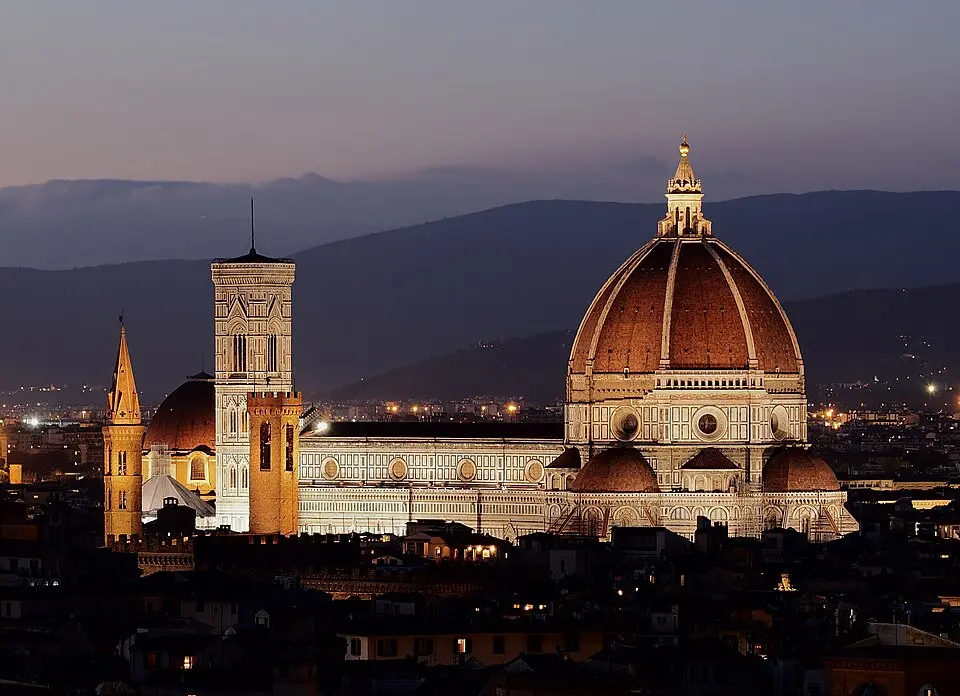
Florence Cathedral, officially the Cattedrale Metropolitana di Santa Maria del Fiore, is the city's principal Roman Catholic church and the seat of the archbishopric. Consecrated by Pope Eugene IV on March 24, 1436, the monumental church holds between four and five thousand visitors inside. The structure is considered one of the most important witnesses to the early Renaissance and is best known for its enormous dome, regarded as a technical masterpiece of the era. The architectural ensemble on Cathedral Square is rounded out by the Campanile di Giotto bell tower and the Battistero di San Giovanni baptistery. With a nave 153 meters long and 38 meters wide, the cathedral is one of the largest churches in Europe. The interior height of the dome from the floor to the lantern is 90 meters, while the total exterior height including the lantern exceeds 114 meters.
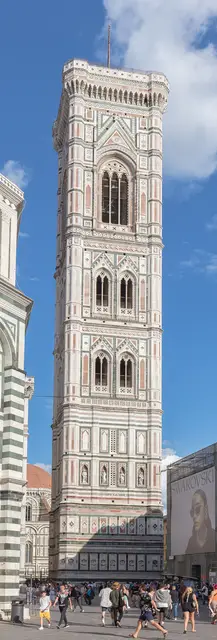
The history of the building began in 1296, when the decision was made to construct a cathedral of unprecedented scale. The master builder Arnolfo di Cambio presented the first plans, with the new structure initially enclosing the existing bishop's church of Santa Reparata. After Arnolfo's death, work stalled because resources were needed for other civic projects such as the city walls and the Palazzo della Signoria. It was only the appointment of Giotto that brought new momentum to the project. Giotto focused on building the bell tower, which was placed in line with the west façade to keep the view of the planned dome unobstructed. After Giotto's death in 1337, Andrea Pisano and Francesco Talenti completed the tower, which reached a height of 85 meters and now houses twelve church bells, including the heavy Apostolica.
From 1330, responsibility for the cathedral's construction fell to the Wool Merchants' Guild, which modified the plans and in 1368 approved a binding brick model at a scale of 1:10. Construction of the nave then progressed quickly, so that it could be used for services in 1379. The original façade, begun under Arnolfo, was torn down in 1588 as outdated. Today's west façade is a Neo-Gothic completion from the late 19th century that continues the three-colored marble style of the nave. It was finished by 1887 to designs by Emilio de Fabris and Guglielmo Calderini and forms a harmonious conclusion to the building.
Inside the cathedral, you will find remarkable works of art. On the north wall are two large frescoes of horsemen depicting mercenary commanders. The monument on the right, for Giovanni Acuto, is by Paolo Uccello and was created in 1436. It shows the English mercenary in the service of Florence and is known for its unusual perspective, which contemporaries did not always understand. Next to it on the left is a work by Andrea del Castagno from 1456 depicting Niccolò da Tolentino. Both works reflect the development of painting in Florence and testify to the high standing of military leaders at the time.
The centerpiece of the cathedral, however, is the dome, designed by Filippo Brunelleschi and built between 1418 and 1434. Construction took sixteen years and was a technical challenge, since the dome had to be built without traditional centering. Brunelleschi devised an innovative system of two brick shells that supported each other, along with a skeleton of ribs. The outer shell serves as the roofing, while the inner shell bears the load. Between the shells runs a staircase of 463 steps that leads visitors to the lantern at a height of 106 meters. The dome weighs about 37,000 tons and has held up to this day despite some hairline cracks attributed to temperature fluctuations.
The painting of the dome's interior was begun in 1572 by Giorgio Vasari and completed in 1579 by Federico Zuccari. The fresco is considered one of the largest Christian fresco cycles and shows hundreds of figures surrounding the Last Judge. Although the work was originally regarded as a failure, restorations beginning in 1979 uncovered artistic qualities that had previously been overlooked. Vasari himself died two years after work began, before the fresco was finished. The painting is so far from the floor that details are hard to make out, and the dome fresco makes the space appear lower than it actually is.
The dome's construction drew on ideas from Gothic and ancient Roman architecture, in particular the Pantheon. Brunelleschi used a system of stone chains to neutralize the horizontal thrust of the vault and channel only vertical forces into the walls. A chestnut-wood chain was also installed, intended to withstand earthquakes better than stone. These measures helped the dome remain undamaged during the earthquakes of 1510, 1675, and 1895. The construction machinery Brunelleschi designed to hoist the stones was revolutionary for its time and included cranes and hoists that ranked among the most admired mechanical devices of the Renaissance.
Building the dome was also an expression of civic pride and the power of Florence. With the cathedral, the city wanted to underscore its supremacy in Tuscany and make up the artistic ground it had lost to cities such as Pisa and Siena. The dome became a symbol of state power and influenced the architecture of the entire Renaissance. Brunelleschi, who belonged not to the stonemasons' guild but to the goldsmiths', initially worked alongside Lorenzo Ghiberti, which led to tensions, since Ghiberti had previously won the competition for the bronze doors of the Baptistery. Despite these differences, they worked together on the dome for sixteen years.
The cathedral's organ complex has been built by the firm Mascioni since 1961 and has been expanded several times. It consists of several divisions that can be controlled from a mobile main console. The instrument comprises six manuals and pedal divisions with a total of 107 stops. A separate instrument is located in the Madonna della Neve chapel, while further organs are distributed in the choir and the octagon. The organ is an important part of the cathedral's liturgical and musical tradition.
Florence Cathedral is not only an architectural masterpiece but also the site of historic events. In 1478, during Easter Mass, Giuliano di Piero de' Medici was murdered in the Pazzi Conspiracy. The assassin's original target was Lorenzo il Magnifico, who managed to escape, though wounded. This event shaped the history of the city and of the Medici dynasty. Today the cathedral is a popular destination that impresses visitors with its history, architecture, and art. The dome offers a breathtaking view over Florence and is a symbol of the courage and creativity of the Renaissance.
At a glance
- Category
- Sight › Historic sites
- Rating
- no reviews yet · write a review
- Address
- Piazza del Duomo
50123 Florence, Italy - District
- Quartiere 1
- Phone
- —
- Website
- www.duomofirenze.it
- —
- Coordinates
- 43.77322° N · 11.25668° E
- Data quality
- confidence 0.87
- Identifier
- ID f28042a0-cb0…
Part of the tour
Florence in One Day: Duomo, David and Piazza della Signoria →Location & surroundings
Toggle layersRatings & comments
none yetNear Floransa Katedrali
closest 5 per category · 2 kmSights
Restaurants
Museums
Hotels
More:Historic sites in Florence (306)Sights in Quartiere 1 (320)All sights in Florence (418)
300 places within 2 km loaded.
You need a free account to leave reviews and photos – that keeps comments genuine and lets you edit them later.