About Cappella Brancacci
The Brancacci Chapel is a side chapel inside the church of Santa Maria del Carmine in Florence. It is considered one of the most important places in the history of European art, because in the 1420s a fresco cycle was created here that fundamentally changed early 15th-century painting. The walls are completely covered with paintings originally created by the artists Masolino and Masaccio. Later, in the 1480s, Filippino Lippi completed damaged or unfinished sections. The chapel has been admired ever since it was created, because its style of depiction marked a clear break with the artistic tradition of the 14th century and pointed the way toward new approaches to spatial design and emotional expression.
Construction of the chapel was commissioned by Pietro Brancacci and begun in 1386. The actual painting was commissioned by his nephew and heir, the silk merchant Felice Brancacci, who had previously served as Florentine ambassador in Cairo. After his return, he wanted to create the chapel for the glory and spiritual salvation of his family. The pictorial program focused on scenes from the life of Saint Peter, the namesake of his uncle. The collaboration between Masolino and Masaccio, who was eighteen years his junior, followed a unified concept, which is evident in details such as the continuous landscape and the consistent coloring of the garments.
The history of the chapel is closely tied to the political turmoil in Florence. When Felice Brancacci became involved in a conspiracy against the powerful Medici family, he had to go into exile and was posthumously declared an enemy of the state. This had direct consequences for the artworks: the fresco of the Martyrdom of Saint Peter was removed, and in other paintings the portraits of the Brancacci family were painted over. Only after 1480 could work resume and be completed by Filippino Lippi. The chapel also survived a fire in 1771 nearly unscathed, although the heat caused slight color changes in some places.
Over the centuries, the frescoes underwent various restorations and suffered losses. In the 16th century they were cleaned because of dark candle soot, and in the 18th century all the frescoes in the uppermost register were chipped away, a result of changing artistic tastes. During extensive restorations beginning in 1984, it was discovered that the painters had worked not only on wet plaster but in some places also on dry plaster. It also became clear that the landscapes continue from one scene to the next behind a painted pilaster, which underscores the spatial unity of the room.
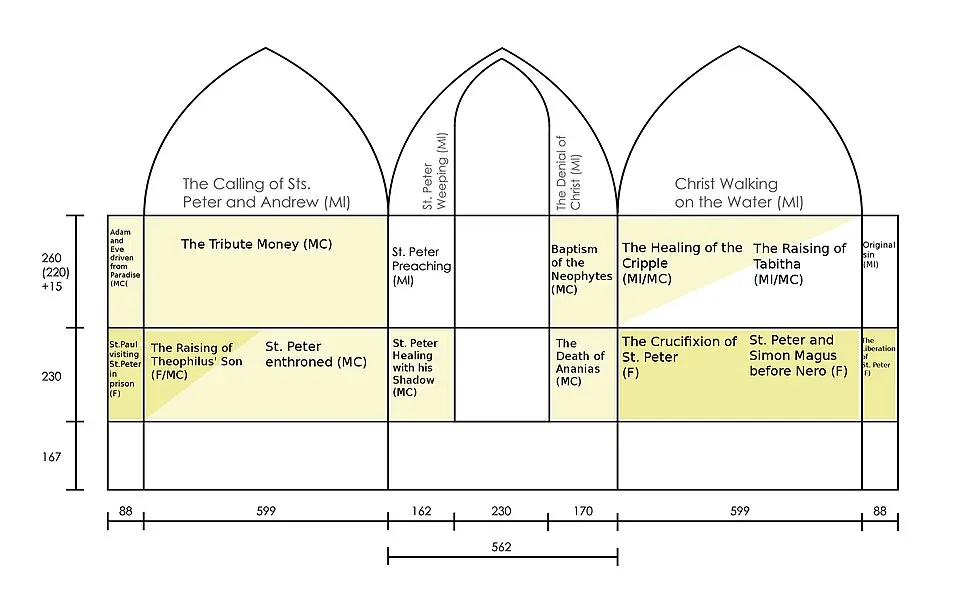
The cycle begins with the Fall of Man, painted by Masolino. Adam and Eve stand side by side, their bodies appearing somewhat elongated. The scene is still strongly shaped by the Gothic style, recognizable in its soft linework and limited sense of depth. On the opposite side is Masaccio's famous fresco of the Expulsion from the Garden of Eden. This work stands in stark contrast to the previous painting through its vitality and its unprecedented expression of emotion. Adam covers his face in despair, while Eve modestly covers her nakedness. An armed angel drives them out of the garden with a threatening sword, while dark divine rays emphasize the dynamism of the scene.
In his works, Masaccio makes a break with the Florentine pictorial tradition by employing central-perspective construction. He moves away from a symbolic view of humanity and paints realistically, which art historians regard as a continuation of the path begun by Giotto. In the scene of the Healing of the Cripple and the Raising of Tabitha, he shows a typical Tuscan town in central perspective in the background. Noteworthy are the everyday details in the background, such as laundry hanging out, a birdcage, and neighbors chatting, which bring the scene to life.
Another masterpiece is the Baptism of the Neophytes, in which Masaccio achieves remarkable realism through the dripping water, the shivering of the man waiting, and the undressing of the next in line. Here he worked extensively with complementary colors, a technique later taken up by Michelangelo as well. In the scene in which Peter heals with his shadow, the foreshortening of the houses and the lifelike depiction of the sick are impressive. The man in front still crouches paralyzed on the ground, while another is already on his feet, thanking the saint.
Filippino Lippi completed the cycle in the 1480s, adhering to the guidelines of his predecessors. His frescoes include Paul visiting Peter in prison, as well as the Liberation of Saint Peter by an Angel. These scenes are architecturally matched precisely to the adjacent paintings by Masaccio. In the double scene with Peter and Simon Magus before Emperor Nero and the Crucifixion of Peter, there are numerous portraits of contemporaries. The young man under the archway, for example, is identified as Sandro Botticelli, while the young man looking out of the picture is believed to be Filippino Lippi himself.
The significance of the Brancacci Chapel lies in the fundamental transformation of painting brought about by Masaccio's work. The precise use of perspective, the uniform direction of light, the skillful use of chiaroscuro, and the lifelike depiction of human emotions had a lasting influence on the following generations of artists. The young Michelangelo was one of the many who gained important inspiration for their own work by studying these frescoes. The chapel thus remains a key place for understanding the transition from Gothic to Renaissance painting and for tracing the development of European art history.
At a glance
- Category
- Sight › Historic sites
- Rating
- no reviews yet · write a review
- Address
- Piazza del Carmine, 14
50124 Florence, Italy - District
- Quartiere 1
- Phone
- +390550541450
- Website
- www.museicivicifiorentini.it
- —
- Coordinates
- 43.76830° N · 11.24369° E
- Data quality
- confidence 0.98
- Identifier
- ID 686a53b7-6ed…
Location & surroundings
Toggle layersFAQ about Cappella Brancacci
quick answersWhat is the Brancacci Chapel in Florence?
The Brancacci Chapel is a side chapel in the church of Santa Maria del Carmine in Florence and is considered one of the most important sites in European art history. In the 1420s, Masolino and Masaccio created a fresco cycle here that fundamentally changed painting in the early 15th century. Its style broke with the artistic tradition of the 14th century and pointed the way toward new approaches to spatial composition and emotional expression. You'll find the chapel at Piazza del Carmine 14 in the historic center of Florence.
Which artists painted the frescoes in the Brancacci Chapel?
The frescoes in the Brancacci Chapel in Florence were painted by Masolino, Masaccio, and Filippino Lippi. Masolino and Masaccio, who was eighteen years younger, worked from a unified concept in the 1420s, which is evident in the continuous landscape and the consistent coloring of the garments, for example. In the 1480s, Filippino Lippi completed sections that had been damaged or left unfinished. The cycle begins with Masolino's Temptation of Adam and Eve, which is still strongly influenced by the Gothic style.
What do the frescoes in the Brancacci Chapel depict, and who commissioned them?
The frescoes in the Brancacci Chapel in Florence mainly depict scenes from the life of Saint Peter. Pietro Brancacci had the chapel built beginning in 1386, and the painted decoration was commissioned by his nephew and heir Felice Brancacci, a silk merchant and former Florentine ambassador to Cairo. Saint Peter was chosen because he was the namesake of Felice's uncle, and the chapel was meant to serve the glory and spiritual salvation of the family.
What is the history of the frescoes in the Brancacci Chapel?
The frescoes in the Brancacci Chapel in Florence were shaped by political turmoil, a fire, and several interventions. Because Felice Brancacci took part in a conspiracy against the Medici, he went into exile; the fresco of the Martyrdom of Saint Peter was removed and portraits of the family were painted over. The chapel survived a fire in 1771 almost unscathed, but in the 18th century all the frescoes in the uppermost register were chipped away. During restorations beginning in 1984, it was discovered that some of the painting had also been done on dry plaster.
What can you see around the Brancacci Chapel in Florence?
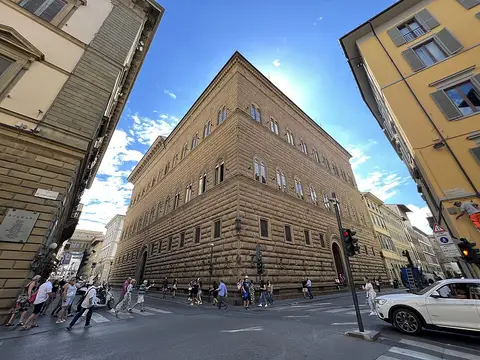
Several historic sites and a museum lie within walking distance of the Brancacci Chapel in Florence. travelguide195 lists, among others, the Museum of Masonic symbols about 124 meters away, the Borgo San Frediano about 178 meters away, and the Church of San Frediano about 189 meters away. There are also palaces such as the Palazzo Soderini, about 220 meters away, and the Palazzo Rinuccini, about 253 meters away. Within a 500-meter radius, travelguide195 also lists around 173 restaurants.
Ratings & comments
none yetNear Cappella Brancacci
closest 5 per category · 2 kmSights
Restaurants
Museums
Hotels
More:Historic sites in Florence (306)Sights in Quartiere 1 (320)All sights in Florence (418)
300 places within 2 km loaded.
You need a free account to leave reviews and photos – that keeps comments genuine and lets you edit them later.