About Opera di Santa Croce
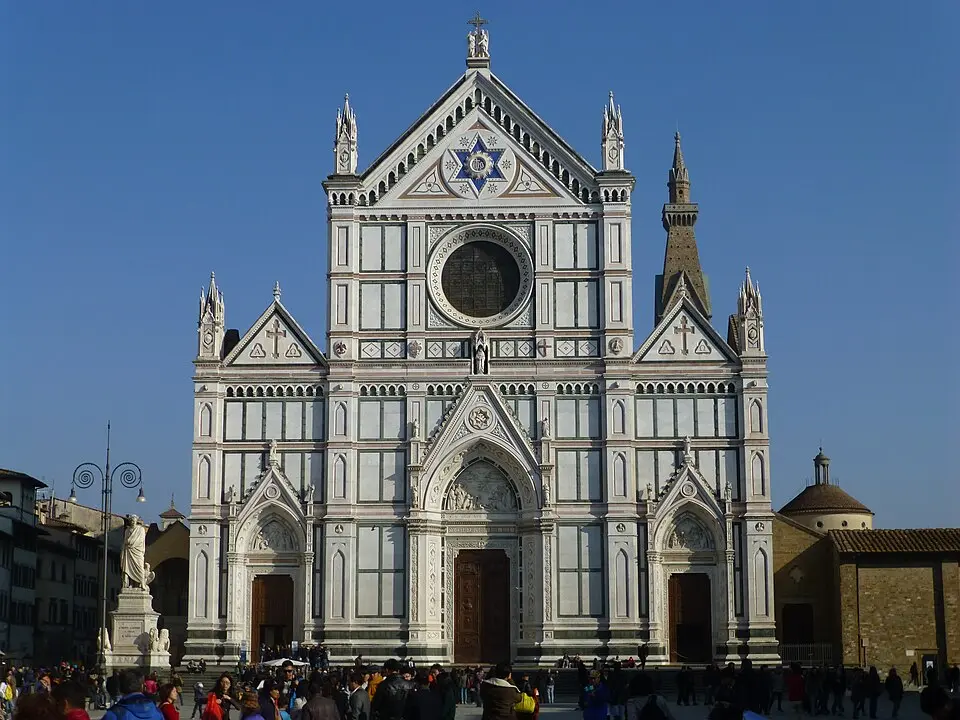
The Basilica of Santa Croce in Florence is one of the city's most important churches and is often called the Pantheon of Florence. The name has less to do with the architecture than with the large number of famous figures who are buried here or commemorated inside. Among the most prominent tombs are those of Niccolò Machiavelli, Michelangelo, Galileo Galilei, and Gioachino Rossini. You'll also find a cenotaph for Dante Alighieri, as well as the tombs of Julie Clary, the former Queen of Naples, and her daughter, the painter Charlotte Napoléone Bonaparte. The church is considered the largest Franciscan church in Italy and, together with the Duomo and Santa Maria Novella, forms a defining trio of Gothic religious architecture in Tuscany.
Construction of the church dates back to the late 13th century, and the design is attributed to the architect Arnolfo di Cambio, who also designed Florence Cathedral. Building work dragged on for decades, and the façade by Nicola Matas was not completed until the 19th century. Architecturally, Santa Croce is marked by the classic simplicity of the Franciscan order, here raised to a monumental scale. Unlike northern European Gothic, which is often characterized by stone vaulting, the nave of Santa Croce is topped by an open timber-truss roof. This design evokes the Franciscan ideal of simplicity and creates a wide, unified space, with sturdy corbel cornices providing structural emphasis.
For visitors, the church is above all a highlight for its rich collection of 14th-century art. It houses masterpieces by Giotto, Taddeo Gaddi, and other leading painters of the period. In the Peruzzi Chapel you can see frescoes by Giotto depicting scenes from the lives of John the Baptist and John the Evangelist. The Bardi Chapel also contains works by Giotto and his school illustrating the life of Saint Francis. These frescoes were whitewashed over in the Baroque era and were not rediscovered until the 19th century. The Baroncelli and Castellani Chapels in the transept likewise hold important fresco cycles by Taddeo Gaddi, showing scenes from the life of the Virgin Mary, and are regarded as key examples of medieval Italian painting.
Besides painting, the church also offers remarkable sculpture. Donatello created his first crucifix here, along with a high relief of the Annunciation. Another well-known work is the crucifix by Cimabue, which was damaged in the flood of 1966 but is still considered an important work of art. The church is also known for its large organ, which has four manuals and a pedalboard. Santa Croce is not only a place of worship but also a cultural center that reflects Florence's history and cultural wealth in a striking way.
At a glance
- Category
- Museum › Museums (general)
- Rating
- no reviews yet · write a review
- Address
- Piazza di Santa Croce, 16
50122 Florence, Italy - District
- Quartiere 1
- Phone
- +390552466105
- Website
- www.santacroceopera.it
- booking@santacroceopera.it
- Coordinates
- 43.76850° N · 11.26159° E
- Data quality
- confidence 0.99
- Identifier
- ID d0bfac25-fc3…
Part of the tour
From San Lorenzo to Santa Croce: Walking Florence's Old Town →Location & surroundings
Toggle layersRatings & comments
none yetNear Opera di Santa Croce
closest 5 per category · 2 kmSights
Restaurants
Museums
Hotels
More:Museums in Quartiere 1 (138)All museums in Florence (164)
300 places within 2 km loaded.
You need a free account to leave reviews and photos – that keeps comments genuine and lets you edit them later.