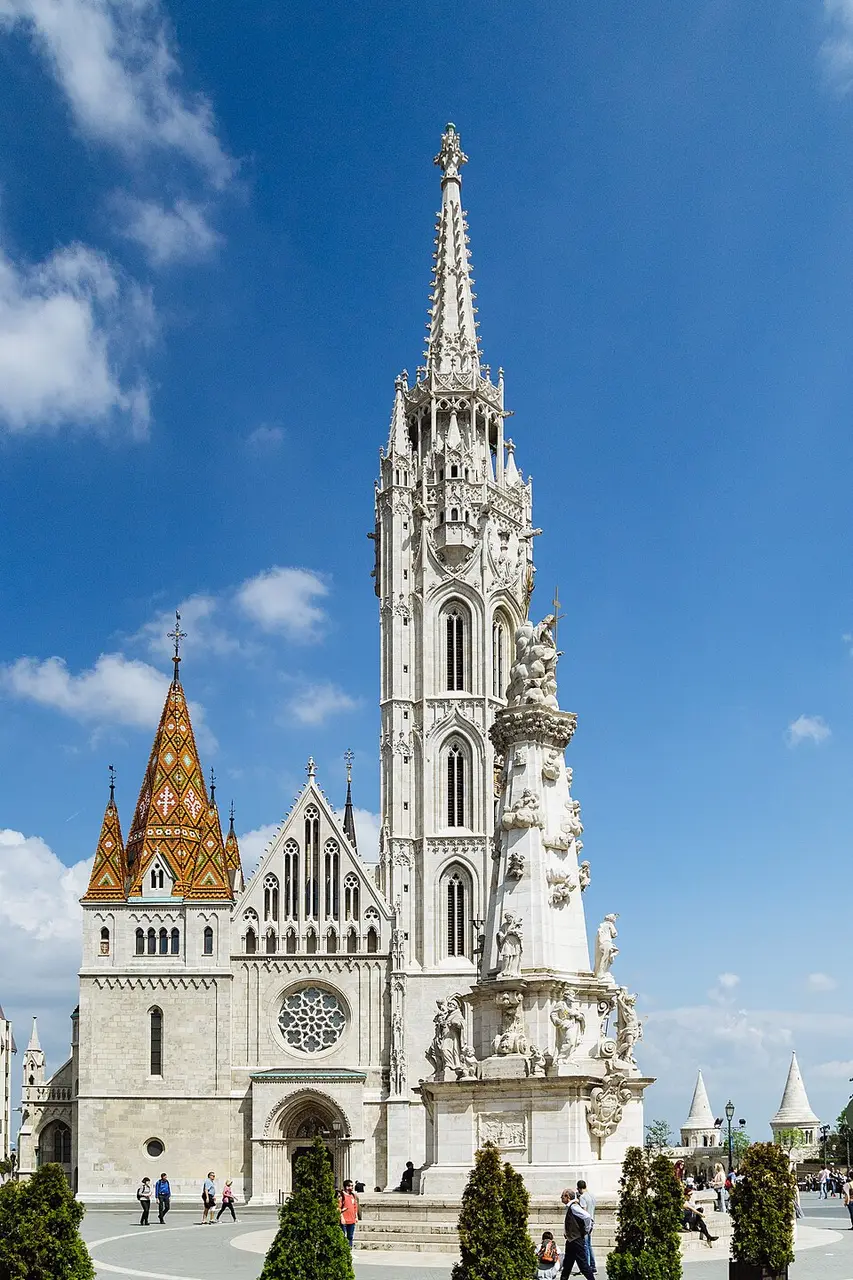
About Mátyás-templom torony
Matthias Church, whose official name is the Church of the Assumption of the Blessed Virgin Mary, is an important Roman Catholic place of worship in Buda, the historic part of the Hungarian capital, Budapest. It stands on Holy Trinity Square in the Castle District, right next to the Fisherman's Bastion in the 1st District. As part of a UNESCO World Heritage Site, it ranks among the country's most important cultural landmarks. For centuries the church served as the coronation church of the Hungarian kings, and today it is the cathedral of the Hungarian Military Ordinariate. Its Neo-Gothic character shapes the city's skyline, while its roots reach deep into the Middle Ages.
The history of the site traditionally goes back to the year 1015, when King Stephen I had a church built here, possibly where the remains of Saint Gellért were laid to rest. However, there is no archaeological evidence of settlement on Castle Hill before the 13th century. The present building dates from the period between 1255 and 1269, when King Béla IV had a Romanesque basilica built after the devastation caused by the Mongols. It originally served the German citizens of Buda and still forms the basic shape of the building today. Some capitals from the 13th century bear witness to this early construction phase.
In the 14th century, under King Louis the Great, the church was converted into a Gothic hall church. The side aisles were raised to the height of the nave, and the ornate Mary Gate was created, modeled on the west portal of St. Lawrence's Church in Nuremberg. King Sigismund of Luxembourg later expanded the building with altar chapels, which were removed again in the 19th century. Important political events also took place during this period, including the coronation of Charles I Robert in 1309.
The church's present name goes back to King Matthias Corvinus, who in 1470 had a five-story tower and the royal oratory added. Matthias, a great patron of the arts, brought many artists from Italy to Hungary, which is why the tower shows an interesting blend of Gothic and Renaissance elements. On the east wall of the south tower is his coat of arms, which shows the kingdoms of Hungary, Dalmatia, and Bohemia as well as the coat of arms of the House of Hunyadi. The church's southeast portal has been known as the Bridal Gate since his wedding was held here.
After the Ottomans conquered Buda in 1541, the church was converted into the Great Mosque. It served this purpose for almost 150 years, during which the original furnishings were destroyed and the walls were painted over in white. The heads of the saints' figures on the Mary Gate were knocked off, which is still visible today. Only after the Holy League recaptured the city in 1686 was the church used for Christian worship again and handed over to the Jesuits, who remodeled it in the Baroque style and added a monastery and a seminary.
In the 19th century the church received its present Neo-Gothic appearance. Between 1873 and 1896, the architect Frigyes Schulek carried out extensive renovations that preserved the medieval basic structure while introducing new stylistic elements. During this time, in 1867, Emperor Franz Joseph I and Queen Elisabeth were crowned here, an event commemorated by flags, coats of arms, and a large fresco in the Oratory of the Order of Malta. In 1916, the last Hungarian royal couple, Charles IV and Zita, were crowned here. After severe damage in World War II, the church was reconstructed according to the original plans between 1950 and 1960.
The church's exterior is defined by two unequal towers. The squatter Béla Tower on the left is decorated with colorful tiles that form a mosaic. On the right rises the 80-meter-high (262-foot) octagonal Matthias Tower in the Gothic style. The church roof is covered with Zsolnay factory majolica tiles. Inside, the rich decorative paintings by Bertalan Székely and Károly Lotz, made up of geometric and floral motifs, are striking. The 14th-century Mary Gate is considered one of the most important examples of Gothic sculpture in Hungary.
Inside the church, you can discover several chapels. The Loreto Chapel houses a Baroque statue of the Virgin in red marble that commemorates the recapture of Buda. According to legend, a statue of the Virgin Mary was walled up before the Ottoman conquest and exposed by an explosion in 1686, which was interpreted as a miracle. The Baptismal Chapel to the right of the main portal contains a Romanesque capital from the 13th century that depicts two monks and resembles the works of the Master of Naumburg. On the north wall of this chapel is a fresco by Károly Lotz depicting the Battle of Belgrade.
The St. Emeric Chapel on the north side features frescoes of the life of Saint Francis of Assisi and houses the Emeric Altar, a triptych with scenes from the life of Saint Emeric. The neighboring Trinity Chapel is the final resting place of King Béla III and his wife Agnes de Châtillon, whose remains were transferred here in 1860. They rest beneath a stone canopy, and the chapel also holds a small organ and a memorial plaque of the Cistercian Order.
To the left of the choir lies the St. Ladislaus Chapel, where Károly Lotz depicts six legends of the holy King Ladislaus I in murals. These scenes, including the rescue of a woman from the Cumans and the miracle of the water supply, led to his canonization. A copy of his head reliquary is also on display here. The presbytery at the eastern end houses the Neo-Gothic high altar with a wooden statue of the Virgin Mary as Regina Hungariae. Behind the altar, rows of windows show the most important saints of the Hungarian and Catholic churches, with the depiction of Jesus particularly highlighted by Mary's crown of stars.
To the right of the altar is the Neo-Romanesque Holy Cross Chapel, whose colors and forms set it apart from the rest of the Neo-Gothic furnishings. It contains a crucifixion scene and a Pietà. From here, steps lead down to the crypt, which today serves as a lower church for baptisms and funeral masses and houses the shared sarcophagus of the medieval Hungarian kings. The Neo-Gothic pulpit, a work by Schulek and Mikula, shows the four Evangelists and the four original Doctors of the Church.
Church music has a long tradition at Matthias Church. The main organ in the west gallery was built in 1909 and now has 88 stops. About 80 organ concerts take place here every year. Important works have also premiered here, including Franz Liszt's Coronation Mass and Zoltán Kodály's Budavári Te Deum. The climb to the church museum begins in the Baptismal Chapel and leads to the Béla Halls, where the cathedral treasury is on display, including Empress Elisabeth's coronation robe and the Black Madonna of Loreto.
In the Oratory of the Order of Malta, you can see the coats of arms of important members of the order as well as the first Catholic translation of the Bible into Hungarian. A large fresco on the east wall depicts the coronation of 1867. In the Royal Oratory, from which the kings once followed Mass, the enthronement chairs of Charles IV and Zita are on display, flanked by a copy of the Holy Crown of Hungary. The Gara Chapel houses frescoes of the holy King Stephen and a shrine made for the Holy Right Hand, which, however, is kept in St. Stephen's Basilica in Pest.
At a glance
- Category
- Sight › Historic sites
- Rating
- no reviews yet · write a review
- Address
- Szentháromság tér 2
1014 Budapest, Hungary - District
- Castle District
- Phone
- —
- Website
- www.matyas-templom.hu
- —
- Coordinates
- 47.50223° N · 19.03453° E
- Data quality
- confidence 0.99
- Identifier
- ID 5f026e98-72e…
Part of the tour
Budapest in One Day: Castle Hill, the Danube and Andrássy út →Location & surroundings
Toggle layersRatings & comments
none yetNear Mátyás-templom torony
closest 5 per category · 2 kmSights
Restaurants
Museums
Hotels
More:Historic sites in Budapest (767)All sights in Budapest (876)
276 places within 2 km loaded.
You need a free account to leave reviews and photos – that keeps comments genuine and lets you edit them later.