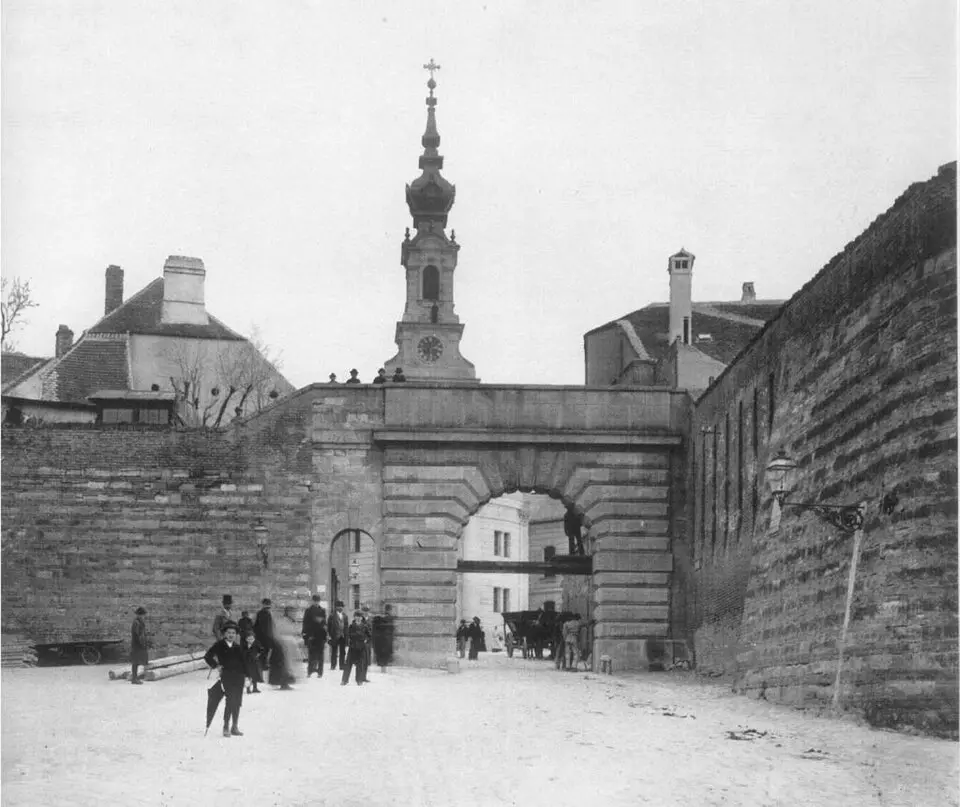
About Bécsi Kapu
The Bécsi Kapu, also known as the Vienna Gate, stands on the square in front of Buda Castle in Budapest's First District. Historically, it connected the fortress with the road to Vienna. In the Middle Ages it was called the Szombat-kapu (Saturday Gate) because markets were held there on Saturdays, while the Ottomans called it Beç kapusu. Later it became known as the Zsidó-kapu (Jewish Gate). The original structure was demolished in 1896. The present-day reconstruction from 1936, designed by Jenő Kismarty-Lechner, marks the 250th anniversary of the recapture of Buda. It is largely symbolic in character and links two sections of the bastion terrace. Visitors admire the reliefs, ornaments, and inscriptions created by Béla Ohmann, including a running angel.
At a glance
- Category
- Sight › Monuments
- Rating
- no reviews yet · write a review
- Address
1014 Budapest, Hungary- District
- Castle District
- Phone
- —
- Website
- —
- —
- Coordinates
- 47.50506° N · 19.03060° E
- Data quality
- confidence 0.87
- Identifier
- ID 61bd865c-5b3…
Location & surroundings
Toggle layersFAQ about Bécsi Kapu
quick answersWhat is the Bécsi Kapu in Budapest?
The Bécsi Kapu, also known as the Vienna Gate, is a historic city gate in Budapest's Castle District, located on the square in front of Buda Castle in the first district. Historically, it connected the fortress with the road to Vienna, hence its name. The original gate was torn down in 1896. The current structure is a reconstruction that is largely symbolic in character and links two sections of the bastion terrace.
What names has the Bécsi Kapu had throughout history?
The Bécsi Kapu in Budapest's Buda Castle District has gone by several names over the centuries. In the Middle Ages it was called Szombat-kapu (Saturday Gate) because markets were held there on Saturdays. The Ottomans called it Beç kapusu, and it was later known as Zsidó-kapu. Its present name, Bécsi Kapu, means Vienna Gate and refers to the road to Vienna.
Who designed the present-day Bécsi Kapu, and what is there to see?
The present-day Bécsi Kapu in Budapest was built in 1936 to plans by Jenő Kismarty-Lechner. The reconstruction commemorates the 250th anniversary of the recapture of Buda. Worth a look are the reliefs, ornaments, and inscriptions by the sculptor Béla Ohmann, including the depiction of a running angel.
What can you visit around the Bécsi Kapu in Budapest?
Around the Bécsi Kapu in the Buda Castle District, you'll find several museums and historic sites within just a few minutes' walk. Right next door, about 44 meters away, is the national archive Magyar Nemzeti Levéltár Országos Levéltára, and after about 90 meters you reach the Középkori Zsidó Imaház museum (Medieval Jewish Prayer House). Within about 200 meters, travelguide195 also lists the exhibition T9 - Az első bástya kiállítás, the Telefónia Múzeum Budapest, the monument to Abdurrahman Abdi Pasha, the Church of Saint Mary Magdalene, and the Zenetörténeti Múzeum (Museum of Music History).
Are there restaurants near the Bécsi Kapu in Budapest?
Yes, you'll find plenty of places to eat around the Bécsi Kapu in the Buda Castle District. travelguide195 lists around 62 restaurants within 500 meters of the Vienna Gate. That makes it easy to combine a stroll through the Castle District with a break.
Ratings & comments
none yetNear Bécsi Kapu
closest 5 per category · 2 kmSights
Restaurants
Museums
Hotels
More:Monuments in Budapest (92)All sights in Budapest (876)
258 places within 2 km loaded.
You need a free account to leave reviews and photos – that keeps comments genuine and lets you edit them later.
During the Middle Ages it was called Szombat-kapu (Saturday Gate), because markets were held in front of it every Saturday. It has been called Becs kapuszu by the Ottomans. Later it called also as Jewish Gate. One of its two side-gates were removed in the early 19th century, and in 1896, the whole gate was demolished. The current gate was restored in 1936, commemorating the 250th anniversary of Recapturing of Buda. The rebuilt gate, designed by Jenő Kismarty-Lechner, has a more symbolical, rather than functional value. Inscriptions, ornaments and reliefs, including a running angel was sculpted by Béla Ohmann. Two parts of Bastion Promenade are connected on the top of the gate.
Source: Wikivoyage, „Budapest/Budavár“ · authors per page history · CC BY-SA 4.0 · as of 1/13/2021