About Propylaea
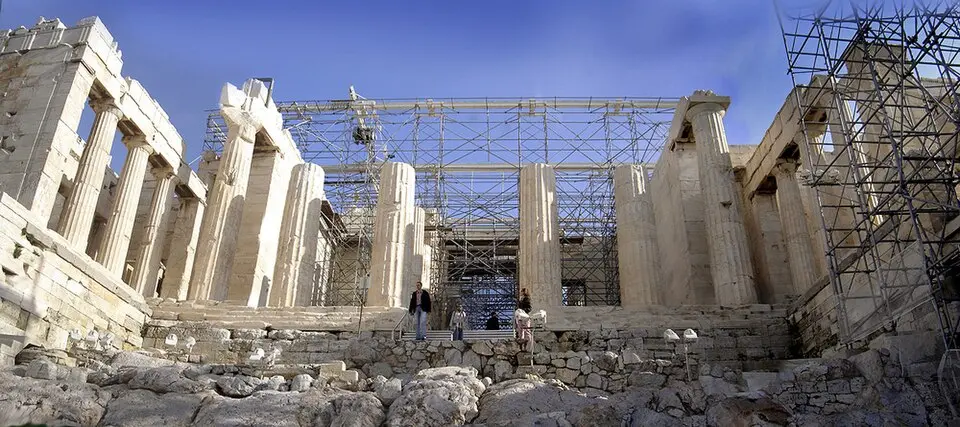
The Propylaea form the monumental and imposing gateway to the sacred precinct of the Athenian Acropolis. As the entrance structure, they mark the top of the western access ramp, which visitors traditionally climbed to reach the hilltop. The building was constructed between 437 and 432 B.C. under the direction of the architect Mnesicles and was part of the great Periclean building program that was undertaken after work on the Parthenon was completed. Construction was halted, however, no later than the start of the Peloponnesian War and never resumed, which is why the complex was left unfinished. An older gateway had already stood on this spot since the end of the 6th century B.C.; it was destroyed by the Persians in 480 B.C. and was oriented differently, toward the old Temple of Athena.
The structure as built consists of three main sections arranged in the shape of a pi opening to the west. At the center stands the gatehouse, flanked by a northwest wing and a southwest wing. The builders used light-colored Pentelic marble and dark Eleusinian marble. A technical innovation for its time was the first use of structural iron beams, which allowed wide spans to be bridged with a minimum of material. The north wing, often called the Pinakotheke, probably served as a dining hall for festivities and later housed panel paintings by famous painters such as Polygnotus. The south wing, by contrast, was heavily cut back and served mainly as a passage to the small sanctuary of Athena Nike.
The central gatehouse stood on a platform four steps high, which compensated for the difficult terrain. The front consisted of a six-columned Doric porch with a triangular pediment, an element normally reserved for temples. Behind this row of columns opened a spacious vestibule with a deep blue coffered ceiling decorated with golden stars, which was still considered unique in the 2nd century A.D. The actual door wall controlled access to the Acropolis and had five passageways, the central one built especially wide and tall for processions and wagons. East of the door wall lay a second six-columned porch, set on a higher level. From there, visitors had an impressive view of the nearly ten-meter-tall statue of Athena Promachos, as well as the Parthenon and the Erechtheion.
In the post-classical period, the Propylaea served a variety of purposes. Until the 12th century they remained largely in their original state, before serving as a bishop's seat. In Frankish times an upper story was added to the north wing, and later the Florentine Nerio I Acciaiuoli had a palace built into the complex, which also gained a tower above the south wing. In Ottoman times the building served as the residence of the city's military commander, until a severe explosion of a gunpowder magazine in 1645 or 1656 badly damaged it. Restoration work began gradually in 1909 and, from 1984, continued with extensive restoration and stabilization measures to preserve this historic heritage.
The architectural design of the Propylaea is considered groundbreaking, as it was the first to fully interweave different building types in a single complex. The combination of temple-like facades, megaron-style wings, and the mastery of complex terrain made the structure a forward-looking ensemble. This style later served as a model for many modern imitations, especially in Neoclassicism. Well-known examples include the Brandenburg Gate in Berlin, which follows the motifs of the overall complex more closely, and the Propylaea on Königsplatz in Munich, which differs from the ancient original in its massive corner towers.
At a glance
- Category
- Sight › Historic sites
- Rating
- no reviews yet · write a review
- Address
- Acropolis, Dionysiou Areopagitou
105 58 Athens, Greece - Phone
- +302103214172
- Website
- odysseus.culture.gr
- —
- Coordinates
- 37.97171° N · 23.72518° E
- Data quality
- confidence 0.91
- Identifier
- ID 8f73a3af-7e2…
Part of the tour
Athens in a Day: Acropolis, Agora, and Syntagma →Location & surroundings
Toggle layersFAQ about Propylaea
quick answersWhat are the Propylaea in Athens?
The Propylaea are the monumental gateway to the sacred precinct of the Acropolis in Athens, Greece. They mark the top of the western access ramp, which visitors have traditionally climbed to reach the Acropolis hill. The complex consists of three main parts arranged like a pi opening to the west: the central gatehouse, the northwest wing, and the southwest wing.
When and by whom were the Propylaea of the Acropolis built?
The Propylaea of the Athenian Acropolis were built between 437 and 432 BC under the direction of the architect Mnesicles. They were part of Pericles' building program and were begun after work on the Parthenon was completed. By the start of the Peloponnesian War at the latest, construction was halted and never resumed, which is why the structure remains unfinished to this day. An older gateway from the late 6th century BC had previously stood on the same spot, until it was destroyed by the Persians in 480 BC.
What is special about the architecture of the Propylaea in Athens?
The Propylaea in Athens are considered exceptional in both engineering and design, partly because they were the first to use structural iron beams to span large distances. They were built with light Pentelic marble and dark Eleusinian marble, and the front features a six-columned Doric porch with a triangular pediment, an element otherwise reserved for temples. The vestibule had a deep blue coffered ceiling with golden stars, and the door wall had five passageways, the middle one being especially wide and tall to accommodate processions and wagons. The north wing, often called the Pinakotheke, later housed panel paintings by famous painters such as Polygnotos.
How were the Propylaea used after antiquity?
After antiquity, the Propylaea on the Athenian Acropolis were repurposed and altered several times. Until the 12th century they remained largely in their original condition and then served as a bishop's residence. In Frankish times, an extra story was added to the north wing, and later the Florentine Nerio I Acciaiuoli had a palace with a tower built over the south wing. In Ottoman times, the city commander lived in the building.
What can you see around the Propylaea in Athens?
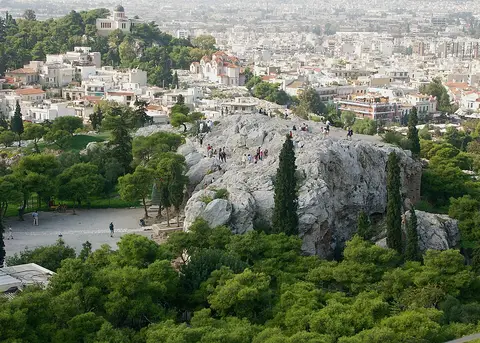
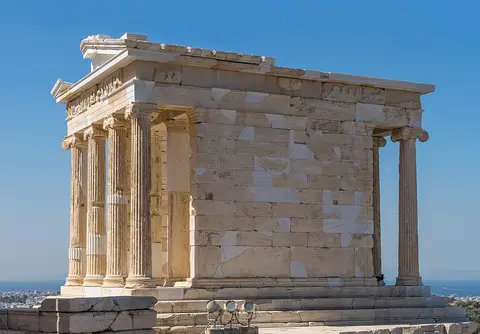
Around the Propylaea in Athens, several other significant sites of the Acropolis lie in the immediate vicinity. travelguide195 lists, among others, the Brauroneion (about 22 m), the Temple of Athena Nike (about 31 m), the Monument of Agrippa (about 36 m), the Pandroseion (about 88 m), the Odeon of Herodes Atticus (about 100 m), and the Areopagus (about 125 m). Within a 500-meter radius, travelguide195 lists around 88 restaurants. The Propylaea are also part of the tour "Athens Compact: Acropolis, Agora, and Syntagma in One Day."
Ratings & comments
none yetNear Propylaea
closest 5 per category · 2 kmRestaurants
Museums
Hotels
More:Historic sites in Athens (406)All sights in Athens (497)
300 places within 2 km loaded.
You need a free account to leave reviews and photos – that keeps comments genuine and lets you edit them later.
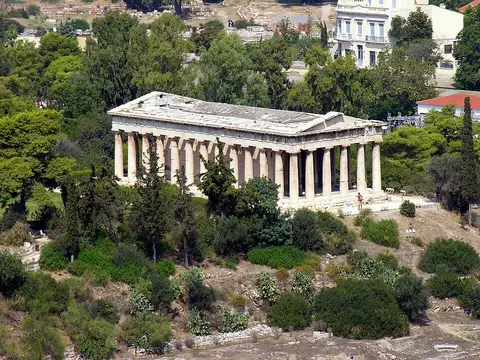
The monumental gate at the western end of the Acropolis with Doric columns of Pentelic marble. In a prominent position on a steep bastion to the right of the entrance is the Temple of Athena Nike
Source: Wikivoyage, „Athens“ · authors per page history · CC BY-SA 4.0 · as of 12/14/2025