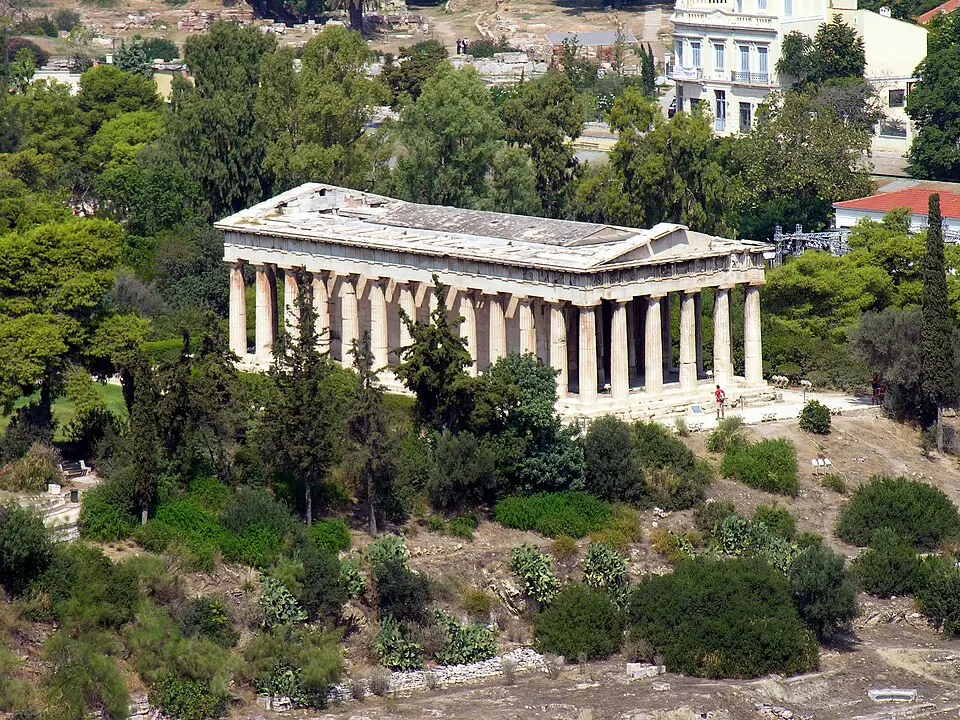
About Temple of Hephaestus
The Hephaisteion, also known as the Theseion, is one of the best-preserved ancient temples in Greece. It stands in the heart of Athens on the small hill of Kolonos Agoraios at the western edge of the Agora. Built of Pentelic marble, construction began around 449 B.C. and was largely completed by about 430 B.C., though the roofing and the cult statue were added later, in the wake of the Peace of Nicias. The temple was probably consecrated in 415 B.C. It was dedicated to the god Hephaestus, who was considered the ruler of metalworking and the blacksmith's craft. This dedication is explained by the building's location on what was then the western edge of the city, where numerous foundries and metalworkers' workshops were situated. In Byzantine times, the site was mistakenly linked with the legendary hero Theseus, as people believed his bones were buried here, which gave rise to the alternative name Theseion.
Architecturally, it is a Doric peripteral temple with six columns on the fronts and thirteen along the long sides. The structure rests on a three-step base, with the bottom step made of limestone and the visible parts of marble. Notable is the combination of strict Doric style with Ionic elements, particularly in the eastern porch, which stands out for its sculpted frieze and unusual depth. The metopes on the east front and the adjoining long sides were decorated with sculptures of Parian marble depicting scenes from the lives of Heracles and Theseus. These carvings were painted, with blue backgrounds and red figures creating a strong contrast. The pediments, too, were adorned with groups of figures showing mythological battles such as the Centauromachy. Inside the cella stood a two-tiered Doric colonnade, providing space for the cult statue group of Hephaestus and Athena, which was probably created by the sculptor Alcamenes.
The temple owes its exceptional state of preservation to its reuse in late antiquity. In the fifth century, the building was converted into a Christian church dedicated to Saint George. This function protected the temple from the complete decay that befell many other ancient monuments in Athens, as the roof remained largely intact and all the columns survived. During Ottoman rule, the building continued to serve as a Greek Orthodox church and was an important place for the local community. When King Otto I visited Athens in 1834, a welcoming Mass was held here. During this period, the temple was also used as the city's first archaeological museum before it eventually came under the authority of the Greek antiquities service.
Today, the Hephaisteion is part of the archaeological site of the Athenian Agora and offers visitors an impressive glimpse into classical Greek architecture. You can view the temple in its original form, including the characteristic optical refinements such as the slight curvature of the structural elements and the slight inward tilt of the columns, which give the building a harmonious appearance. Its proximity to the Agora excavations lets you experience the temple in its historical context, which was shaped by the blacksmiths' workshops and the public life of the ancient city. A scaled-down replica of the temple can also be found in the Volksgarten in Vienna, underscoring the enduring fascination with this architectural masterpiece.
At a glance
- Category
- Sight › Historic sites
- Rating
- no reviews yet · write a review
- Address
- Stirieon 3
105 55 Athens, Greece - Phone
- +302103210185
- Website
- odysseus.culture.gr
- —
- Coordinates
- 37.97560° N · 23.72142° E
- Data quality
- confidence 0.97
- Identifier
- ID c8a1cbae-536…
Part of the tour
Athens in a Day: Acropolis, Agora, and Syntagma →Location & surroundings
Toggle layersFAQ about Temple of Hephaestus
quick answersWhat is the Temple of Hephaestus in Athens?
The Temple of Hephaestus, also known as the Hephaisteion, is one of the best-preserved ancient temples in Greece. It stands on Kolonos Agoraios hill on the western edge of the Agora in Athens. Built of Pentelic marble, construction began around 449 B.C., was largely completed around 430 B.C., and the temple was probably consecrated in 415 B.C. It was dedicated to Hephaestus, the god of metalworking, because numerous foundries and metalworkers' workshops lay along what was then the city's western edge. Architecturally, it is a Doric peripteral temple with six columns across the front and rear and thirteen along the sides.
Why is the Temple of Hephaestus in Athens also called the Theseion?
The name Theseion stems from a mistake made in Byzantine times, when the Temple of Hephaestus in Athens was linked with the legendary hero Theseus. People then believed that the bones of Theseus were buried here. In fact, the Parian marble metopes on the east front and the adjoining sides showed scenes from the lives of Heracles and Theseus, but the temple was dedicated to Hephaestus.
Why is the Temple of Hephaestus in Athens so well preserved?
The Temple of Hephaestus in Athens owes its exceptional state of preservation above all to its conversion into a church. In the fifth century it was turned into a Christian church dedicated to Saint George, which left the roof largely intact and saved all of the columns. It continued to serve as a Greek Orthodox church under Ottoman rule, and in 1834 a welcome service for King Otto I was held here. Later, the building was used as the city's first archaeological museum before passing to the Greek antiquities authority.
What can you see around the Temple of Hephaestus in Athens?
Around the Temple of Hephaestus in Athens you'll find numerous other sites of the ancient Agora, whose archaeological grounds begin only about 46 meters away. travelguide195 lists nearby attractions including the Temple of Apollo Patroos (about 62 meters), the Monument of the Heroes (about 102 meters), the Altar of Zeus Agoraios (about 108 meters), and the Temple of Ares (about 117 meters). Also right nearby are the Altar of the Twelve Gods (about 119 meters), the Museum of the Ancient Agora (about 125 meters), and the Stoa Poikile (about 146 meters).
Are there tours and restaurants near the Temple of Hephaestus in Athens?
Yes, the Temple of Hephaestus in Athens is part of the tour "Athens Compact: Acropolis, Agora and Syntagma in One Day" on travelguide195. For a break after your visit, travelguide195 lists around 219 restaurants within 500 meters of the temple.
Ratings & comments
none yetNear Temple of Hephaestus
closest 5 per category · 2 kmSights
Restaurants
Museums
Hotels
More:Historic sites in Athens (406)All sights in Athens (497)
300 places within 2 km loaded.
You need a free account to leave reviews and photos – that keeps comments genuine and lets you edit them later.