About Musée de l'Agora antique d'Athènes
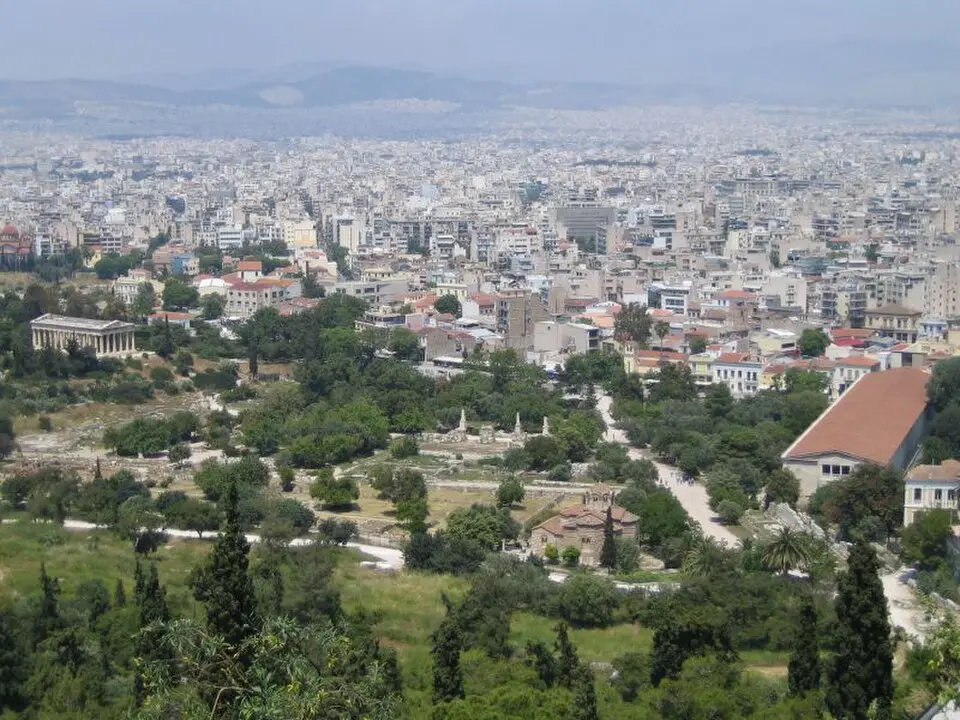
The ancient Agora in Athens was far more than just a marketplace. It formed the beating heart of Athenian democracy and served as the central gathering place for the citizens of the polis. Here, people met to debate political matters, hold trials, and take part in religious festivals. In contrast to the Acropolis, which was regarded as the cultic and political power center of the Archaic period, the Agora embodied the step into a new era of participation and public life. This site has existed since the fifth century B.C. and still shapes the image of the city today. Walking among the ruins, you can sense just how central this square was to the social, legal, and cultural life of antiquity.
The history of the area reaches far back into prehistory. As early as the Neolithic period, around 3000 B.C., pottery finds near wells point to early settlement. In the late Bronze Age and up to the seventh century B.C., however, the area served primarily as a cemetery, as numerous graves attest. Only from around 1000 B.C. was the site also used for housing, as many well shafts show. Toward the end of the eighth century B.C., settlement activity became less frequent, before around 600 B.C. the area began to be systematically developed as a public square. Around 500 B.C., the Agora was formally marked off by boundary stones known as horoi, to prevent unregulated building and to bar certain people, such as criminals or draft evaders, from entering.
A decisive event in the history of the Agora was the Persian conquest of Athens in 480 B.C. The destruction of the city caused great damage, but the rebuilding that followed brought a golden age. Many of the buildings we see today as ruins date from this phase of reconstruction. In the second century B.C., Athens became the intellectual center of the Mediterranean world. Rulers from countries such as Egypt, Syria, and Pergamon had impressive buildings erected to demonstrate their power. The large, imposing colonnaded halls known as stoas were built at this time. By the second half of the second century, the Agora was completely surrounded by buildings with columned façades, giving the square an enclosed and monumental appearance.
With the Roman conquest of Greece in 146 B.C., the function of the area gradually changed. After a siege in 86 B.C., in which the southern part was damaged, the Romans showed a growing interest in Athens. They built a new marketplace, the Roman Agora, about 150 meters (about 500 feet) to the east, which took over the commercial function of the old square. The open space of the ancient Agora was then built over. The site enjoyed one last golden age under the emperors Trajan and Hadrian. But with the raid of the Heruli in A.D. 267, in which most of the buildings were destroyed, the final decline began. In the fourth century, the Agora was largely abandoned and lost its importance as the center of the city.
Archaeological exploration of the area began in 1931 by the American School of Classical Studies at Athens. Funded by John D. Rockefeller and led by Theodore Leslie Shear, the archaeologists succeeded in uncovering the marketplace of ancient Athens in a short time. After an interruption by World War II, excavations resumed in 1946 under Homer A. Thompson. In the early 1950s, Rockefeller financed the reconstruction of the Stoa of Attalos, which now serves as a museum. This reconstruction is a main attraction for visitors, as it offers an impressive glimpse into the architecture and everyday life of ancient Athenians.
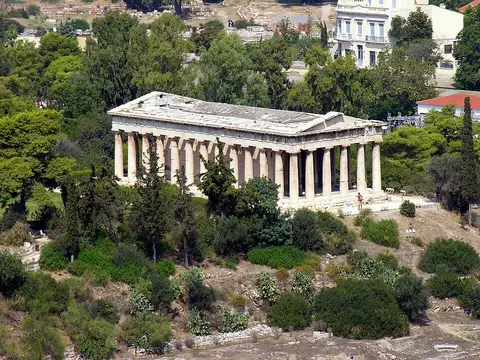
A highlight of any visit is the Hephaisteion, an almost undamaged marble temple on Kolonos Agoraios hill. It is considered the best-preserved Greek temple apart from the Parthenon, because it was never plundered as a quarry and later served as a Christian church. Dedicated to Hephaestus, the god of metalworking, and the goddess Athena, the building impresses with its rich sculptural decoration. The metopes show the deeds of Heracles and Theseus, while the friezes depict battles. The proximity to the smiths' workshops, which are believed to have stood in the surrounding area, underscores the logical placement of this sacred building.
Another significant structure is the Stoa of Attalos, donated in the second century B.C. by King Attalos II Philadelphos of Pergamon. Measuring 115 by 20 meters (about 377 by 66 feet) and with two stories, it was an impressive building that originally served as a market hall. Behind the double rows of columns were 21 rooms used as shops. After its destruction in A.D. 267, it was reconstructed between 1952 and 1956. Today it houses a collection of finds from the Agora, including vases, clay figurines, and portrait busts that illustrate daily life and art in antiquity.
The Stoa Poikile, also known as the "Painted Stoa," was an important meeting place for philosophers, merchants, and citizens. Here Zeno, the founder of Stoicism, met with his followers, and Socrates is also said to have spent time nearby. The stoa was famous for its paintings, which depicted military scenes such as the Battle of Marathon and were created by artists such as Polygnotos. Besides the paintings, trophies such as armor and shields taken from defeated enemies were also displayed. This mix of art, politics, and philosophy made the stoa a lively center of Athenian intellectual life.
Several buildings were of central importance for the administration and justice of the democracy. The Old Bouleuterion served as the seat of the council before it was converted into the state archive and a sanctuary of Rhea. The New Bouleuterion, built at the end of the fifth century B.C., provided space for the deliberations of the Boule. The Tholos, a round building, was the seat of the Boule's executive committee, the Prytaneis. Here, officials were fed and official weights and measures were kept. In the southwest corner stood the Heliaia, the largest courtroom in Athens, where large juries of up to 2,500 jurors sat.
Further facilities ensured the supply of the population and cultural life. Two large fountain houses, one in the southeast and one in the southwest, provided water and served as social meeting places where women and slaves could also exchange news. The state mint in the southeastern corner produced not only coins but possibly also bronze weights and other objects. The Odeion of Agrippa, built around 15 B.C., provided space for musical performances and lectures, while the Library of Pantainos in the southeast corner served as a place of learning, where books could only be read inside the building.
Today, the ancient Agora invites visitors to trace the footsteps of Athenian democracy. The ruins of the stoas, temples, and administrative buildings tell of a society that understood public space as a place for discussion, law, and trade. The reconstructed Stoa of Attalos and the well-preserved structures of the Hephaisteion offer a fascinating contrast to the exposed foundations and walls. A visit here lets you experience the historical depth of Athens and understand how this square helped shape the foundations of Western political culture.
At a glance
- Category
- Museum › History museums
- Rating
- no reviews yet · write a review
- Address
- —
Athens, Greece - Phone
- —
- Website
- odysseus.culture.gr
- —
- Coordinates
- 37.97534° N · 23.72392° E
- Data quality
- confidence 0.84
- Identifier
- ID 8f591196-0f4…
Location & surroundings
Toggle layersRatings & comments
none yetNear Musée de l'Agora antique d'Athènes
closest 5 per category · 2 kmSights
Museums
Hotels
More:History museums in Athens (55)All museums in Athens (276)
300 places within 2 km loaded.
You need a free account to leave reviews and photos – that keeps comments genuine and lets you edit them later.