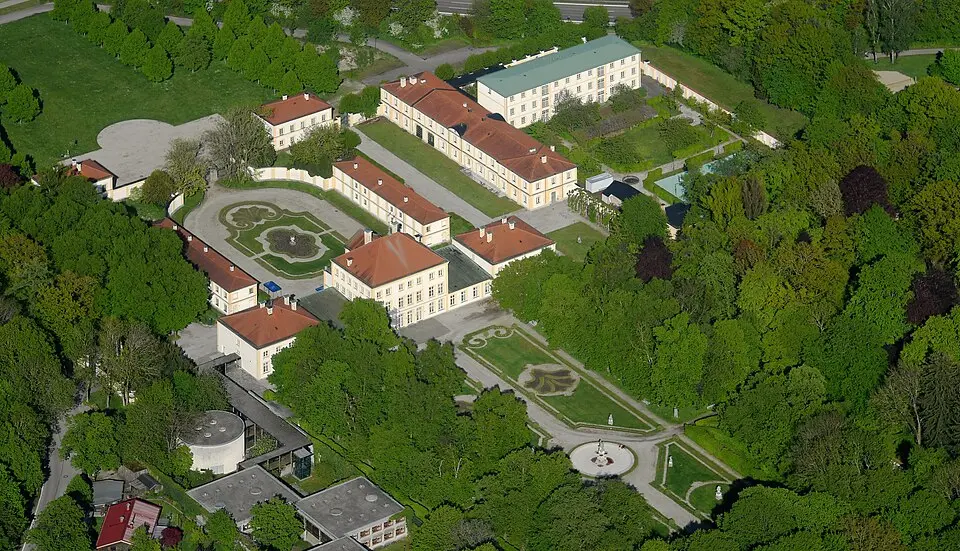
About Schloss Fürstenried
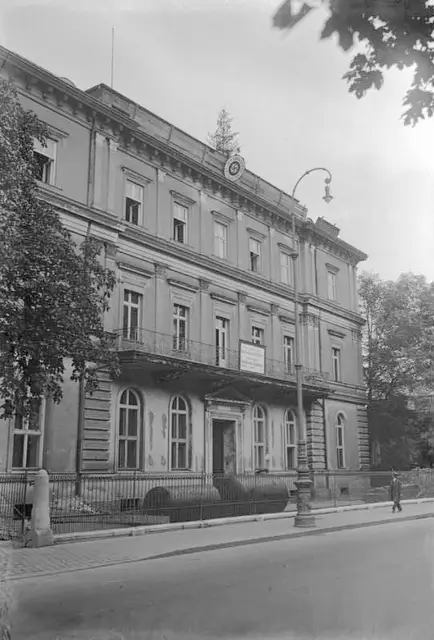
Fürstenried Palace in Munich's Thalkirchen-Obersendling-Forstenried-Fürstenried-Solln district is a historic building that originally served as a hunting lodge. Elector Max Emanuel had the complex built between 1715 and 1717, with court architect Joseph Effner transforming the existing manor house into an imposing Baroque palace. The symmetrical design consists of a central main pavilion connected to two secondary pavilions by galleries. Over the centuries, the palace changed purpose several times. After a period as a widow's residence and a military hospital, it served from 1883 as the home of the incapacitated King Otto of Bavaria, who lived here until his death in 1916. Since 1925, the building has been used by the Archdiocese of Munich and Freising as a retreat house, conference center, and school pastoral center.
Particularly remarkable is the palace park, a rare combination of Baroque design and the landscape tastes of the late 19th century. While renovations have robbed the interior rooms of their original artistic value, the garden remains an architectural rarity. It was reconstructed and redesigned under King Otto based on plans by Carl von Effner, the court garden director. Highlights include the double rows of linden trees that form a long sight line toward Munich, as well as a rose garden, a winter garden, and an evergreen garden. The park also contains rare tree species and historic plantings that make it a botanical curiosity. The ensemble of palace, park, and adjoining avenues is listed as an architectural monument in the Bavarian Monument List.
Fürstenried Palace is generally not open to the public. You can only visit during special events or on the annual open house day. Otherwise, the complex is used exclusively for church and academic purposes. You can therefore only admire the palace and its gardens from the outside, where the historic sight line and the imposing facade of the Baroque complex make the first impression. The surroundings, shaped by the nearby autobahn and the Waldfriedhof cemetery, underscore the quiet, secluded character of the grounds, which once served as a rural retreat.
At a glance
- Category
- Sight › Historic sites
- Rating
- no reviews yet · write a review
- Address
- Forst-Kasten-Allee 103
81475 Munich, Germany - District
- Thalkirchen-Obersendling-Forstenried-Fürstenried-Solln
- Phone
- +498974508290
- Website
- www.erzbistum-muenchen.de
- exerzitien@schloss-fuerstenried.de
- Coordinates
- 48.09437° N · 11.48559° E
- Data quality
- confidence 0.95
- Identifier
- ID b35120c2-efd…
Location & surroundings
Toggle layersFAQ about Schloss Fürstenried
quick answersWhat is Fürstenried Palace in Munich?
Fürstenried Palace (Schloss Fürstenried) is a Baroque former hunting lodge in Munich's Thalkirchen-Obersendling-Forstenried-Fürstenried-Solln district, located at Forst-Kasten-Allee 103. Elector Max Emanuel had it built from 1715 to 1717, when court architect Joseph Effner transformed an existing manor house into a stately Baroque palace. The symmetrical complex consists of a central main pavilion connected by galleries to two side pavilions. The palace, park, and adjoining avenues are listed as a protected monument in the Bavarian Monument List.
Can you visit Fürstenried Palace?
Fürstenried Palace in Munich is generally not open to the public. You can only plan a visit during special events or the annual open house day; otherwise, the complex is used exclusively for church and academic purposes. Since 1925, the Archdiocese of Munich and Freising has used the palace as a retreat house, conference center, and school pastoral center. From the outside, you can admire the Baroque facade and the historic sight line.
What makes the park at Fürstenried Palace special?
The park at Fürstenried Palace in Munich combines Baroque design with the landscape tastes of the late 19th century in a rare way. Under King Otto, it was reconstructed and redesigned based on plans by court garden director Carl von Effner. Highlights include double rows of linden trees lining avenues with a long sight line toward Munich, a rose garden, a winter garden, and an evergreen garden. Rare tree species and historic plantings also make the park a botanical curiosity.
Who lived at Fürstenried Palace?
From 1883, King Otto of Bavaria, who was unfit to rule, lived at Fürstenried Palace in Munich until his death in 1916. Before that, the building, originally constructed as a hunting lodge, had already served as a widow's residence and as a military hospital. Due to numerous renovations, the interiors have largely lost their original artistic value.
What can you see around Fürstenried Palace?
Near Fürstenried Palace in Munich, you'll find mainly two memorial and cemetery sites. travelguide195 lists the Ehrenmal München war graves memorial at the Waldfriedhof about 760 meters away and the New Jewish Cemetery Munich about 850 meters away. For a break, travelguide195 lists two restaurants within 500 meters of the palace.
Ratings & comments
none yetNear Schloss Fürstenried
closest 5 per category · 2 kmSights
Restaurants
Hotels
Cocktail bars
None within 2 km.
More:Historic sites in Munich (291)Sights in Thalkirchen-Obersendling-Forstenried-Fürstenried-Solln (19)All sights in Munich (375)
86 places within 2 km loaded.
You need a free account to leave reviews and photos – that keeps comments genuine and lets you edit them later.