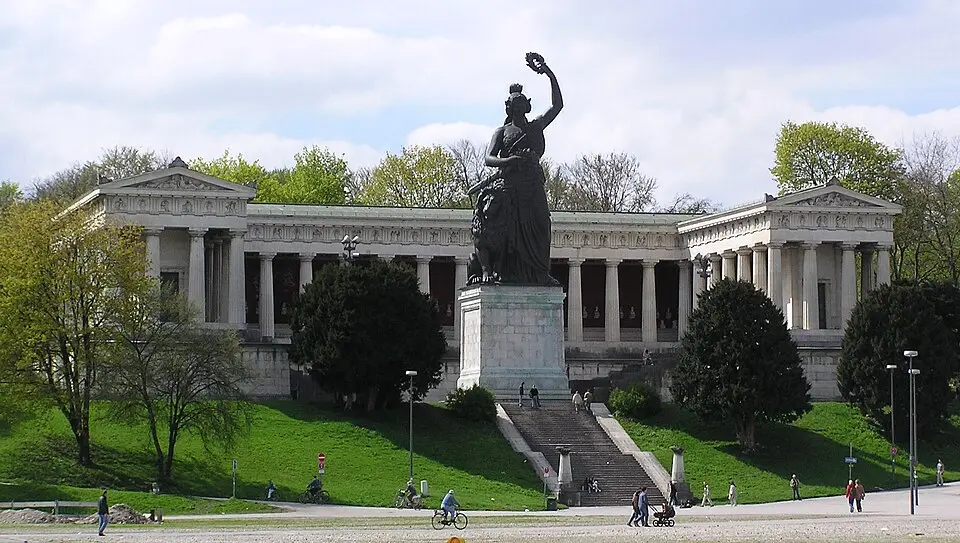
About Ruhmeshalle
The Ruhmeshalle (Hall of Fame) is an important memorial in Munich, built on the Isar ridge edge overlooking the Theresienwiese. King Ludwig I of Bavaria commissioned the neoclassical building between 1843 and 1853 from designs by the architect Leo von Klenze. Inspired by ancient altar structures, the three-winged Doric colonnade forms an architectural ensemble together with the monumental Bavaria statue, partly enclosed by a section of Bavariapark. The hall stands on a gently sloping base and is supported by 48 columns as well as the rear wall. With this project, Ludwig I aimed to create a self-portrait of the entire Bavarian state by honoring figures from the various tribes of Bavaria, including the regions of Franconia, the Palatinate, and Swabia, which had only been added around 1800.
Inside the hall are busts of numerous distinguished figures from the arts, sciences, politics, and the military. The original selection from 1853 has been expanded over time, with new names added in the 20th century as well, among them poets, physicists, and resistance fighters. The complex was damaged by air raids in World War II, but was restored and reopened in 1972 in connection with the Olympic Games. Some of the destroyed busts could be restored or recreated, while others were lost forever. Today, new figures are chosen by decision of the Bavarian Council of Ministers following a vote by an expert commission, which makes the Ruhmeshalle a living place of historical tribute.
At the Ruhmeshalle, you experience a unique combination of architecture and history. The imposing structure of Kelheim limestone and the carefully crafted busts invite you to linger and reflect on Bavaria's cultural and political development. The ensemble with the Bavaria, depicted as an allegory of the fatherland with a bearskin and a lion, underscores the national significance of the site. The Ruhmeshalle is not only a museum but is actively continued in order to honor contemporary contributions to the people and the state. As a result, it remains a central place of remembrance and appreciation in the Bavarian state capital.
At a glance
- Category
- Sight › Monuments
- Rating
- no reviews yet · write a review
- Address
- Theresienwiese Theresienhöhe 16, Theresienhöhe 16
80339 Munich, Germany - Phone
- +4989290671
- Website
- www.schloesser.bayern.de
- residenzmuenchen@bsv.bayern.de
- Coordinates
- 48.13072° N · 11.54569° E
- Data quality
- confidence 0.99
- Identifier
- ID b5854e1d-476…
Location & surroundings
Toggle layersFAQ about Ruhmeshalle
quick answersWhat is the Ruhmeshalle in Munich?
The Ruhmeshalle (Hall of Fame) is a neoclassical memorial on the Theresienwiese in Munich, where distinguished figures from Bavaria are honored with busts. King Ludwig I of Bavaria had it built between 1843 and 1853 on the edge of the Isar escarpment, based on designs by the architect Leo von Klenze. Ludwig I wanted it to present a portrait of the entire Bavarian state, including the territories of Franconia, the Palatinate, and Swabia that were added around 1800. The address is Theresienhöhe 16.
Who is honored in Munich's Ruhmeshalle?
The Ruhmeshalle in Munich holds busts of distinguished figures from the arts, science, politics, and the military. The original selection from 1853 has been expanded over time, and in the 20th century, for example, poets, physicists, and resistance fighters were added. Today, new names are decided by the Bavarian Council of Ministers following a recommendation from a panel of experts, so the Ruhmeshalle continues to be updated to this day.
How are the Ruhmeshalle and the Bavaria statue in Munich connected?
The Ruhmeshalle and the monumental Bavaria statue form a single architectural ensemble in Munich, partly enclosed by the Bavariapark. The three-winged Doric colonnade is inspired by ancient altar structures, stands on a gently sloping base, and is supported by 48 columns as well as the back wall. It is built of Kelheim limestone. The Bavaria is depicted as an allegory of the fatherland, with a bearskin and a lion.
Was the Ruhmeshalle in Munich destroyed in World War II?
The Ruhmeshalle in Munich was damaged by air raids in World War II and was restored and reopened in 1972 in connection with the Olympic Games. Some of the destroyed busts could be restored or recreated. Other busts, however, were lost forever.
What can you see around the Ruhmeshalle in Munich?
Several museums and memorials are located near the Ruhmeshalle in Munich. travelguide195 lists the Deutsches Museum Verkehrszentrum (Transport Museum) about 329 meters away, as well as the memorial to the victims of the Oktoberfest attack about 649 meters away and the Oktoberfest Attack Documentation about 664 meters away. For a break, travelguide195 lists around 35 restaurants within 500 meters of the Ruhmeshalle.
Ratings & comments
none yetNear Ruhmeshalle
closest 5 per category · 2 kmSights
Restaurants
Museums
Hotels
More:Monuments in Munich (68)All sights in Munich (375)
236 places within 2 km loaded.
You need a free account to leave reviews and photos – that keeps comments genuine and lets you edit them later.