About München Salvatorplatz
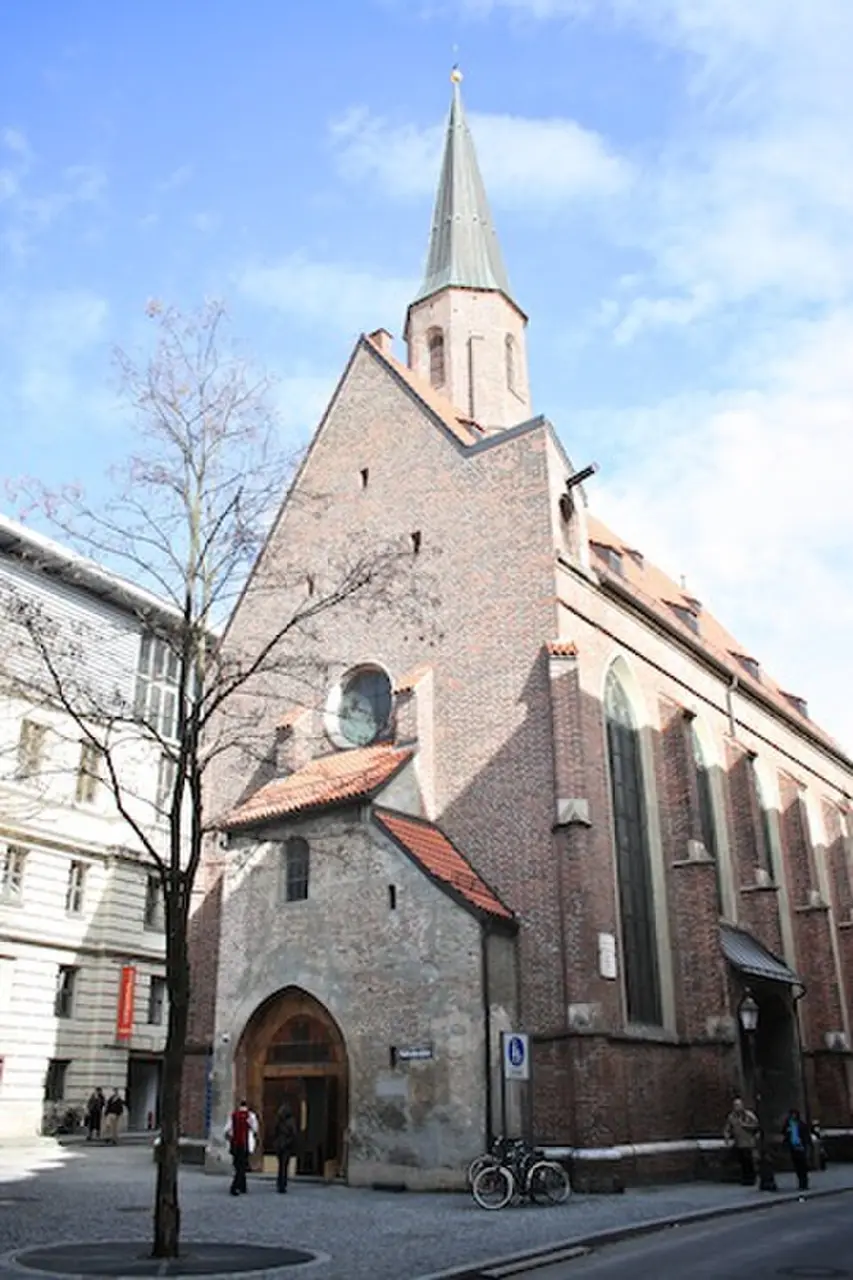
Salvatorplatz in Munich's Old Town is home to St. Salvator, a historic Gothic brick church that originally served as the cemetery church of the Frauenkirche. Located in the Kreuzviertel, near the former city wall, the building reflects the city's urban development. When the cemeteries around the central churches were no longer large enough in the 15th century, Duke Albrecht IV ordered the cemetery moved to the edge of town. The shell of Salvator Church was completed in 1493, and it was solemnly consecrated on August 15, 1494. The master builder is not documented in any record, but it is thought that Lukas Rottaler, a student of Jörg von Halsbach, was responsible for the project.
The church's history is marked by changing uses. After the cemetery was closed in 1789 and secularization followed, the building faced demolition, but it was used as a depot and later as a granary. Not until 1829 was St. Salvator handed over to the Greek Orthodox community, after King Ludwig I released the building for use. The conversion for the Orthodox rite was carried out under the direction of the architect Leo von Klenze, who reconsecrated the church on December 18, 1829. Since then it has been the seat of the "Transfiguration of the Savior" congregation and belongs to the Greek Orthodox Metropolis of Germany. A long-running legal dispute over usage rights, which at times made the church inaccessible, was finally settled in 1999 when the church was transferred to the Metropolis.
Today, visitors can admire the architectural blend of Gothic brick construction with later Baroque and Orthodox influences. Notable works of art include the late Gothic stained-glass windows, four restored examples of which were reinstalled after being rediscovered in 2000, as well as remnants of frescoes on the north facade. The iconostasis, designed by Leo von Klenze, defines the interior. The tower, which was re-Gothicized in the 19th century, once again carries a spire in its original Gothic style. The church is not only a place of worship but also a testament to Munich's cultural and religious diversity, shaped by its close ties to the Greek community and the historical significance of the site as a former cemetery with prominent burials such as François de Cuvilliés and Hans Mielich.
At a glance
- Category
- Sight › Monuments
- Rating
- no reviews yet · write a review
- Address
- —
Munich, Germany - District
- Altstadt-Lehel
- Phone
- —
- Website
- —
- —
- Coordinates
- 48.14190° N · 11.57445° E
- Data quality
- confidence 0.65
- Identifier
- ID aaa334c6-630…
Location & surroundings
Toggle layersFAQ about München Salvatorplatz
quick answersWhat is Salvatorplatz in Munich?
Salvatorplatz is in Munich's Old Town, in the Kreuzviertel (Altstadt-Lehel borough), and is best known for the Church of St. Salvator, a Gothic brick church. It originally served as the cemetery church of the Frauenkirche, after Duke Albrecht IV had the cemetery moved to the edge of town in the 15th century. The shell was finished in 1493, and the church was consecrated on August 15, 1494.
Who uses the Church of St. Salvator on Salvatorplatz in Munich today?
St. Salvator on Munich's Salvatorplatz is home to the Greek Orthodox congregation "Transfiguration of the Savior" and belongs to the Greek Orthodox Metropolis of Germany. King Ludwig I released the building in 1829, and Leo von Klenze oversaw its conversion for the Orthodox rite and reconsecrated the church on December 18, 1829. Before that, after the cemetery was closed in 1789 and during secularization, it had been used as a depot and granary; a long legal dispute over usage rights ended in 1999 with the transfer to the Metropolis.
What can you see in the Church of St. Salvator on Salvatorplatz in Munich?
At St. Salvator on Munich's Salvatorplatz, you'll see Gothic brick architecture with later Baroque and Orthodox influences. Highlights include the late Gothic stained-glass windows, four of which were restored and reinstalled after their rediscovery in 2000, as well as fresco remnants on the north facade. The interior is dominated by the iconostasis designed by Leo von Klenze, and the tower, re-Gothicized in the 19th century, once again carries a Gothic-style spire.
Who is buried in the former cemetery on Salvatorplatz in Munich?
The former cemetery at the Church of St. Salvator on Munich's Salvatorplatz was the burial place of, among others, the architect François de Cuvilliés and the painter Hans Mielich. The cemetery was closed in 1789. The church's own master builder is believed to have been Lukas Rottaler, a student of Jörg von Halsbach, though this is not documented.
What can you visit around Salvatorplatz in Munich?
Around Salvatorplatz in Munich's Old Town, several historic buildings are within walking distance. travelguide195 lists, among others, the Alte Bayerische Staatsbank (about 76 m), the Müllerturm (about 86 m), the Palais Neuhaus-Preysing (about 96 m), the Palais Holnstein (about 99 m), and the Jungfernturm (about 128 m). Also nearby are the Memorial to the Victims of Nazi Tyranny (about 132 m), the Palais Seinsheim (about 143 m), and the Kurt Eisner Memorial (about 182 m); within 500 m, travelguide195 also lists about 100 restaurants.
Ratings & comments
none yetNear München Salvatorplatz
closest 5 per category · 2 kmSights
Restaurants
Museums
Hotels
More:Monuments in Munich (68)Sights in Altstadt-Lehel (114)All sights in Munich (375)
300 places within 2 km loaded.
You need a free account to leave reviews and photos – that keeps comments genuine and lets you edit them later.