About Glaspalast
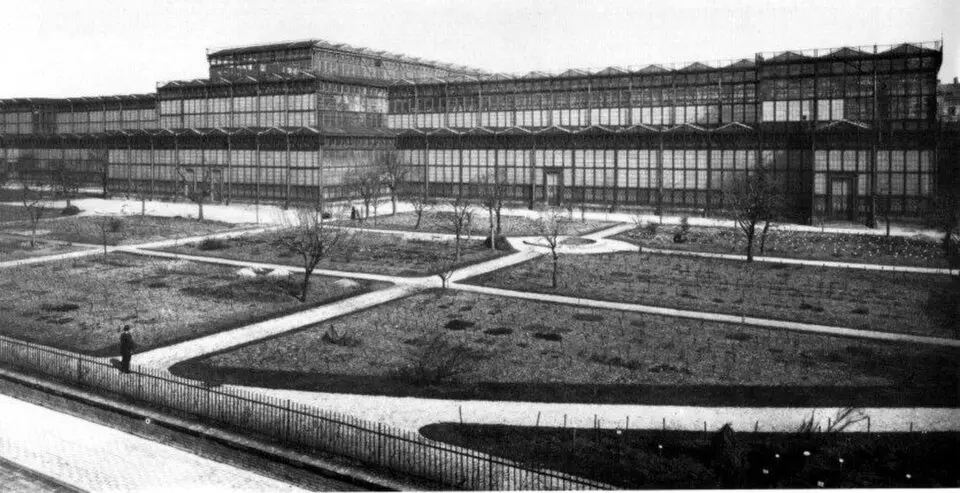
The Glaspalast (Glass Palace) in Munich was a historic exhibition building erected in 1854 on the grounds of the Old Botanical Garden. King Maximilian II of Bavaria commissioned the complex for the First General German Industrial Exhibition, which took place just three years after the completion of London's famous Crystal Palace. The architect August von Voit designed the building as an elongated five-aisle hall with a transept and rectangular annexes. At 234 meters long, 67 meters wide, and 25 meters high, it was an imposing structure of glass and cast iron. Remarkably, it used no load-bearing masonry at all. The prefabricated iron components came from the Cramer-Klett company in Nuremberg, while the glass was sourced from the Schmidsfelden glassworks, among others. Construction took only six months, made possible by the use of standardized building elements.
After the industrial exhibition opened in 1854, overshadowed by cases of cholera, the Glaspalast became a central venue for cultural and technological events. In 1882 it hosted the first electrically lit International Electricity Exhibition, where Oskar von Miller demonstrated the transmission of electrical power over long distances. In the following decades, the building served almost exclusively as a venue for international art exhibitions. These events cemented Munich's reputation as a city of art and culture as well as an important trade fair and congress location. The Glaspalast was not only a place for presentation but also a forum for the international art trade and social gatherings.
On June 6, 1931, the building was completely destroyed in a major fire. The cause was later determined to be arson. The fire destroyed more than 3,000 works of art, including an entire special exhibition of German Romantic painters, and damaged numerous other works by contemporary artists. Plans to rebuild the Glaspalast on the same site were abandoned after the Nazis seized power in 1933. Instead, the Haus der Deutschen Kunst (House of German Art) was built there in 1937. Today, the only reminder of the original building is the Glaspalast Fountain, which survived unscathed and now stands on Weißenburger Platz. On the site of the former Glaspalast, you'll now find a park café with a beer garden.
At a glance
- Category
- Sight › Historic sites
- Rating
- no reviews yet · write a review
- Address
- —
Munich, Germany - District
- Maxvorstadt
- Phone
- —
- Website
- fr.wikipedia.org
- —
- Coordinates
- 48.14230° N · 11.56470° E
- Data quality
- confidence 0.81
- Identifier
- ID 727514b9-610…
Location & surroundings
Toggle layersFAQ about Glaspalast
quick answersWhat was the Glaspalast in Munich?
The Glaspalast (Glass Palace) in Munich was a historic exhibition hall made of glass and cast iron, built in 1854 on the grounds of the Old Botanical Garden in the Maxvorstadt district. King Maximilian II of Bavaria commissioned it for the First General German Industrial Exhibition, and the architect August von Voit designed a five-aisle hall with a transept. The building was 234 meters long, 67 meters wide, and 25 meters high, and it required no load-bearing masonry at all. Thanks to standardized building components, such as iron parts from the Nuremberg firm Cramer-Klett, construction took only six months.
What exhibitions were held at the Glaspalast in Munich?
The Glaspalast in Munich hosted major industrial, technology, and above all art exhibitions. It began in 1854 with the First General German Industrial Exhibition, which was overshadowed by cholera cases. In 1882, the International Electricity Exhibition showed how Oskar von Miller transmitted electrical power over long distances. In the decades that followed, the Glaspalast was used almost exclusively for international art exhibitions, cementing Munich's reputation as a city of art.
How was the Glaspalast in Munich destroyed?
The Glaspalast in Munich was completely destroyed in a major fire on June 6, 1931; arson was later determined to be the cause. The fire destroyed more than 3,000 works of art, including an entire special exhibition of German Romantic painters. Plans to rebuild on the same site were abandoned after the Nazis seized power in 1933.
What can still be seen of the Glaspalast in Munich today?
Today, the main surviving piece of the Glaspalast is the Glaspalast Fountain, which came through the fire unscathed and now stands on Weißenburger Platz. The former site of the Glaspalast is now home to a park café with a beer garden. travelguide195 also lists around 203 restaurants within 500 meters.
What can you visit around the former Glaspalast in Munich?
Around the former site of the Glaspalast in Munich's Maxvorstadt district, you'll find several churches, museums, and monuments. According to travelguide195, the Basilica of St. Boniface (about 166 m) and the Kunstbunker (about 185 m) are very close by. A bit farther away are the Museum of Casts of Classical Sculpture (about 284 m), the State Collections of Antiquities (about 328 m), and the Antike am Königsplatz (about 369 m). You can also visit the Gabelsberger Monument, the Karlsbrunnen, and the Main Synagogue memorial stone, all about 320 to 365 meters away.
Ratings & comments
none yetNear Glaspalast
closest 5 per category · 2 kmSights
Restaurants
Museums
Hotels
More:Historic sites in Munich (291)Sights in Maxvorstadt (33)All sights in Munich (375)
300 places within 2 km loaded.
You need a free account to leave reviews and photos – that keeps comments genuine and lets you edit them later.