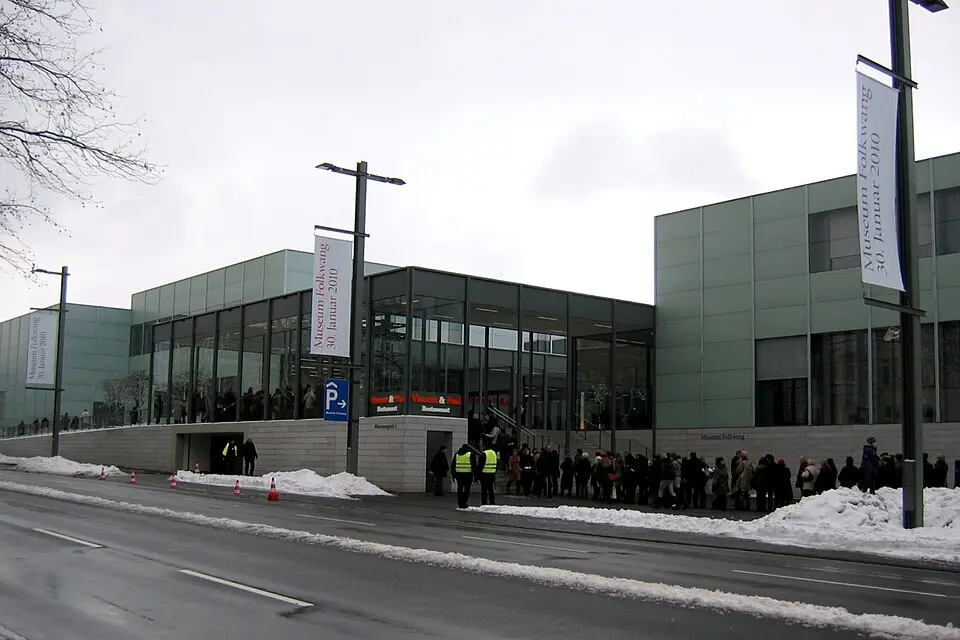
About Museum Folkwang
The Museum Folkwang in Essen is one of the most important institutions for modern art in Germany. Its history goes back to 1902, when the art patron Karl Ernst Osthaus opened the museum in Hagen. Osthaus, a young banker's son, had come into an inheritance that gave him the financial means to realize his vision of a museum that would raise public taste in the industrial Ruhr region. He originally planned a combination of natural history, folk art, and applied art objects that he had collected on trips through Europe, the Orient, and North Africa. The name Folkwang comes from Old Norse mythology and refers to the palace of the goddess Freya, which was meant to symbolize the desired unity of art and life.
The museum's focus changed quickly when Osthaus got in touch with the Belgian artist Henry van de Velde. Van de Velde advised him on acquisitions and encouraged his turn toward modernism. Osthaus thus acquired works early on by French and Belgian artists, including Pierre-Auguste Renoir and Vincent van Gogh. Remarkably, in 1902 the museum became the first in Germany to add a work by van Gogh to its collection. The art was not presented chronologically but according to aesthetic criteria. Osthaus also dared to regard African and Oceanic art as related to European modernism, which underscored the museum's pioneering role.
After Osthaus died in 1921, the collection faced dissolution. The executor of his estate, Ernst Fuhrmann, offered it to the Städtisches Kunstmuseum Essen in order to fulfill the wish expressed in Osthaus's will that the collection be kept together. The Folkwang-Museumsverein (Folkwang Museum Association) was then founded in Essen and financed the acquisition of the collection. The holdings were moved to Essen in 1922 and housed in the Goldschmidt villas on Bismarckstrasse. This handover marked the beginning of the museum's new era, with the association and the city of Essen now sharing ownership.
Under the direction of Ernst Gosebruch, a close friend of Osthaus, the museum received a new building in 1929. The design by architect Edmund Koerner integrated the existing villas and created a new type of museum that colleagues praised as groundbreaking for its time. Gosebruch continued the committed support of artists and expanded the collection with significant works, which, however, also drew political attacks from the right because so many French works were on display.
The Nazi era brought a severe crisis for the museum. After the Nazis seized power in 1933, director Gosebruch was removed and replaced by Klaus Graf von Baudissin, who rejected modern art. As part of the "Degenerate Art" campaign, around 1,400 works from the collection were confiscated in 1937, including masterpieces by Kandinsky, Matisse, and Picasso. These losses were enormous and left the museum almost entirely stripped of its modern holdings. Many of the works were auctioned off abroad or destroyed.
After World War II, the painstaking work of restoration began. The museum building had been completely destroyed in 1945, and the collection had been moved to storage elsewhere. The city of Essen and the museum association decided to rebuild, a project completed in 1960 with the opening of a new building. This new structure, designed by Erich Hösterey, Werner Kreutzberger, and Horst Loy, became a symbol of the return to modernism in West Germany. Its architecture, with courtyards and large windows, linked the exhibition rooms to a garden hall and gave the works natural light.
In the decades that followed, directors Heinz Köhn and Paul Vogt succeeded in buying back many of the lost works or replacing them with new acquisitions. Among others, August Macke's painting "The Hat Shop" returned to the collection. The museum also expanded its holdings to include contemporary art and in 1979 integrated the photographic collection of the Folkwangschule as an independent department. This collection, founded by Otto Steinert, now comprises thousands of photographs and the estates of important photographers.
Today, the Museum Folkwang's collection includes around 600 paintings, 280 sculptures, about 12,000 prints and drawings, and over 50,000 photographs. It covers a wide span of time, from Romanticism and Neoclassicism through Impressionism and Expressionism to contemporary art. Highlights include works by Claude Monet, Édouard Manet, Paul Cézanne, Henri Matisse, and Pablo Picasso. German modernism is also strongly represented, with works by Ernst Ludwig Kirchner, Emil Nolde, August Macke, and Karl Schmidt-Rottluff.
In 2006, the Alfried Krupp von Bohlen und Halbach Foundation decided to finance a new extension because the existing space was no longer sufficient. British architect David Chipperfield won the competition for the project. His design respects the landmarked original building and takes up its principles of brightness and transparency. The new building, which opened in 2010 as part of the European Capital of Culture program RUHR.2010, blends harmoniously into the existing structure and provides additional exhibition space.
The new building consists of six cubic structures connected by courtyards. Large windows and atriums help visitors find their bearings while immersing themselves in the art. Wherever conservation allows, the artworks are displayed in natural light, which enhances their impact. The connection between the old and new sections is at ground level, creating a seamless transition. This architectural solution was well received by both the jury and the public.
Since 2015, the Museum Folkwang has offered free admission to its permanent collection, which has led to a significant increase in visitor numbers. Under the current director, the collection has been rehung thematically rather than strictly chronologically. This reflects Osthaus's original idea of presenting art as a living whole. The museum remains an important place for engaging with modern art and its history, particularly with regard to the losses suffered during the Nazi era and the efforts to secure their restitution.
At a glance
- Category
- Museum › Art museums
- Rating
- no reviews yet · write a review
- Address
- Museumsplatz 1
45128 Essen, Germany - District
- Stadtbezirk I
- Phone
- +492018845000
- Website
- www.museum-folkwang.de
- presse@museum-folkwang.essen.de
- Coordinates
- 51.44256° N · 7.00518° E
- Data quality
- confidence 1.00
- Identifier
- ID dc61d5b9-b37…
Location & surroundings
Toggle layersRatings & comments
none yetNear Museum Folkwang
closest 5 per category · 2 kmSights
Restaurants
Museums
Hotels
More:All museums in Essen (23)
164 places within 2 km loaded.
You need a free account to leave reviews and photos – that keeps comments genuine and lets you edit them later.
Known for the exhibits covering the history of photography and for paintings from all eras.
Source: Wikivoyage, „Essen“ · authors per page history · CC BY-SA 4.0 · as of 8/1/2022