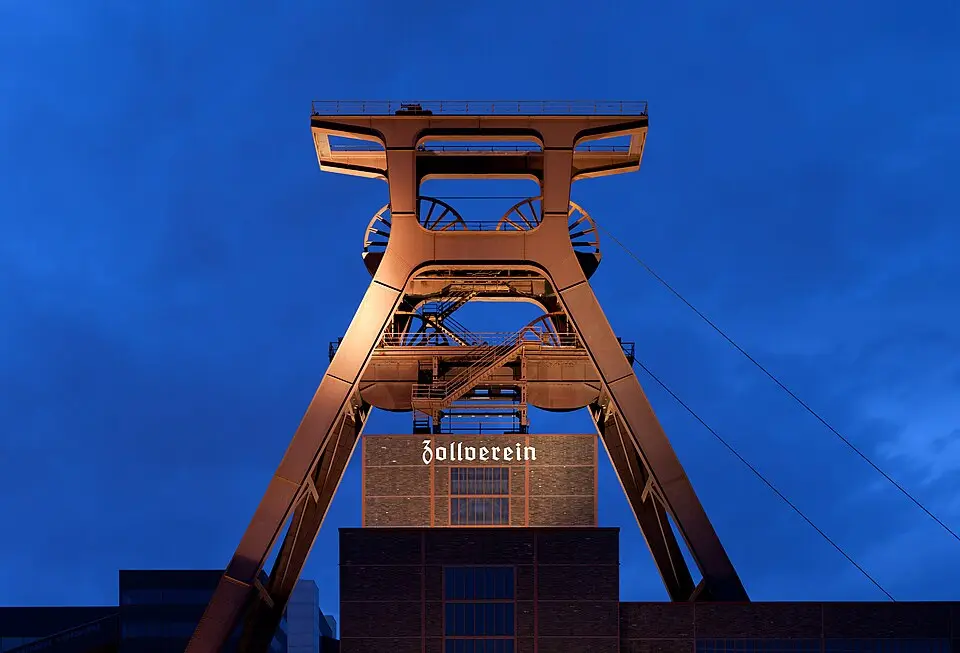
About Zeche Zollverein
The Zollverein Coal Mine in Essen is far more than just a decommissioned mine. It is an impressive testament to the industrial history of the Ruhr region and today a vibrant center for culture, science, and tourism. From 1851 to 1986, hard coal was mined here, and at times the complex ranked among the most productive mines in Germany. It was named after the German Customs Union (Zollverein), the economic alliance founded in 1834. Today the site, together with the neighboring coking plant, is a UNESCO World Heritage Site and is considered one of the most important anchor points of the European Route of Industrial Heritage.
The history of the site begins in the 1830s, when the industrialist Franz Haniel was searching for suitable coal deposits for steel production. After successful drilling, he founded the Zollverein mining company in 1847. The choice of Essen-Stoppenberg as the location was strategically smart, since the Cologne-Minden Railway, which opened in 1847, ran immediately north of the grounds and thus ensured an efficient connection to the transport network. The first shaft-sinking work began that same year, but coal production could not actually begin until 1851 because of water inflows.
Over the following decades, the mine grew steadily. New shaft complexes were built to increase output and improve the underground infrastructure. Particularly noteworthy is Shaft Complex 1/2/8, which was modernized several times over the years. An important milestone was the construction of the central hoisting facility at Shaft XII in the late 1920s. This facility was designed by the architects Fritz Schupp and Martin Kremmer and followed the principles of the functional industrial architecture of the New Objectivity movement.
Shaft XII was a technical and architectural masterpiece, regarded as the most modern and "most beautiful coal mine in the world." The double-braced solid-wall headframe built in 1930 became a model for many later central hoisting facilities. With a daily output capacity of 12,000 tons, this shaft took over all the coal production of the earlier facilities. The mine reached its production records in the 1930s and 1950s, placing it at the forefront of German hard coal mining.
After World War II and during the period of rationalization, Zollverein remained an important site. Production became increasingly mechanized, and the coking plant, long considered the most modern in Europe, produced coke until 1993. Finally, the mine was shut down on December 23, 1986, the last of around 290 mines in Essen. Shafts 2 and XII still serve today as safeguarding sites for water management, although they were filled with concrete in spring 2023 to ensure structural stability.
The transformation from industrial site to cultural venue began immediately after the closure. The state of North Rhine-Westphalia bought the grounds and placed them under historic preservation to prevent demolition. The renovation and conversion was a complex project, supported by various foundations and architects. In 2001, Shaft Complexes XII and 1/2/8 and the coking plant were added to the UNESCO World Heritage list. The justification was the outstanding application of modern design concepts to an entire industrial complex.
Today the site is home to numerous cultural institutions. The centerpiece is the converted coal washing plant of Shaft XII, which houses the Ruhr Museum and the Ruhr Visitor Center. Here you can learn about the history of the Ruhr region and its industrial heritage. A freestanding escalator, said to be the highest of its kind in Germany, leads 24 meters up into the building. On the roof is the Erich Brost Pavilion, a venue for events of every kind.
Other important institutions include the Red Dot Design Museum in the former boiler house and the Zollverein Cube, which serves as a campus of the Folkwang University of the Arts. The former coking plant houses exhibition spaces for contemporary art, including the walk-in installation "Palace of Projects." The former pithead baths are home to the Choreographic Center NRW, while the former machine hall houses the Kunstschacht art space. This diverse use makes the site a lively place for art, design, and science.
The grounds are also a place of nature. A species-rich flora and fauna has developed on the slag heaps and in the rail yards, referred to as "industrial nature." This ecological diversity is unique in Germany and underscores the importance of the site for preserving urban biodiversity. The Zollverein Park, completed in 2012, connects the historic buildings with new paths, plazas, and pavilions, deliberately putting industrial nature in the foreground.
At Zollverein, you'll experience a unique mix of history, architecture, and nature. You can view the complex from the outside at any time, and the Visitor Center offers daily tours, some of them led by former miners. The site hosts numerous national and international events, from art exhibitions to sporting events. The Zollverein Coal Mine is thus not just a monument to the past, but a dynamic place that shapes the future of industrial culture in the Ruhr region.
At a glance
- Category
- Sight › Monuments
- Rating
- no reviews yet · write a review
- Address
- Gelsenkirchener Straße 181
45309 Essen, Germany - District
- Stoppenberg
- Phone
- +49201246810
- Website
- www.zollverein.de
- socialmedia@zollverein.de
- Coordinates
- 51.48657° N · 7.04419° E
- Data quality
- confidence 0.99
- Identifier
- ID 285fb772-bdf…
Location & surroundings
Toggle layersFAQ about Zeche Zollverein
quick answersWhat is the Zollverein Coal Mine in Essen?
The Zollverein Coal Mine is a former hard coal mine in Essen's Stoppenberg district and is now a center for culture, science, and tourism. Coal was mined here from 1851 to 1986, and at times the complex was one of the most productive mines in Germany. Together with the neighboring coking plant, the site at Gelsenkirchener Straße 181 is a UNESCO World Heritage Site and is considered one of the key anchor points of the European Route of Industrial Heritage.
Why is the Zollverein Coal Mine in Essen called that, and who founded it?
The Zollverein Coal Mine is named after the German Zollverein, the customs union founded in 1834. It was established by the industrialist Franz Haniel, who founded the mining company Gewerkschaft Zeche Zollverein in 1847 after successful drilling. He chose the site in Essen-Stoppenberg for strategic reasons: the Cologne-Minden Railway, which opened in 1847, ran directly north of the grounds. Because of water inflows, coal production didn't begin until 1851.
What is special about Shaft XII of the Zollverein Coal Mine?
Shaft XII is the central production facility of the Zollverein Coal Mine in Essen and was considered the most modern and "most beautiful coal mine in the world." The architects Fritz Schupp and Martin Kremmer designed the complex in the late 1920s in the functional style of New Objectivity. The double-frame headframe built in 1930 with solid-wall construction became a model for many later central production facilities. With a daily production capacity of 12,000 tons, Shaft XII took over all coal production from the earlier facilities.
When was the Zollverein Coal Mine in Essen shut down?
The Zollverein Coal Mine was shut down on December 23, 1986, as the last of around 290 mines in Essen. It reached its production records in the 1930s and 1950s, and the neighboring coking plant continued to produce coke until 1993. Shafts 2 and XII still serve as safeguarding sites for water drainage and were filled with concrete in spring 2023 to ensure structural stability.
What can you see around the Zollverein Coal Mine in Essen?
Around the Zollverein Coal Mine in Essen, several museums and historic sites are within walking distance. travelguide195 lists the following within one kilometer, among others: the Portal of Industrial Heritage (about 140 m), the Ruhr Museum (about 160 m), the Red Dot Design Museum (about 160 m), the Alte Waage (about 350 m), and the Zollverein Coking Plant (about 400 m). travelguide195 also lists around 7 restaurants within 500 meters. The coal mine is also part of the tour "Essen Compact: Zollverein, Cathedral, and Folkwang in One Day."
Ratings & comments
none yetNear Zeche Zollverein
closest 5 per category · 2 kmSights
Restaurants
Museums
Hotels
Cocktail bars
None within 2 km.
84 places within 2 km loaded.
You need a free account to leave reviews and photos – that keeps comments genuine and lets you edit them later.
Called the most beautiful coal mine in the world (in fact, it's a UNESCO World Heritage Site), Zollverein nowadays hosts diverse cultural highlights including an outstanding design centre and several museums. It is also famous for its Bauhaus architecture.
Source: Wikivoyage, „Essen“ · authors per page history · CC BY-SA 4.0 · as of 9/28/2022