About Weltkulturerbe Zollverein
The Zollverein World Heritage Site in Essen is far more than a decommissioned coal mine. Today it is a living place where industrial history, modern architecture, and cultural diversity come together. Originally conceived as a hard coal mine that operated from 1851 to 1986, it shapes the cityscape in Essen's northeastern district of Stoppenberg with its distinctive winding towers and enormous halls. Together with the neighboring Zollverein Coking Plant, it forms an ensemble that was added to the UNESCO World Heritage List in 2001. The site is considered an anchor point of the European Route of Industrial Heritage and attracts visitors interested in the history of the Ruhr region, modern art, and innovative architectural solutions.
The history of the site begins in the mid-19th century, when the industrialist Franz Haniel went looking for suitable coal deposits for steel production. After successful drilling, he founded the Gewerkschaft Zeche Zollverein mining company in 1847, named after the German Zollverein (customs union). The location was a smart strategic choice, as the Cologne-Minden Railway ran directly north of the site, making it easier to transport the coal. The first shafts were sunk, and production began in 1851. Over the following decades the mine grew steadily, with several shaft complexes built in Katernberg and Stoppenberg.
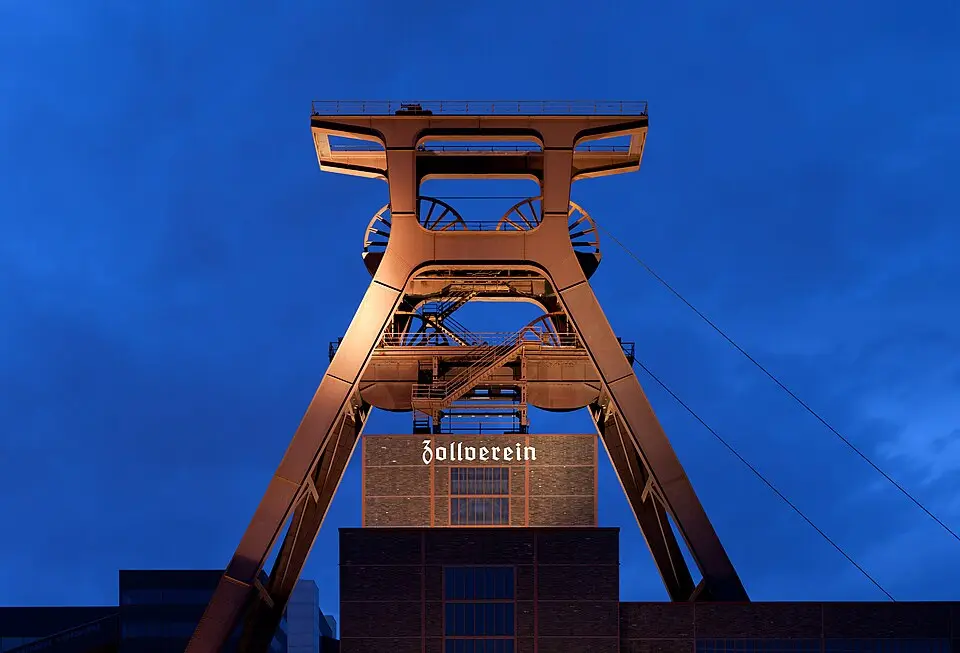
A decisive turning point was the construction of Shaft Complex XII, which began in 1928. This central production facility was designed by the architects Fritz Schupp and Martin Kremmer and followed the principles of New Objectivity. It was revolutionary both technically and architecturally, as it consolidated production from several smaller shafts and largely automated it. The double-trestle winding tower of solid-wall construction, built in 1930, became the iconic symbol of the colliery and is regarded as one of the finest examples of sober, functional industrial architecture. This facility at times made Zollverein the mine with the highest output in Germany.
After mining ceased in 1986, the question arose of what to do with the vast industrial monument. Demolition was averted, and the state of North Rhine-Westphalia bought the site from Ruhrkohle AG. A ministerial decree placed Shaft Complex XII under historic preservation to prevent the cultural loss that demolition would have meant. In the following years the buildings were renovated and prepared for new uses. The renovation was a major challenge, as the industrial facilities had never been intended for public visitors.
The conversion into a cultural center was driven by a master plan from the architect Rem Koolhaas and the landscape architect Henri Bava. The goal was to transform the site into a vibrant cultural and business location that serves not only as a museum but is also economically active. This approach sparked an intense debate about the balance between preserving original fabric and creating new, functional spaces. Critics warned against excessive commercialization, while supporters emphasized that only new uses could secure the site's preservation in the long term.
A central element of the ensemble today is the coal washing plant, which, after an extensive conversion, houses the Ruhr Museum. The huge hall, with its historic sorting machines, raw coal bunkers, and conveyor belts, was renovated in a way that preserves its industrial character. Visitors can ride a freestanding escalator, said to be the tallest of its kind in Germany, up to the building's upper levels. The museum presents the history of the Ruhr region and its industrial culture. On the roof is the Erich Brost Pavilion, a venue for a variety of events.
Besides the museum, the historic buildings house other cultural institutions. The former boiler house was converted into the Red Dot Design Museum, which awards international design prizes. On the grounds of Shaft Complex 1/2/8 you will find the Choreographic Centre NRW, the Kunstschacht Zollverein art space, and the Keramische Werkstatt Margaretenhöhe ceramics workshop. The former coking plant houses exhibition spaces for contemporary art, including the walk-in installation Palace of Projects. This variety makes Zollverein an important hub for art and culture in the Ruhr region.
Since 2010, the Folkwang University of the Arts has used the Zollverein Cube as its second Essen campus. This striking building by the Japanese architecture firm SANAA stands at the entrance to the site and houses various university departments. A second university building, home to the design department, has opened nearby. The university's presence brings academic life and young people to the area and adds to the dynamic atmosphere of the site.
The Zollverein Park, completed at the end of 2012, links the various facilities and makes the grounds accessible to the public. The concept is based on carefully integrating existing structures into the redesign. The former railroad track fan serves as a track boulevard that makes the historically grown structures visible. New paths, plazas, and pavilions are designed so that the industrial buildings remain the focus. The park offers a lovely setting for strolls and events.
A special feature of Zollverein is its so-called industrial nature. On the slag heaps and fallow areas, a species-rich flora and fauna has developed that is typical of former industrial sites. The nutrient-poor soils and open spaces provide habitat for heat-loving plants and animals. Hundreds of plant species, numerous bird species, wild bees, and amphibians can be found on the grounds. This unique biodiversity makes Zollverein an important place for nature conservation in the city and underscores the connection between industry and nature.
Visitors experience Zollverein as a place that links past and future. The authentically preserved facilities of the colliery and coking plant are open to visitors along a heritage trail and offer insights into the hard work of the miners. At the same time, modern museums, universities, and event spaces provide a current cultural program. Regular events such as the contemporary art fair, the Long Night of Industrial Heritage, and various festivals attract many visitors every year. The exterior can be viewed at any time, and guided tours of the interior, often led by former miners, offer deeper insights into the site's history. Zollverein is thus a fascinating example of how an industrial monument can become a living cultural center.
At a glance
- Category
- Museum › History museums
- Rating
- no reviews yet · write a review
- Address
- —
Essen, Germany - District
- Stoppenberg
- Phone
- —
- Website
- —
- info@zollverein.de
- Coordinates
- 51.48698° N · 7.04332° E
- Data quality
- confidence 0.76
- Identifier
- ID e96952ad-df7…
Location & surroundings
Toggle layersRatings & comments
none yetNear Weltkulturerbe Zollverein
closest 5 per category · 2 kmSights
Restaurants
Museums
Hotels
Cocktail bars
None within 2 km.
More:All museums in Essen (23)
84 places within 2 km loaded.
You need a free account to leave reviews and photos – that keeps comments genuine and lets you edit them later.