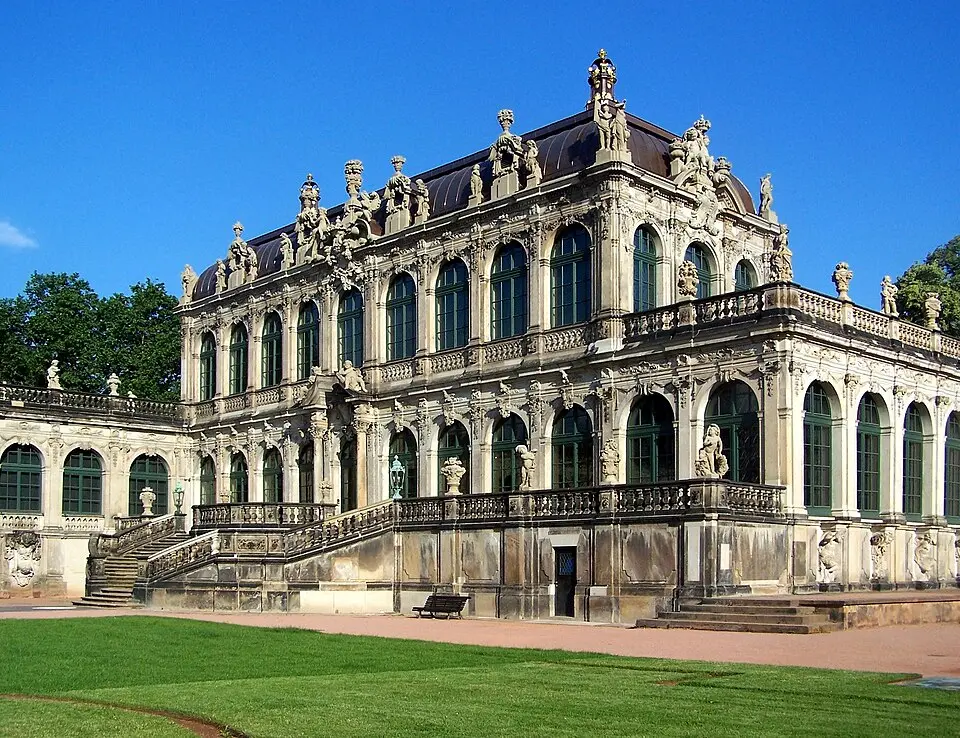
About Mathematisch-Physikalischer Salon
The Mathematisch-Physikalischer Salon (Mathematical and Physical Salon) in Dresden is a museum of the Staatliche Kunstsammlungen (State Art Collections) that has been housed in the Zwinger since 1728. The collection grew out of the interest in technology shown by Saxon rulers and was separated from the Armory in 1724, though its roots reach back to the 16th century. Elector Augustus of Saxony is considered its founder; he acquired instruments from southern Germany and northern Italy. The collection promoted regional fine craftsmanship and had a major influence on technical culture, including through the founding of the Dresden University of Technology. Today you can see around 500 exhibits from a holding of 3,000 pieces, presented in four thematic areas. These range from mechanical marvels and mathematical instruments from around 1600 and terrestrial and celestial globes spanning seven centuries to telescopes and burning mirrors from the Age of Enlightenment. A special focus is on the history of the mechanical clock, including the famous planetary clock. The museum also owns the only surviving Pascaline by Blaise Pascal in a public collection outside France.
At a glance
- Category
- Museum › Science museums
- Rating
- no reviews yet · write a review
- Address
- Zwinger
01067 Dresden, Germany - District
- Innere Altstadt
- Phone
- +4935149142000
- Website
- www.skd.museum
- mps@skd.museum
- Coordinates
- 51.05323° N · 13.73281° E
- Data quality
- confidence 1.00
- Identifier
- ID 87c4d232-c22…
Location & surroundings
Toggle layersRatings & comments
none yetNear Mathematisch-Physikalischer Salon
closest 5 per category · 2 kmRestaurants
Museums
Hotels
More:Museums in Innere Altstadt (32)All museums in Dresden (93)
243 places within 2 km loaded.
You need a free account to leave reviews and photos – that keeps comments genuine and lets you edit them later.
A collection of historical scientific instruments from the 18th century. It features a variety of early precision tools, including telescopes, clocks, and celestial models that reflect the scientific interests and technological advancements of that era.
Source: Wikivoyage, „Dresden“ · authors per page history · CC BY-SA 4.0 · as of 6/11/2026