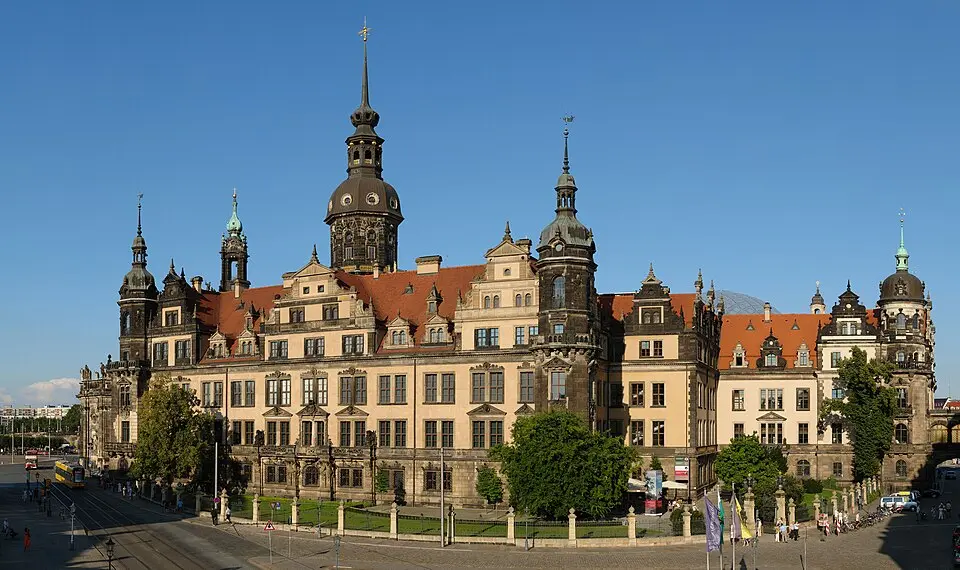
About Residenzschloss
Dresden Royal Palace (Residenzschloss) is the former main residence of the electors and kings of Saxony and stands in the heart of the Old Town. Construction of this historic four-wing complex began in 1548 in the Renaissance style and was completed in 1901 in the Neo-Renaissance style. After its destruction in World War II, the building has been rebuilt since 1986 for the Dresden State Art Collections. Today it is one of the city's most visited museums and houses important collections such as the Green Vault, the Print Room, the Coin Cabinet, the Armory, and the State Apartments of Augustus the Strong.
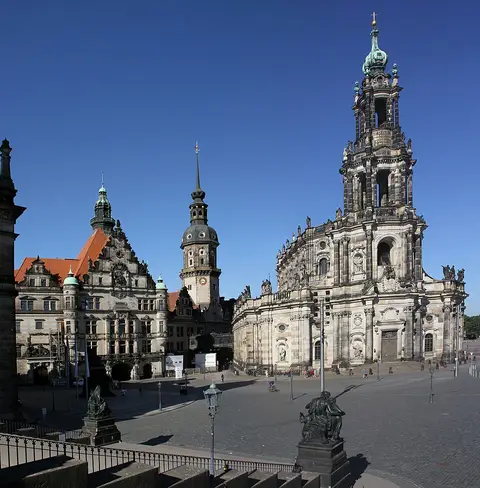
The history of the site goes back to the 13th century, when a castle was built on the grounds of what is now the large palace courtyard. The complex was first mentioned in a document in 1289. Around 1400, it began to be expanded into a princely residence, with the focus of the complex shifting to the north side. Between 1468 and 1480, the complex was enlarged into an enclosed four-wing structure, accessed through an elaborate gatehouse. The Georgenbau, which stands on Schlossplatz, was built in the early 16th century and is among the most important buildings of the German Renaissance. Its present exterior dates from a 1899 remodeling that created a Neo-Renaissance facade with a tall decorative gable.
Under Elector Moritz, the palace courtyard was extended westward to twice its size between 1548 and 1556. With the new west wing, the stair towers, and the balcony terrace, a magnificent Renaissance palace took shape, reflecting the acquisition of the electoral title. Renowned artists decorated the facades with scenes from the Bible and Roman history. Elector August completed the building, which became a principal work of Saxon Renaissance architecture. The Hausmann Tower, originally built around 1400 as the main tower, was raised in the 17th century and, with its height, is one of the city's most striking landmarks. The viewing platform offers sweeping views over Dresden.
A palace fire in 1701 destroyed parts of the complex, which were later rebuilt. The interiors on the second upper floor were designed in the Baroque style, including the bedroom and audience chamber of Augustus the Strong. Between 1723 and 1729, the splendid collection area of the Green Vault was installed on the ground floor of the west wing. Matthäus Daniel Pöppelmann designed the architecture of these treasure chambers. In the 19th century, a major remodeling was carried out for the 800th anniversary of the House of Wettin, in which a new south wing was built and the facade was unified in the Neo-Renaissance style. The palace is of great significance in architectural history, as every style from Romanesque to Historicism has left its mark.
Following the air raids at the end of World War II, the palace burned down to its foundation walls in February 1945. The Hausmann Tower lost its spire, which was not restored until 1991. After German reunification, comprehensive reconstruction began. Between 2004 and 2010, various areas were set up, including the art library, the Print Room, and the New Green Vault. The treasure chamber of the Historic Green Vault reopened in 2006. The Giant Hall in the east wing, the largest room in the palace, was completed as a shell and has housed parts of the Armory's permanent exhibition since 2013. The palace chapel, where Heinrich Schütz worked, has also been reconstructed.
The museum complex includes the Historic and the New Green Vault. While the New Green Vault displays art objects from three centuries in modern display cases, the Historic Green Vault impresses with the magnificent furnishings of its reconstructed Renaissance and Baroque rooms. Here the exhibits are presented as they once were, freely arranged on consoles and ornate tables. Access to the Historic Green Vault is only possible with a timed ticket purchased in advance. Highlights include the Dresden Green Diamond, the largest cut natural green diamond, as well as works by the court goldsmith Johann Melchior Dinglinger.
The Print Room is an art museum for drawings, prints, and photographs. On display are works ranging from Albrecht Dürer, Rembrandt, Michelangelo, and Caspar David Friedrich to Picasso. In rotating exhibitions lasting three months, roughly 100 to 130 objects are shown on a given theme. The Coin Cabinet holds an extensive collection of coins, medals, orders, and historic securities from antiquity to the present. Part of the collection is shown in the former princely living quarters in the Georgenbau.
The Armory comprises historic weapons, armor, and portraits from the 15th to 18th centuries. The collection contains around 10,000 art objects, including swords, rapiers, pistols, and rifles. A special section is the Turkish Chamber (Türckische Cammer), which, with more than 600 objects, ranks among the most important collections of Ottoman art outside Turkey. The three-mast tent from the Zeithain Camp is well known. Driven by their passion for collecting and their desire to display power, the Saxon electors amassed treasures of the Turkish fashion.
On September 28, 2019, the Royal State Apartments of Augustus the Strong reopened. These rooms were reconstructed from plans and color photographs and furnished with the pieces that had been moved out for safekeeping at the time. The State Apartments include the Corner State Hall, the antechambers, the audience chamber with the ceiling painting by Louis de Silvestre, the state bedroom, as well as the retiring rooms and picture cabinets. The Tower Room with the Porcelain Cabinet is located in the Hausmann Tower. The interior furnishings were completed with tapestries woven thread for thread at the Royal Tapestry Factory in Madrid.
On the first upper floor of the Armory, three permanent exhibitions are open to visitors. The exhibition "Worldview and Knowledge around 1600" shows works of art from the late Renaissance and items from the Dresden Kunstkammer. The exhibition "On the Road to Electoral Power" in the east wing follows the Wettins' path from the acquisition of the electoral title to the Albertines' assumption of power. At its center is the original Moritz Monument. The exhibition "Electoral Wardrobe" in the north wing presents precious garments of the electors from the Renaissance and early Baroque, including complete ruler's costumes and ladies' dresses. The completion of the palace's reconstruction is planned for 2027.
At a glance
- Category
- Sight › Palaces
- Rating
- no reviews yet · write a review
- Address
- Taschenberg 2
01067 Dresden, Germany - District
- Innere Altstadt
- Phone
- +4935149142000
- Website
- www.skd.museum
- besucherservice@skd.museum
- Coordinates
- 51.05245° N · 13.73660° E
- Data quality
- confidence 1.00
- Identifier
- ID 39a6e2b9-c72…
Part of the tour
Dresden in One Day: Zwinger, Palace, and Neumarkt →Location & surroundings
Toggle layersFAQ about Residenzschloss
quick answersWhat is the Residenzschloss in Dresden?
The Residenzschloss (Royal Palace) in Dresden is the former main residence of the electors and kings of Saxony. It stands in the Inner Old Town at Taschenberg 2. Construction of the four-wing complex began in 1548 in the Renaissance style and was completed in 1901 in the Neo-Renaissance style. Today the Residenzschloss is part of the Dresden State Art Collections and is one of the most visited museums in the city.
Which collections can you see in the Residenzschloss in Dresden?
In the Residenzschloss in Dresden you'll find several major collections: the Green Vault, the Kupferstich-Kabinett (Prints and Drawings Cabinet), the Coin Cabinet, the Armory, and the State Apartments of Augustus the Strong. The lavish treasure chambers of the Green Vault were set up between 1723 and 1729 on the ground floor of the west wing, with architecture designed by Matthäus Daniel Pöppelmann. On the second floor are Baroque rooms such as the bedroom and the audience chamber of Augustus the Strong.
How old is the Residenzschloss in Dresden?
The history of the Residenzschloss in Dresden goes back to the 13th century, when a fortress was built on the site of today's large castle courtyard; it was first mentioned in documents in 1289. Around 1400, work began to expand it into a princely residence, and under Elector Moritz the courtyard was doubled in size between 1548 and 1556. In February 1945, the palace burned down to its foundations following the air raids, and it has been under reconstruction since 1986. Because every architectural style from Romanesque to Historicism has left its mark, the palace is considered especially significant in terms of architectural history.
Can you climb a tower at the Residenzschloss in Dresden?
Yes, the Hausmannsturm (Hausmann Tower) of the Residenzschloss in Dresden has an observation platform with wide views over Dresden. The tower was originally built around 1400 as the main tower and was raised in the 17th century. It is one of the most distinctive landmarks in the city.
What can you see around the Residenzschloss in Dresden?
Around the Residenzschloss in Dresden, you'll find more museums and historic buildings just a few steps away. travelguide195 lists the Türckische Cammer (about 33 m), the New Green Vault (about 55 m), and the Taschenbergpalais by Matthäus Daniel Pöppelmann (about 62 m), among others. Within a 500 m radius, travelguide195 lists around 140 restaurants. The palace is also part of the tour "Dresden in One Day: Zwinger, Palace and Neumarkt."
Ratings & comments
none yetNear Residenzschloss
closest 5 per category · 2 kmSights
Restaurants
Museums
Hotels
More:Sights in Innere Altstadt (46)All sights in Dresden (141)
247 places within 2 km loaded.
You need a free account to leave reviews and photos – that keeps comments genuine and lets you edit them later.
During the bombing of Dresden in February 1945 the interior of the palace was almost completely destroyed by fire. Only the part that is now the Historisches Grünes Gewölbe (and the basements) was unaffected. Due to lack of money and political will during the GDR and despite the efforts of volunteers and local organizations, restoration only took place after reunification in the 1990s. It is now a palace for art and science. The Royal Palace is part of the Dresden State Art Collections (SKD).
Source: Wikivoyage, „Dresden“ · authors per page history · CC BY-SA 4.0 · as of 6/11/2026