About Fürstenzug
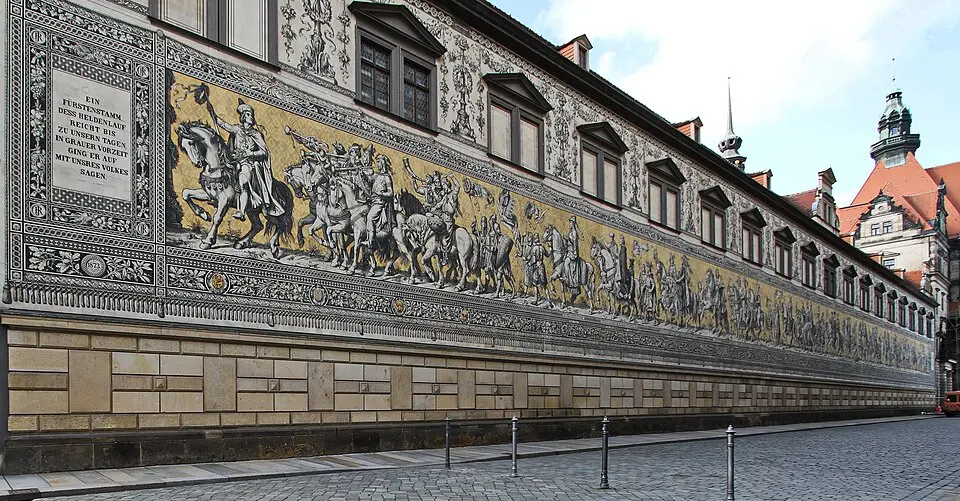
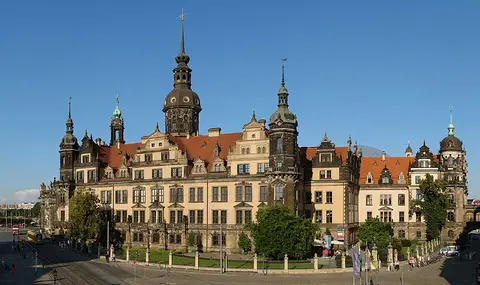
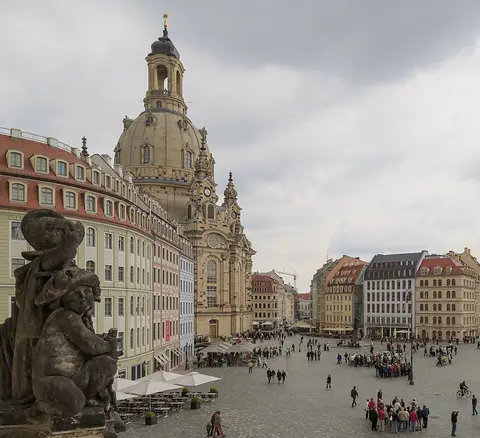
The Procession of Princes (Fürstenzug) in Dresden is a monumental work of art that is considered the largest porcelain mural in the world. It stretches for about 102 meters (roughly 335 feet) and is mounted on the outer wall of the former stable courtyard of the Dresden Residence Palace on Augustusstraße. Its location near the Frauenkirche, between the Georgentor and the Johanneum, makes it a central landmark of the Saxon state capital. The mural shows a larger-than-life mounted procession depicting the ancestral gallery of the Saxon rulers from the House of Wettin. From margraves to dukes, prince-electors, and kings, a total of 34 rulers who governed Saxony between 1127 and 1902 are portrayed. Prince Georg, who rides at the end of the procession and later also became king, brings the total to 35 rulers in the picture.
The history of the work goes back to 1589, when the north wall of the stable courtyard was first decorated with a lime-paint mural. This early version weathered away over time. In the 19th century, ahead of the 800th anniversary of the ruling house, the history painter Wilhelm Walther submitted a new design in 1865. Between 1868 and 1872 he produced a detailed preparatory drawing, which is now kept in the Dresden State Art Collections. The actual execution of the mural in sgraffito, a special plaster-scratching technique, took place from 1873 to 1876. Walther devoted great care to historical accuracy, which required years of study in museums and palaces as well as the creation of full-scale original cartoons.
Although the initially celebrated black-and-white frieze was well received at first, it proved not to be very weather-resistant. By the turn of the century, considerable damage had appeared, requiring extensive repairs in 1901. To preserve the artwork permanently, a complete redesign was decided on for the years 1904 to 1907. The damaged plaster frieze was replaced with seamlessly fitted ceramic tiles from the Meissen Porcelain Manufactory. An innovative process developed by the manufactory's technical director was used. The tiles were dry-pressed, fired at high temperatures, ground, and then painted by porcelain painters, with the historic original cartoons serving as templates.
Producing the tiles was a laborious process involving ten painters and numerous assistants. Artistic supervision was initially in the hands of Court Councillor Sturm and later the painter Gruft. King Friedrich August III honored the work of the porcelain manufactory's employees with orders and medals. Painting of the tiles began in November 1904 and was completed in March 1906. Each individual tile was marked on the back with a system of letters and numbers to avoid mix-ups during installation and to make later repairs easier. The first tiles were put in place in April 1907, and by August of that year the work was fully completed, so that the mural could be seen for the first time in its present form along its entire length.
The picture is designed as a giant tapestry, held at the top by fastening buttons and at the bottom by tassels. The lighting is arranged so that it falls on the tapestry from the upper left and on the figures from the front left. Above the main frieze are decorative elements such as festoons of flowers and fruit, as well as the heads of various animals at the column bases. The ornamental frame features tendrils, birds, and butterflies. The procession is opened by a herald on horseback, who turns halfway toward those following him. The path is sandy and strewn with flowers, which brings the scene to life.
In total, 94 people are depicted in the Procession of Princes, of whom 45 are riding and 49 are on foot. Alongside the rulers, you can see scholars, artists, craftsmen, soldiers, and farmers. Remarkably, almost all the figures keep their mouths closed, with gesture taking center stage. The only exception is the charcoal burner Georg Schmidt, who is portrayed as the rescuer of a kidnapped prince. Sixteen figures look directly out of the picture, making contact with the viewer. The scene also includes various animals, including horses, dogs, birds, and butterflies.
The figures carry a variety of weapons, offering insight into the historical development of bladed weapons and firearms. You can spot slashing weapons, thrusting weapons, sabers, halberds, spears, and various types of swords. Later in the procession, handguns such as wheel-lock pistols, flintlocks, and muskets also appear. These details underscore the historical depth of the work. Beneath each ruler, the name and period of reign are given, though for some princes who had not yet come to power, the dates are missing.
The Procession of Princes survived the air raids on Dresden in February 1945 largely unscathed, as the porcelain withstood the intense heat of the fire. In 1978 and 1979, the mural was cleaned and restored. In the process, 212 heavily damaged tiles had to be replaced and 442 less damaged tiles repaired. A sandstone inscription on the left side commemorates this restoration work. The mural remains an impressive testament to Saxon history and craftsmanship.
More recently, the Procession of Princes has also been staged as a "living picture." For Dresden's 800th anniversary celebrations in 2006 and again in 2018, costumed riders and participants were used to re-create the mural. Since 2007, the costumes have been on display in an exhibition at Rochlitz Castle. In addition, in Cämmerswalde there is a colored section of the Procession of Princes, built in honor of Wilhelm Walther. These re-enactments and exhibitions help spark interest in the historic artwork and bring it to a wider audience.
At a glance
- Category
- Sight › Monuments
- Rating
- no reviews yet · write a review
- Address
- Augustusstraße 1
01067 Dresden, Germany - District
- Innere Altstadt
- Phone
- +49351501501
- Website
- www.geschichte-der-fliese.de
- —
- Coordinates
- 51.05280° N · 13.73891° E
- Data quality
- confidence 0.99
- Identifier
- ID e5976eac-7e0…
Part of the tour
Dresden in One Day: Zwinger, Palace, and Neumarkt →Location & surroundings
Toggle layersFAQ about Fürstenzug
quick answersWhat is the Fürstenzug in Dresden?
The Fürstenzug (Procession of Princes) in Dresden is a monumental mural that is considered the largest porcelain mural in the world. It is about 102 meters (335 feet) long and is mounted on the outer wall of the former Stable Courtyard of Dresden's Royal Palace. The mural you see today consists of tiles from the Meissen Porcelain Manufactory, which replaced the original plaster frieze between 1904 and 1907.
Who is depicted on the Fürstenzug in Dresden?
The Fürstenzug in Dresden shows a larger-than-life equestrian procession with a gallery of ancestors of the Saxon rulers from the House of Wettin. It depicts 34 margraves, dukes, prince-electors, and kings who ruled Saxony between 1127 and 1902. At the end of the procession, Prince Georg, who later also became king, rides along as well, so a total of 35 rulers can be seen.
How did the Fürstenzug in Dresden come about?
Today's Fürstenzug in Dresden goes back to a design by the history painter Wilhelm Walther from 1865, created for the 800th anniversary of the princely house. From 1873 to 1876, Walther first executed the mural in sgraffito, a plaster-scratching technique, but the black-and-white frieze was not very weather-resistant and had to be repaired as early as 1901. It was therefore replaced between 1904 and 1907 with seamlessly fitted tiles from the Meissen Porcelain Manufactory, which ten painters decorated from November 1904 to March 1906 based on Walther's original cartoons. As early as 1589, the north wall of the Stable Courtyard had been adorned with a limewash painting that later weathered away.
Where is the Fürstenzug in Dresden located?
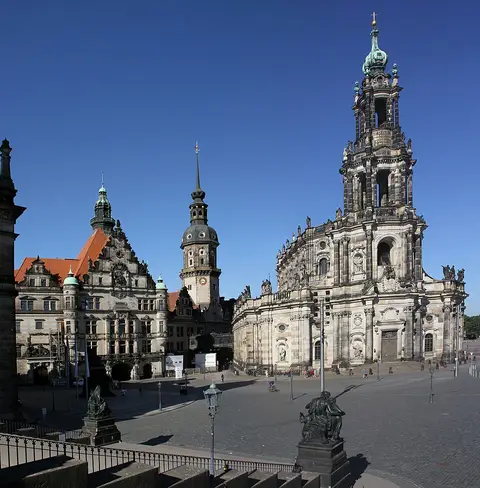
The Fürstenzug is located in Dresden's Inner Old Town (Innere Altstadt) at Augustusstraße 1. The mural decorates the outer wall of the former Stable Courtyard of the Royal Palace and lies between the Georgentor and the Johanneum, not far from the Frauenkirche. The Fürstenzug is part of the tour "Dresden in One Day: Zwinger, Palace, and Neumarkt."
What can you see around the Fürstenzug in Dresden?
Around the Fürstenzug in Dresden, numerous attractions and museums are just a few minutes' walk away. travelguide195 lists, among others, the Zitronenpresse (Lemon Squeezer) about 30 meters away, the Stallhof (Stable Courtyard) about 40 meters away, the Monument to Friedrich August the Just about 66 meters away, and the SKD Coin Cabinet and the Museum of Mineralogy and Geology each about 85 to 86 meters away. Schloßplatz is also only about 86 meters away, and within a 500-meter radius, travelguide195 lists around 143 restaurants.
Ratings & comments
none yetNear Fürstenzug
closest 5 per category · 2 kmSights
Restaurants
Museums
Hotels
More:Monuments in Dresden (21)Sights in Innere Altstadt (46)All sights in Dresden (141)
252 places within 2 km loaded.

You need a free account to leave reviews and photos – that keeps comments genuine and lets you edit them later.
This biggest porcelain painting of the world shows (almost) all Saxon princes, electors and kings on their horses and splendid parade uniforms. (There is only one female person at the painting, find her.) It leads to the "Stallhof" - the last preserved tournament place contained in a European castle. In winter, the Stallhof is the location of a medieval style Christmas market with a big fireplace.
Source: Wikivoyage, „Dresden“ · authors per page history · CC BY-SA 4.0 · as of 6/12/2026