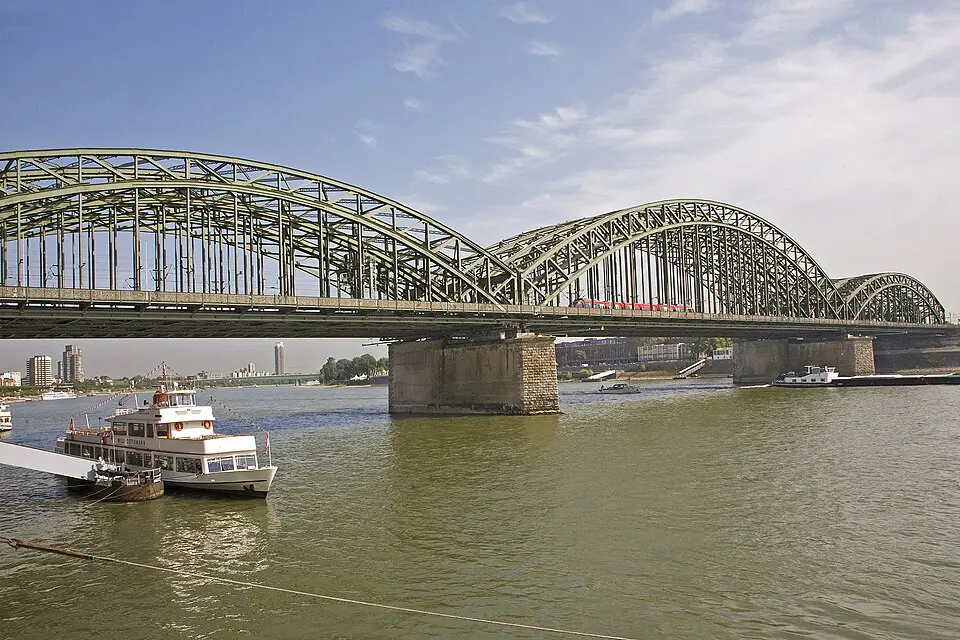
About Hohenzollernbrücke
The Hohenzollern Bridge in Cologne is one of the city's defining landmarks, linking the main train station with Deutz station across the Rhine. As one of the most important junctions in Europe's rail network, it carries thousands of train crossings every day, making it the busiest railway bridge in Germany. Together with Cologne Cathedral, it forms the iconic cityscape that awaits visitors from around the world. The structure is not only a technical masterpiece but also a meeting place where the city's history blends with modern everyday life.
The original bridge was built between 1907 and 1911 and inaugurated by Kaiser Wilhelm II in 1911. At that time, it consisted of two railway spans and one road span. The neo-Romanesque design, created by the Berlin architect Franz Schwechten, was meant to integrate the bridge harmoniously into the surroundings of the cathedral. Tall portals and towers on the river piers adorned the structure, while four equestrian statues of Prussian kings and German emperors flanked the ramps. These figures, created by renowned sculptors, recall the era of Hohenzollern rule in the Rhine Province.
During World War II, the bridge survived the bombings as one of the last intact Rhine crossings, but it was partially blown up by retreating German troops in 1945. Postwar reconstruction was initially makeshift and was completed in 1959. The original road span was not rebuilt, and the outer railway spans were widened to include pedestrian and bicycle paths. The old, heavily damaged portal structures were torn down in 1958, so today only a small part of the old road ramp on the Deutz side remains. In 1989, a third span was added on the north side to make the commuter rail (S-Bahn) schedule possible. This new section was designed so as not to disturb the historic look of the ensemble, using modern welding techniques.
Today, the bridge consists of three adjacent spans with a total width of about 29.5 meters. The construction uses two-hinged truss arches, which give the bridge its characteristic silhouette. For visitors, the Hohenzollern Bridge is best known as a romantic spot, since the custom of attaching love locks has spread here since 2008. Thousands of locks hang from the railings, giving the bridge a unique, personal character. In addition, the eastern side on the Deutz bank offers a public climbing facility run by the German Alpine Club, providing an unusual recreational option right on the riverbank. The bridge is therefore far more than just a traffic artery; it is a lively part of Cologne's city life.
At a glance
- Category
- Sight › Historic sites
- Rating
- no reviews yet · write a review
- Address
- Trankgasse 20
50667 Cologne, Germany - District
- Deutz
- Phone
- +49492212210
- Website
- www.stadt-koeln.de
- —
- Coordinates
- 50.94144° N · 6.96579° E
- Data quality
- confidence 0.99
- Identifier
- ID 9a787778-bdf…
Part of the tour
Cologne in One Day: Cathedral, Old Town, and Rhine Views →Location & surroundings
Toggle layersFAQ about Hohenzollernbrücke
quick answersWhat is the Hohenzollern Bridge in Cologne?
The Hohenzollern Bridge is a railway bridge over the Rhine in Cologne and one of the city's best-known landmarks. It connects Cologne Central Station with Deutz Station and is considered the busiest railway bridge in Germany, carrying thousands of train trips every day. Together with Cologne Cathedral, it defines the city's classic skyline. Today it consists of three side-by-side bridge sections with a total width of about 29.5 meters and two-hinged truss arches that give it its characteristic silhouette.
When was the Hohenzollern Bridge in Cologne built?
The original Hohenzollern Bridge in Cologne was built between 1907 and 1911 and was inaugurated by Kaiser Wilhelm II in 1911. The Berlin architect Franz Schwechten designed it in the Neo-Romanesque style with portals and towers; at the time it consisted of two railway sections and one road section. In 1945, retreating German troops partially blew up the bridge; reconstruction was completed in 1959, and the damaged portal buildings were torn down in 1958. In 1989, a third bridge section for S-Bahn traffic was added on the north side.
Why are there so many love locks on the Hohenzollern Bridge?
Since 2008, the custom of attaching a padlock to the railing as a symbol of love has spread on the Hohenzollern Bridge in Cologne. Thousands of love locks now hang there, giving the bridge a very personal character. That's why, for many visitors, the bridge is above all a romantic spot.
Can you walk across the Hohenzollern Bridge in Cologne?
Yes, you can cross the Hohenzollern Bridge in Cologne on foot or by bike. When the bridge was rebuilt after World War II, the former road section was dropped, and the outer railway sections were widened with pedestrian and bike paths instead. On the Deutz side, you'll also find a public climbing facility run by the German Alpine Club right on the banks of the Rhine.
What can you see around the Hohenzollern Bridge in Cologne?
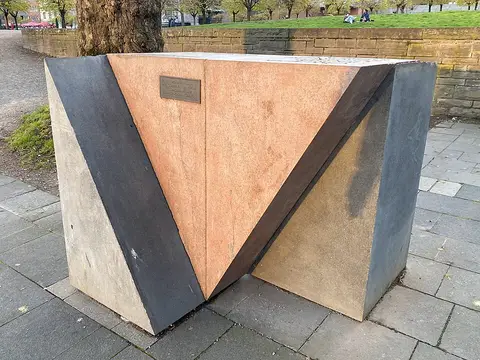
Around the Hohenzollern Bridge in Cologne, several monuments and museums are within walking distance. travelguide195 lists, among others, the equestrian statue of Kaiser Wilhelm I (about 220 meters), the Rhine Steps (about 220 meters), the memorial to the gay and lesbian victims of National Socialism (about 220 meters), and the Museum Ludwig (about 400 meters). Within a 500-meter radius, travelguide195 also lists 57 restaurants, and the bridge is part of the tour "Cologne in One Day: Cathedral, Old Town and Rhine Views."
Ratings & comments
none yetNear Hohenzollernbrücke
closest 5 per category · 2 kmSights
Restaurants
Museums
Hotels
More:Historic sites in Cologne (173)All sights in Cologne (212)
280 places within 2 km loaded.

You need a free account to leave reviews and photos – that keeps comments genuine and lets you edit them later.
Also called the Locking Bridge. If you walk to the back of the Kölner Dom along a straight path, there is a bridge on the Rhine to your right that is covered in padlocks. The locks are placed there by couples to show their loyalty to each other. Couples often have their names and a significant date inscribed on the locks. There are other places around the world that have "love padlocks".
Source: Wikivoyage, „Cologne“ · authors per page history · CC BY-SA 4.0