About King Ludwig
The Museum Ludwig in Cologne is one of the most important institutions for modern and contemporary art in Europe. It sits on the Domplatte, just southeast of Cologne Cathedral and the main train station, and forms a cultural complex together with the Cologne Philharmonic, the Art and Museum Library, and the Filmforum NRW. The museum's exhibition space extends over nearly 9,000 square meters (about 97,000 square feet) and houses a high-caliber cross-section of 20th- and 21st-century art. Here you'll find not only classic modernism but also current positions in art, which make the museum a vibrant place of cultural exchange.
The museum's history is closely tied to the donations of the couple Peter and Irene Ludwig. When they presented the city of Cologne with around 350 works of Pop Art, the city decided to build a dedicated home for contemporary art. Before that, the Expressionism collection of Cologne citizen Josef Haubrich had found its place in the Wallraf-Richartz Museum. The idea was to unite two major collections under one roof while also filling an urban-planning void between the Domplatte and the banks of the Rhine. This thinking led to the announcement of an ideas competition in 1975, which laid the groundwork for the later new building.
The architectural competition of 1974 and 1976 was a pivotal moment in the planning. It was open to all freelance architects in West Germany and attracted renowned participants, including Gottfried Böhm, Oswald Mathias Ungers, and the Briton James Stirling. The jury, chaired by Rudolf Hillebrecht, ultimately chose the design by the Cologne firm Busmann and Haberer. The design stood out for its unusual shape, which critics described as amoeba-like or industrial. The decision was controversial among experts, since other designs, such as Ungers's, had proposed clearer geometric forms. Even so, the Busmann and Haberer project went ahead, after the donation agreement was signed in 1976 and the foundation stone was laid in 1982.
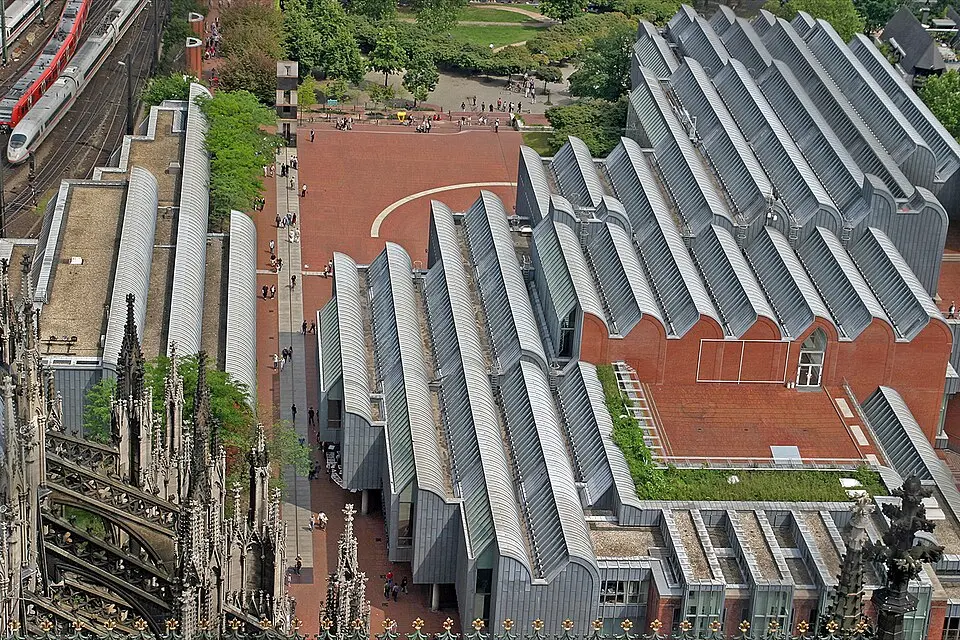
The building's architecture is defined by its distinctive structure, expressed in a series of sawtooth roofs. These undulating roofs translate the vertical dominance of the cathedral into a horizontal line and give the building an unmistakable silhouette in the cityscape. The facades are clad in brick laid in a stretcher bond and in titanium zinc, joined together by seaming. The 10.80-meter (about 35-foot) grid, divided into units of 90 centimeters (about 3 feet), determines the details of the interior design and creates a unified look. Parts of the complex that need no daylight, such as mechanical rooms, parking, and the Philharmonic's concert hall, were moved underground to make the most of the above-ground space for art.
After opening in 1986, the museum quickly became an international reference point. Today the collection includes the largest Pop Art collection in Europe, with key works by artists such as Andy Warhol, Roy Lichtenstein, and Jasper Johns. Another focus is the third-largest Picasso collection in the world, showing works from every phase of the artist's career. The museum also holds one of the most important collections of German Expressionism, known as the Haubrich Collection, as well as significant works of the Russian avant-garde. These core holdings are complemented by works of Abstract Expressionism, Minimalism, and Conceptual art, including pieces by Mark Rothko, Donald Judd, and Eva Hesse.
The Rhineland art scene, which is strongly represented in the museum, holds special significance. Works by Joseph Beuys, Gerhard Richter, Sigmar Polke, and Rosemarie Trockel are a permanent part of the collection. Artists from Africa, Asia, and Latin America are also increasingly present, underscoring the collection's global outlook. The museum is actively reassessing its holdings in order to expose hierarchies between cultures and to give greater consideration to women's positions in art history. This scholarly work goes hand in hand with the continual expansion of the collection through acquisitions and donations.
A unique feature of the museum is its comprehensive collection on the history of photography. With around 70,000 works, it ranges from early daguerreotypes to the digital present. The Agfa Foto-Historama alone holds 20,000 cameras and documents the technical and cultural development of the medium. This collection lets visitors understand photography not only as a means of artistic expression but also as a historical phenomenon. Regular special exhibitions focus on specific aspects of photography and its relationship to reality.
The Museum Ludwig is also a venue for current debates and new ideas. Every two years, the Schultze Projects series invites artists to create works for the striking end wall in the stairwell, in memory of the Cologne artist couple Ursula and Bernard Schultze. In addition, the Gesellschaft für Moderne Kunst am Museum Ludwig awards the Wolfgang Hahn Prize, one of the most important acquisition prizes in Europe, to exceptional contemporary artists. These initiatives secure the museum's relevance to the current art scene and foster dialogue between established and emerging artists.
More recently, the building has faced major challenges. At the end of 2021, the city of Cologne reported problems with the structure and planned a comprehensive overhaul. The cost was initially estimated at one billion euros, which sparked discussions about priorities in the city budget. The architects of the original building criticized the projected sums and called for the building to be given landmark protection. The city of Cologne is currently looking for solutions for a partial renovation and is considering handing operation of the building complex over to an external operator in order to minimize legal risks and preserve the fabric of the historic museum building.
Despite these structural challenges, the Museum Ludwig remains a central draw for art lovers from around the world. The combination of historical significance, architectural individuality, and a diverse collection makes it an indispensable part of cultural life in Cologne. Here you experience not only the artworks but also the story of how they came to be and the constant changes that define a living museum. Its location by the cathedral and the Rhine provides an impressive setting for a visit to this important institution.
At a glance
- Category
- Museum › Art museums
- Rating
- no reviews yet · write a review
- Address
- Heinrich-Böll-Platz
50667 Cologne, Germany - District
- Altstadt-Nord
- Phone
- +4922122126165
- Website
- www.museum-ludwig.de
- —
- Coordinates
- 50.94088° N · 6.96122° E
- Data quality
- confidence 0.58
- Identifier
- ID d1bc26d2-749…
Location & surroundings
Toggle layersRatings & comments
none yetNear King Ludwig
closest 5 per category · 2 kmSights
Restaurants
Museums
Hotels
More:Museums in Altstadt-Nord (24)All museums in Cologne (108)
290 places within 2 km loaded.
Don't miss in Cologne
All sights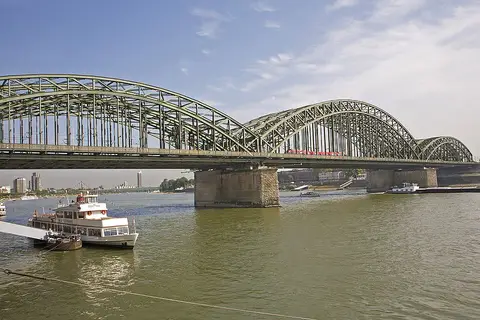 Historic sites01
Hohenzollernbrücke
Trankgasse 20 · Cologne● Website● Phone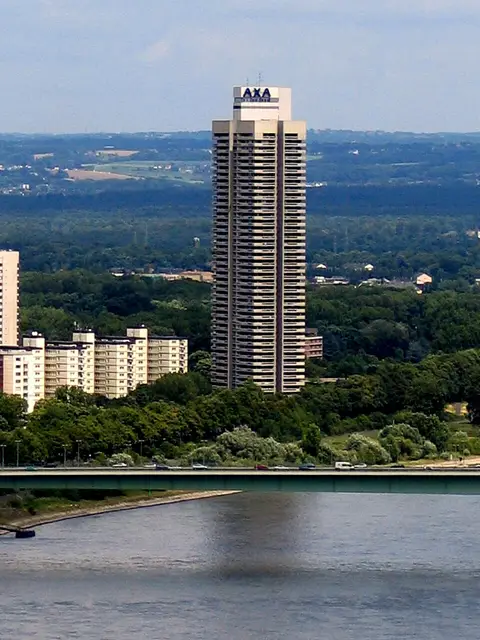 Historic sites02
Colonia-Haus
An d. Schanz 2 · Cologne● Website● Phone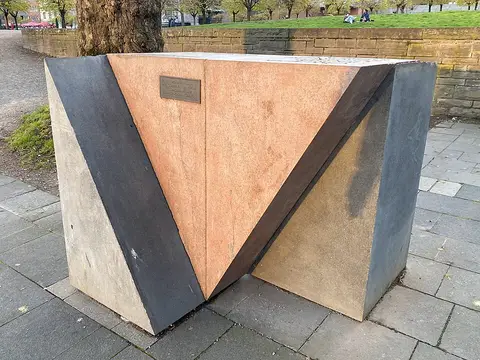 Monuments03
Memorial to Gay and Lesbian Victims of National Socialism
· Cologne○ Website● Phone Historic sites04
You need a free account to leave reviews and photos – that keeps comments genuine and lets you edit them later.