About Prague Astronomical Clock
The Prague Astronomical Clock, known in Czech as the Pražský orloj, is one of the most famous and fascinating landmarks in the Czech capital. It sits on the south wall of the Old Town Hall and is considered a masterpiece of Gothic science and engineering. A treasured cultural monument, it draws countless visitors every day, who come to admire not only its mechanical precision but also the historical depth of this one-of-a-kind creation. The clock is not a single structure but an ensemble that has grown over the centuries, and today it is an indispensable part of Prague's urban identity. Together with the town hall itself, it is protected as a national cultural monument and embodies the rich history of the Bohemian lands.
The clock's history begins in the 14th century, when King John of Bohemia granted the citizens of the Old Town permission in 1338 to build a town hall. The project was financed by a tax on wine. The tower, nearly 70 meters (230 feet) tall, in which the clock is housed today, was completed in 1364 and expanded several times over the years. The clock itself did not appear all at once but developed over the course of centuries. The mechanical movement with the astronomical dial, one of the oldest parts, was built in 1410 by the clockmaker Mikuláš of Kadaň according to plans by Jan Šindel. Šindel was then a professor of mathematics and astronomy at Charles University. The surrounding stonework and sculptures come from the workshop of Peter Parler, which closed in 1419.
In a later phase, around 1490, a calendar dial was added beneath the astronomical dial. This addition is attributed to the clockmakers Jan Růže and Jakub Čech, who were previously mistakenly believed to be the original builders of the entire clock. During this period, the facade was decorated with striking sculptures in the Vladislav Gothic style, a Bohemian variant of Flamboyant Gothic. In 1551, Jan Táborský of Klokotská Hora took over maintenance and restoration of the clock. He introduced the drive for the calendar dial and the half-hour strike, and installed two sundials so that the clock could be set independently. At that time, the clock still displayed only astronomical data, underscoring its scientific purpose.
The clock's history is also a story of rescue. In the 18th century, the mechanism fell into very poor condition and often stood still. In 1787, the city council even planned to sell the clock for scrap. Professor Antonín Strnad recognized the object's historical value and eventually persuaded the city fathers to release the funds needed for repairs. These were carried out between 1787 and 1791 but did not yet provide a lasting solution. Only the so-called Great Repair of 1866 returned the clock to stable, continuous operation. In the process, the original escapement was replaced by a separate precision pendulum clock that gives the old movement an impulse every minute. A mistake made when restoring the astronomical dial, in which the zodiac pointer was made too small, resulted in a distinctive golden ring that makes the clock unique in the world.
During World War II, in the course of the Prague Uprising, the clock was badly damaged by shelling and fire. Many feared the historic work was lost for good. However, the mechanism was saved and the clock was restored to its original form. The apostle figures visible today were not made anew until 1948, by the sculptor Vojtěch Sucharda, since only two of the originals had survived in the City Museum. The electric drive system was not installed until 1957. Despite these severe blows of fate, the clock has been running in its original location for over 600 years, a testament to its robustness and the dedication of its restorers.
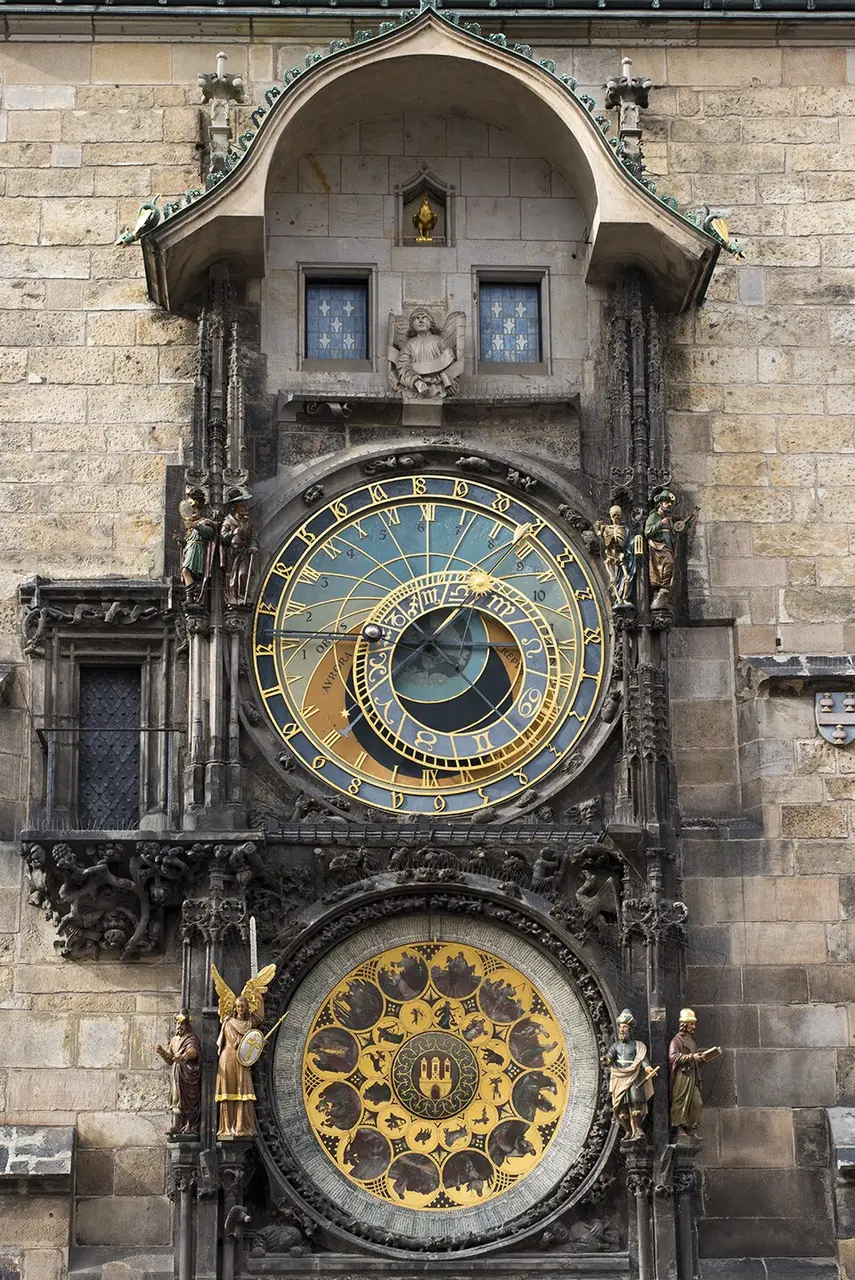
The upper dial is the heart of the clock and functions as a clockwork-driven astrolabe. It shows a stereographic projection from the north and is calibrated to the latitude of Prague. Here visitors can read various astronomical data. A sun pointer moves along the ecliptic and indicates the position of the sun in the zodiac. A moon pointer with a black-and-silver sphere shows the phase of the moon and its position in the zodiac. The dial also displays civil time, the so-called planetary or temporal hours, sidereal time, and Old Bohemian time. Bohemian time begins half an hour after sunset and counts up to 24, with the starting point shifting with the seasons.
Below the astronomical dial is the calendar dial. This disc advances by one segment each day and shows the current date, the Sunday letter, the saint's name day, and the so-called Cisio Janus. Inside the disc are twelve medallions with the signs of the zodiac, each representing one month. The outer ring depicts typical scenes for each month showing seasonal labors. At the center sits the coat of arms of Prague's Old Town. This combination of astronomical and calendar information makes the clock a comprehensive tool for orienting oneself in time and nature.
Probably the best-known attraction for tourists is the hourly show, which takes place between 9 a.m. and 10 p.m. On the hour, the figures of the twelve apostles appear in the two windows above the dial in a solemn procession. At the same time, four allegorical figures spring to life at the sides of the dial. On the left stand Vanity and Greed; on the right, Death, shown as a skeleton with a scythe, and the Turk, who symbolizes Lust. Death turns an hourglass and rings a bell. After the apostles pass by, a rooster crows and the bell strikes the hour. This theatrical performance draws large crowds and is a fixture of Prague city life.
The clock is surrounded by numerous legends and myths that heighten its mystique. The best-known legend tells of Master Hanuš, the fictional builder, whose eyes were put out by jealous councilmen. In his final hour, he is said to have sabotaged the mechanism, after which it could not be repaired for a hundred years. Another legend holds that the twenty-seven Bohemian nobles executed in 1621 appear before the clock every year to check how it is running. If the clock keeps good time, the Czech people will have peace; if it stops, hard times are ahead. These stories give the clock an additional cultural dimension that goes far beyond its technical function.
For visitors, the Prague Astronomical Clock is more than just a timepiece. It is a window into the past, linking medieval science, Gothic art, and modern engineering. The chance to study its complex pointers and their functions offers a deep insight into how people understood celestial mechanics before the modern era. The combination of the hourly figure show, the detailed astronomical display, and its rich history makes it an unforgettable experience. Whether you stand before it as a history buff, an astronomy enthusiast, or simply a curious traveler, the clock captivates with its uniqueness and its enduring presence in the heart of the Old Town.
At a glance
- Category
- Sight › Historic sites
- Rating
- no reviews yet · write a review
- Address
- Staroměstské nám. 1
110 00 Prague, Czechia - District
- Praha 1
- Phone
- +420775400052
- Website
- www.orloj600let.cz
- —
- Coordinates
- 50.08704° N · 14.42067° E
- Data quality
- confidence 0.69
- Identifier
- ID 11b0acdd-bcd…
Location & surroundings
Toggle layersFAQ about Prague Astronomical Clock
quick answersWhat is the Prague Astronomical Clock?
The Prague Astronomical Clock, known in Czech as Pražský orloj, is one of Prague's most famous landmarks and is considered a masterpiece of Gothic science and engineering. It is not a single structure but an ensemble of clockwork, astronomical dial, calendar, and sculptures that has grown over the centuries. Together with the Old Town Hall, the clock is protected as a national cultural monument of the Czech Republic.
Where is the Prague Astronomical Clock located?
The Prague Astronomical Clock is located on the south wall of the Old Town Hall at Staroměstské nám. 1 in the Prague 1 district. It is built into the nearly 70-meter-tall (about 230 feet) town hall tower, which was completed in 1364. Within a 500-meter radius, travelguide195 lists around 407 restaurants, and the clock is part of the tour "Prague in a Nutshell: Castle, Charles Bridge, and Old Town in One Day."
Who built the Prague Astronomical Clock, and when?
The clockwork and astronomical dial of the Prague Astronomical Clock were built in 1410 by the clockmaker Mikuláš of Kadaň, based on designs by Jan Šindel, a professor of mathematics and astronomy at Charles University. The stonework came from the workshop of Peter Parler. Around 1490, the clockmakers Jan Růže and Jakub Čech added the calendar, and starting in 1551, Jan Táborský of Klokotská Hora contributed, among other things, the drive for the calendar dial and two sundials.
Was the Prague Astronomical Clock really almost scrapped?
Yes. In 1787, the Prague city council planned to sell the dilapidated Astronomical Clock for scrap after it had often stood idle during the 18th century. However, Professor Antonín Strnad convinced the city fathers to approve funds for a repair, which lasted from 1787 to 1791. Stable, continuous operation only came with the so-called Great Repair in 1866.
What can you see around the Prague Astronomical Clock?
Around the Prague Astronomical Clock, several Old Town sights lie within walking distance of less than 60 meters (about 200 feet). travelguide195 lists, among others, the Old Town Hall Tower (about 26 meters), the Brožík Hall (Brožíkova síň, about 29 meters), the Church of Our Lady before Týn (about 37 meters), and the Mozart Interactive Museum (about 40 meters). Also very close are the Jan Hus Memorial (about 58 meters) and the House at the Minute (about 59 meters).
Ratings & comments
none yetNear Prague Astronomical Clock
closest 5 per category · 2 kmRestaurants
Museums
Hotels
More:Historic sites in Prague (736)Sights in Praha 1 (290)All sights in Prague (834)
300 places within 2 km loaded.
You need a free account to leave reviews and photos – that keeps comments genuine and lets you edit them later.
The Astronomical Clock located on a side tower of the Old Town Hall (reasonably enough, on Old Town Square) is easy to find—just wait until a few minutes before the hour and look for a large group of tourists standing around waiting for something to happen! Still, Orloj is one of the most popular gathering places in Prague. The closer you are to the astronomical clock, the more astronomical the prices in restaurants and stores. Built in 1410 and thought of as an example of 15th century high-tech device, projected with the participation of maths and astronomy professors at Prague University. The main dial is in principle a mechanical astrolabe, showing not only the current time, but also the placement of the sun and moon in the Zodiac, phases of the moon, the times of sunrise and sunset, length of astronomical night, the time in old Bohemian hours, in unequal hours and other data. From gathering crowds, hardly anybody understands all data astronomical dial displays. Then there is a slow-moving 12-month calendar with incredibly delicate, small figure paintings by 19th century Czech painter Josef Manes. Every day on the hour, the upper, glockenspiel-style section of the clock performs the same scene: Death waves an hourglass, the 12 apostles shuffle past small windows, and a rooster crows. After the hour strikes, a Turk wags his head. Long after the Turks had ceased to be a threat in Central Europe, their use as an allegorical figure in genre paintings and other art continued. The Czechs often sided with the Hungarians in various battles against increasing imperial power as exercised by the ruling Habsburg family over their dominions, and though the Turks never occupied Prague as they did Budapest, both countries' artists used "the Turk" (a dark-complected figure, usually wearing a turban) to represent the dangers of the world, and especially threats to Christianity. In the astronomical clock, the Turk is meant to be the stranger. There is a legend about the clock that states the original master builder of its interior clockworks was blinded by the King who commissioned it after the work was completed so the mechanic could never build such a wonderful clock for someone else. In vengeance, the master builder committed suicide by throwing himself into the gears of the clock, which took nearly a century to be repaired. Pickpocketing is common in this location.
Source: Wikivoyage, „Prague/Old Town and Josefov“ · authors per page history · CC BY-SA 4.0 · as of 9/19/2026