About Prager Rathausuhr
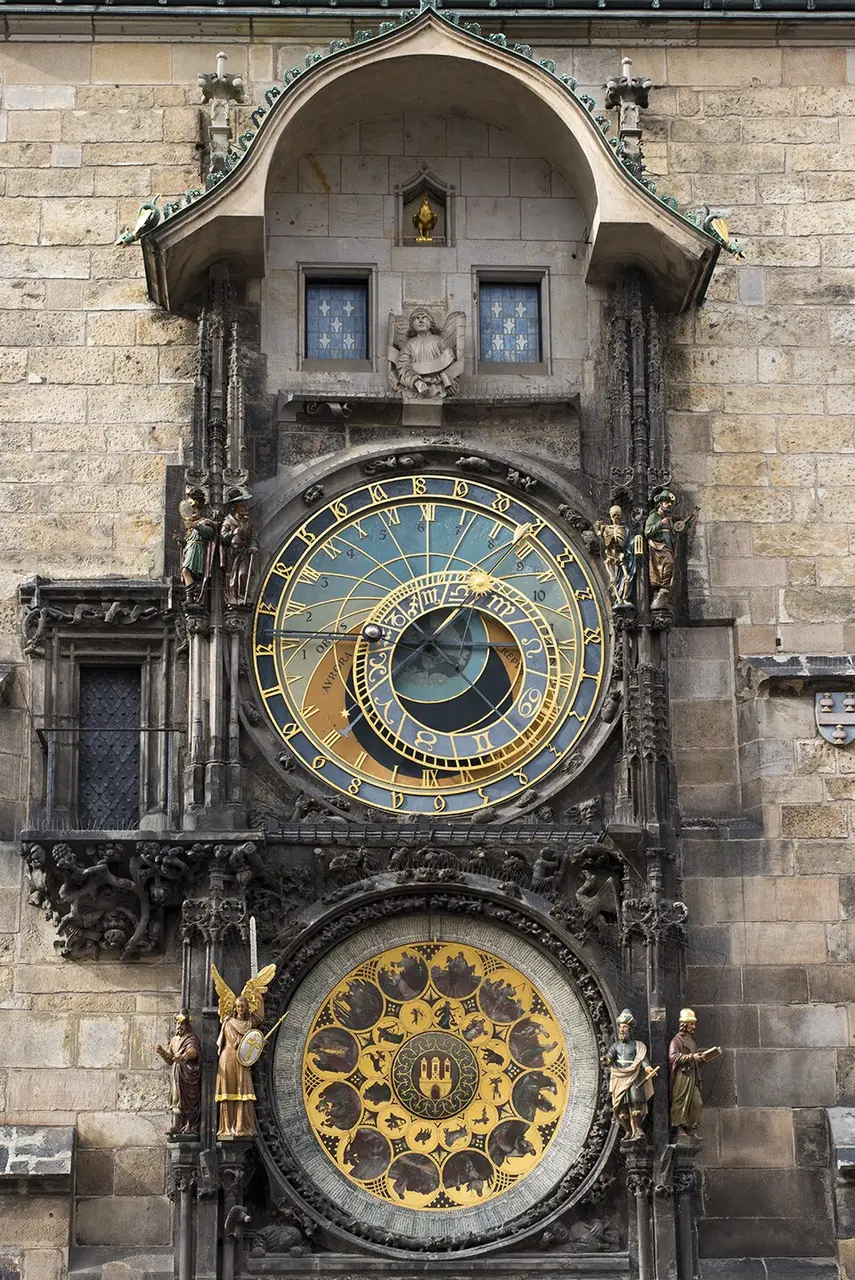
The Prague Astronomical Clock, often known internationally as the Apostles' Clock or the Old Town Astronomical Clock, is one of the most famous sights in the Czech capital. It sits on the south wall of the Old Town Hall and is regarded as an outstanding masterpiece of Gothic science and engineering. As a national cultural monument, the clock, together with the town hall, is an indispensable part of the historic cityscape. The structure was not built in a single step but evolved over the centuries, and it has now been running at its original location for six hundred years.
The history of the town hall begins in 1338, when King John of Bohemia allowed the citizens of the Old Town of Prague to build a building of their own. The project was financed with the wine tax. The tower, almost seventy meters (230 feet) high, in which the clock is housed today, was completed in 1364 and was expanded and altered several times up to the nineteenth century. The clock mechanism itself dates back to 1410. At that time, the clockmaker Mikuláš of Kadaň built the mechanical movement with the astronomical dial based on plans by the mathematician and astronomer Jan Šindel. Šindel was a professor at Charles University in Prague at the time.
The artistic design of the clock was completed in several phases. The stonework and sculptures framing the astronomical dial come from the workshop of Peter Parler, which closed in 1419. In a second phase, around 1490, a calendar dial was added below the astronomical dial. This work is attributed to the clockmakers Jan Růže and Jakub Čech, who were previously mistakenly believed to be the original builders of the entire clock. During this period, the facade was richly decorated with striking sculptures in the Vladislav Gothic style. Later, in 1551, the mechanic Jan Táborský of Klokotská Hora took over maintenance and introduced, among other things, the calendar drive and the half-hour strike.
Over the centuries, the clock had to be comprehensively repaired several times because it was often broken or out of operation for long periods. A first major rescue took place between 1787 and 1791. At that time its condition was so critical that the city council considered selling it as scrap. Professor Antonín Strnad eventually convinced the councilors of the work's historical significance and organized the repair. Despite these efforts, the clock ran poorly until another major restoration in 1866. On that occasion, the original escapement was replaced by a separate precision pendulum clock that gives the old movement an impulse every minute. The calendar dial was also renewed, with the painter Josef Mánes creating the cycle of medallions depicting the twelve months and the zodiac signs.
The Second World War wrote a dramatic chapter in the clock's history. During the Prague Uprising in the last three days of the war, the town hall was heavily damaged by German shelling, which also hit the Astronomical Clock. Many gave up hope of a restoration, and there were even proposals to replace the movement with a modern one. In the end, however, the historic work was saved and restored to its original form. The figures of the twelve apostles visible today were not made until 1948, by the sculptor Vojtěch Sucharda, since only two of the original figures had survived in the city museum.
The upper dial is the most important part of the clock and functions as an astrolabe driven by a clockwork mechanism. It displays a variety of time-related and astronomical data. Three hands turn at the center: the sun hand, the moon hand, and the ecliptic with the zodiac signs. The sun hand shows the civil hour as well as the so-called planetary hours, which begin at sunrise. The moon hand indicates the position of the moon in the ecliptic and at the same time rotates on its own axis to show the lunar phases. Another hand shows sidereal time. On a separate movable ring, you can read the Bohemian hours, which begin half an hour after sunset and automatically adjust to the changing time of sunset.
The lower dial serves as a calendar. It counts the months and days and consists of a rotating ring with 365 segments. Each segment contains information such as the day of the month, the Sunday letter, and the name day. The outer field shows the opening syllables of the Cisiojanus, a medieval method for predicting the weather. At the center of the calendar is the fixed coat of arms of the Old Town of Prague. The twelve inner medallions depict the signs of the zodiac, while the outer medallions show typical scenes for each month, following a centuries-old European tradition.
Particularly fascinating is the daily show on the hour, every hour between 9 a.m. and 10 p.m. In the two windows above the astronomical dial, the figures of the twelve apostles appear. At the same time, four allegorical figures come to life at the sides: Vanity, Greed, Death with his scythe, and the Turk, a symbol of lust. Death turns an hourglass and rings a bell. After the apostles have passed by, a rooster crows, and the bell in the tower strikes the hour. These automata were not added until the seventeenth century, when the astrological tables previously displayed there were replaced by the apostle figures.
The clock is surrounded by numerous myths and legends that underscore its mystical character. The best-known legend tells of Master Hanuš, who supposedly created the clock and was blinded by jealous councilors after its completion. In his despair, he is said to have blocked the movement with his hand, after which it could not be repaired for a hundred years. This story is pure invention, but it has become deeply rooted in the collective memory. Another legend says that every year on the anniversary of the execution of twenty-seven Bohemian noblemen in 1621, the ghosts of the beheaded gather in front of the town hall to watch the clock. If the clock keeps exact time, the Czech people will prosper; if it stops, hard times are in store.
Technically, today's clock mechanism consists of several components that have been carefully developed over the centuries. The original going train with the hand mechanism has survived all repairs without significant changes and is preserved to this day in its original form. The clock is now powered by electric winders, which were not installed until 1957. The Prague Astronomical Clock thus remains a fascinating testament to the union of medieval craftsmanship, astronomical science, and modern technology, drawing visitors from around the world and immersing them in the history of the city.
At a glance
- Category
- Sight › Historic sites
- Rating
- no reviews yet · write a review
- Address
- Staroměstské nám. 1, 110 00 Staré Město
Prague, Czechia - District
- Praha 1
- Phone
- —
- Website
- —
- —
- Coordinates
- 50.08688° N · 14.42074° E
- Data quality
- confidence 0.92
- Identifier
- ID 03af30da-59b…
Location & surroundings
Toggle layersRatings & comments
none yetNear Prager Rathausuhr
closest 5 per category · 2 kmSights
Restaurants
Museums
Hotels
More:Historic sites in Prague (736)Sights in Praha 1 (290)All sights in Prague (834)
300 places within 2 km loaded.
Don't miss in Prague
All sights Historic sites01
Pražský hrad
Pražský hrad, 119 08 · Prague● Website● Phone Historic sites02
Prague Astronomical Clock
Staroměstské nám. 1 · Prague● Website● Phone Historic sites03
Prasna brana
náměstí Republiky 1090/5 · Prague● Website● Phone Historic sites04
You need a free account to leave reviews and photos – that keeps comments genuine and lets you edit them later.
The Astronomical Clock located on a side tower of the Old Town Hall (reasonably enough, on Old Town Square) is easy to find—just wait until a few minutes before the hour and look for a large group of tourists standing around waiting for something to happen! Still, Orloj is one of the most popular gathering places in Prague. The closer you are to the astronomical clock, the more astronomical the prices in restaurants and stores. Built in 1410 and thought of as an example of 15th century high-tech device, projected with the participation of maths and astronomy professors at Prague University. The main dial is in principle a mechanical astrolabe, showing not only the current time, but also the placement of the sun and moon in the Zodiac, phases of the moon, the times of sunrise and sunset, length of astronomical night, the time in old Bohemian hours, in unequal hours and other data. From gathering crowds, hardly anybody understands all data astronomical dial displays. Then there is a slow-moving 12-month calendar with incredibly delicate, small figure paintings by 19th century Czech painter Josef Manes. Every day on the hour, the upper, glockenspiel-style section of the clock performs the same scene: Death waves an hourglass, the 12 apostles shuffle past small windows, and a rooster crows. After the hour strikes, a Turk wags his head. Long after the Turks had ceased to be a threat in Central Europe, their use as an allegorical figure in genre paintings and other art continued. The Czechs often sided with the Hungarians in various battles against increasing imperial power as exercised by the ruling Habsburg family over their dominions, and though the Turks never occupied Prague as they did Budapest, both countries' artists used "the Turk" (a dark-complected figure, usually wearing a turban) to represent the dangers of the world, and especially threats to Christianity. In the astronomical clock, the Turk is meant to be the stranger. There is a legend about the clock that states the original master builder of its interior clockworks was blinded by the King who commissioned it after the work was completed so the mechanic could never build such a wonderful clock for someone else. In vengeance, the master builder committed suicide by throwing himself into the gears of the clock, which took nearly a century to be repaired. Pickpocketing is common in this location.
Source: Wikivoyage, „Prague/Old Town and Josefov“ · authors per page history · CC BY-SA 4.0 · as of 9/19/2026