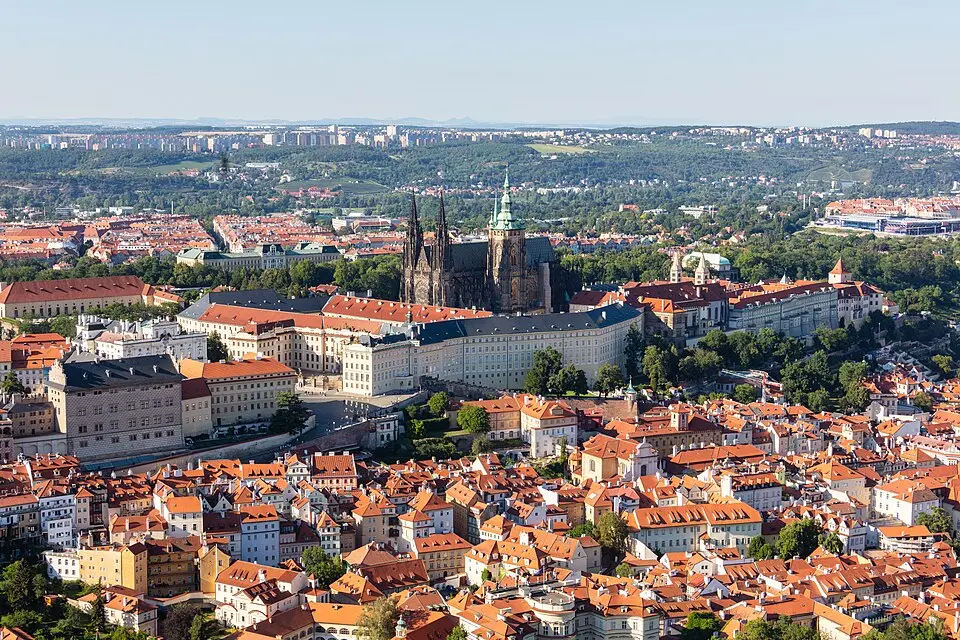
About Pražský hrad
Prague Castle (Czech: Pražský hrad) is one of the most important historic sites in the Czech capital. A former residence of the kings of Bohemia, two Holy Roman Emperors, and the presidents of Czechoslovakia, it is now the seat of the President of the Czech Republic. With an area of almost 70,000 square meters (about 750,000 square feet), it is considered the largest coherent castle complex in the world. The grounds stretch across the Hradčany spur and are divided into several courtyards connected by monumental gates and passageways. The complex is not only a political center but also a cultural heart of the city, drawing millions of visitors every year.
The castle's history goes back to the 9th century, when the first settlements arose on the spur. The oldest written record dates from the founding of the Church of the Virgin Mary by Prince Bořivoj before the year 885. The original fortifications consisted of timber-and-earth walls and ditches that secured access to the spur. Over the centuries, the complex was rebuilt and expanded many times. Archaeological finds show that the early fortifications dated from the 10th century, before the transition to a stone castle under Soběslav I in the 12th century. This Romanesque wall, often called the Soběslav Wall, marks an important step in the development of the fortress.
A decisive turning point in the castle's building history came with the reign of Charles IV in the 14th century. After a devastating fire in 1303, the king had the castle rebuilt and left a lasting mark on its appearance. Under his rule, the Royal Palace was remodeled, and in 1344 construction began on St. Vitus Cathedral, which remains the castle's landmark to this day. The Gothic architecture of this era gives the complex its characteristic medieval charm. Later, in the 15th century, the castle enjoyed another heyday under the Jagiellonians. The master builder Benedikt Ried created Vladislav Hall, an outstanding Renaissance hall whose elaborate rib vaulting and large windows make it one of the earliest examples of the style north of the Alps.
In the 16th and 17th centuries, the castle continued to serve as a Habsburg residence. Emperor Rudolf II held court here and surrounded himself with scholars and artists, leading to a final cultural flowering before the Thirty Years' War. The Second Defenestration of Prague also took place during this period, an event often regarded as the trigger of the Thirty Years' War. After the war, in the 18th century, the entrance courtyard was rebuilt in the Baroque style by Nicolò Pacassi for Maria Theresa. The castle remained a center of power for centuries, at times serving as barracks and even as a prison, before being converted into the presidential seat after the founding of Czechoslovakia in 1919.
The architect Josef Plečnik was responsible for the alterations of the early 20th century, which changed the look of the courtyards and their paving. This work also laid the foundation for systematic archaeological investigations that continue today and yield new insights into the early medieval history of the site. The castle's present layout is divided into four main courtyards: the First Courtyard, also known as the Court of Honor, followed by the Second, Third, and Fourth Courtyards. There are also St. George's Square and Jiřská Street in the eastern part.
Visitors usually enter the complex from Hradčany Square in the west through a monumental gate, where the changing of the guard takes place regularly. From there, the route leads through the Baroque Matthias Gate into the Second Courtyard. This courtyard is enclosed by the wings of the New Royal Palace, with its Neoclassical facade. Here you will find the Prague Castle Picture Gallery, which houses works by famous masters such as Rubens and Titian, as well as the Baroque Chapel of the Holy Cross and the Kohl Fountain. The New Royal Palace also contains the president's state reception rooms, which are open to the public only on special occasions such as national holidays.
In the Third Courtyard, the center of the complex, the Gothic St. Vitus Cathedral dominates. The cathedral is not only the architectural highlight but also houses the St. Wenceslas Chapel and the Crown Chamber with the Bohemian Crown Jewels. Next to the cathedral stands the Old Royal Palace, home to the aforementioned Vladislav Hall. Another important feature of this courtyard is the statue of St. George on a fountain, designed by Plečnik. The Mrákotín monolith commemorates the victims of World War I. From here, Jiřská Street leads to the East Gate, which can also be reached from the Lesser Town via the Old Castle Stairs.
A popular attraction within the castle is Golden Lane, a row of small houses from the Gothic and Renaissance periods. The writer Franz Kafka lived briefly in one of them, number 22. The Romanesque St. George's Basilica, with its towers known as Adam and Eve, stands on St. George's Square and is among the oldest structures in the complex. In the eastern section you will find Lobkowicz Palace, a private museum with the princely family's art collections, as well as the former Burgrave's Palace, which now serves as a toy museum and houses the largest private toy collection in the world.
The castle is surrounded by several gardens that round out its historic ambiance. On the south side, the Ramparts Garden, the Paradise Garden, and the Hartig Garden lie directly below the castle wall. On the north side, across the Stag Moat, stretches the Royal Garden, founded by Emperor Ferdinand I. Here you will find Queen Anne's Summer Palace, a Renaissance pleasure pavilion, and the famous Singing Fountain. The Palace Gardens below Prague Castle are laid out in terraces and offer lovely views of the city. This combination of historic architecture, cultural treasures, and green oases makes Prague Castle an unforgettable destination that brings the rich history of Bohemia vividly to life.
At a glance
- Category
- Sight › Historic sites
- Rating
- no reviews yet · write a review
- Address
- Pražský hrad, 119 08
110 00 Prague, Czechia - District
- Praha 1
- Phone
- +420224373368
- Website
- www.hrad.cz
- jaroslava.janackova@hrad.cz
- Coordinates
- 50.09034° N · 14.39953° E
- Data quality
- confidence 0.89
- Identifier
- ID 7f71eed5-b15…
Location & surroundings
Toggle layersFAQ about Pražský hrad
quick answersWhat is Prague Castle (Pražský hrad)?
Prague Castle, known in Czech as Pražský hrad, is one of the most important historic sites in Prague and today serves as the seat of the president of the Czech Republic. It was once the residence of the kings of Bohemia, two Holy Roman Emperors, and the presidents of Czechoslovakia. At almost 70,000 square meters, it is considered the largest ancient castle complex in the world. The site sits on the Hradčany spur in Prague 1 and is divided into several courtyards connected by monumental gates.
How old is Prague Castle?
The history of Prague Castle goes back to the 9th century. The oldest written record concerns the founding of the Church of the Virgin Mary by Prince Bořivoj before the year 885; in the 12th century, under Soběslav I, the castle's wood-and-earth ramparts were replaced by stone construction. After a fire in 1303, Charles IV had the complex rebuilt and in 1344 began construction of St. Vitus Cathedral, which remains the castle's landmark to this day.
Which historical events and buildings shape Prague Castle?
Prague Castle combines Gothic, Renaissance, and Baroque architecture and was the setting for key moments in European history. In the 15th century, under the Jagiellonian dynasty, master builder Benedikt Ried created Vladislav Hall, one of the earliest examples of Renaissance architecture north of the Alps. Under Emperor Rudolf II, the court enjoyed a cultural golden age, and the Second Defenestration of Prague is often seen as the trigger of the Thirty Years' War. In the 18th century, Nicolo Pacassi rebuilt the entrance courtyard in Baroque style for Maria Theresa.
What can you see around Prague Castle?
Numerous other sights lie right on the grounds of Prague Castle. travelguide195 lists, among others, the Great South Tower of St. Vitus Cathedral (Velká jižní věž, about 29 m away), the Bohemian Crown Jewels (České korunovační klenoty, about 38 m), and the St. Vitus Treasure (Svatovítský poklad, about 45 m). Also just a few meters away, you'll find Matthias Gate, the state rooms of the New Royal Palace, the Crypt of the Bohemian Kings, the Eagle Fountain (Orlí kašna), and the Old Royal Palace (Starý královský palác, about 113 m).
Are there restaurants and tours around Prague Castle?
Yes, there are plenty of dining options around Prague Castle: travelguide195 lists about 84 restaurants within 500 meters. If you'd like to combine the castle with other highlights in Prague, the tour "Prague Compact: Castle, Charles Bridge, and Old Town in One Day" includes Pražský hrad as a stop.
Ratings & comments
none yetNear Pražský hrad
closest 5 per category · 2 kmSights
Restaurants
Museums
Hotels
More:Historic sites in Prague (736)Sights in Praha 1 (290)All sights in Prague (834)
293 places within 2 km loaded.
Don't miss in Prague
All sights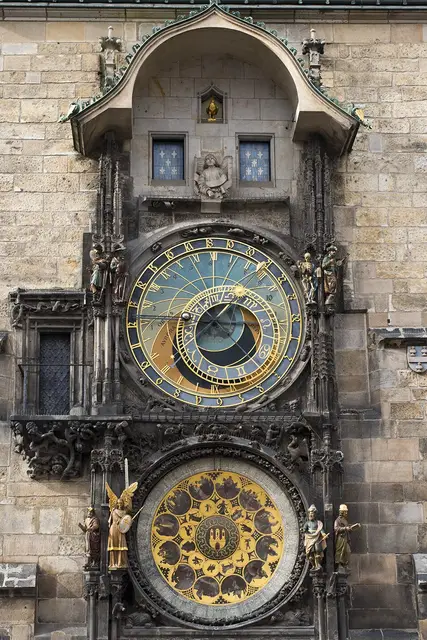 Historic sites01
Prague Astronomical Clock
Staroměstské nám. 1 · Prague● Website● Phone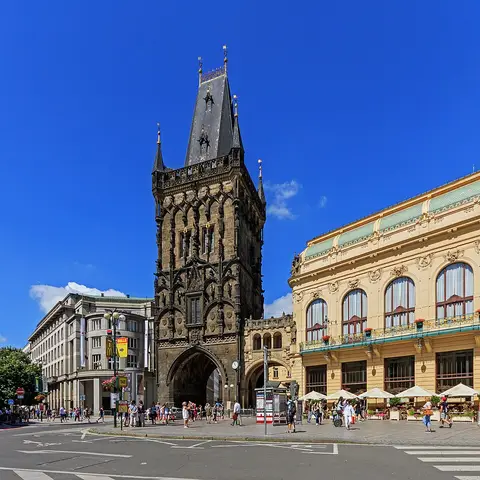 Historic sites02
Prasna brana
náměstí Republiky 1090/5 · Prague● Website● Phone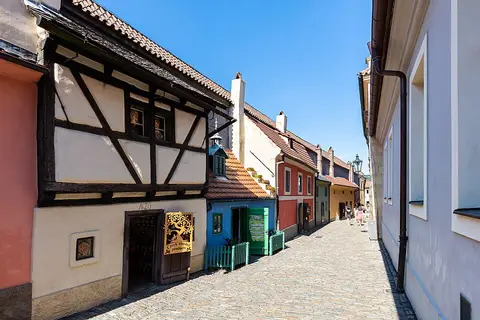 Historic sites03
Golden Lane
Pražský hrad Hrad III, nádvoří · Prague● Website● Phone Monuments04
You need a free account to leave reviews and photos – that keeps comments genuine and lets you edit them later.
The former seat of the King and is now the seat of the Czech president. This is Prague's number one tourist attraction so expect huge crowds and possibly long lines, especially during high tourist season. Your best bet is to come early, as soon as the castle opens. Similar to other royal palaces, there is an hourly changing of the guard ceremony. At noon, the ceremony includes fanfare at a flag ceremony in the first courtyard.
Source: Wikivoyage, „Prague/Castle and Lesser Town“ · authors per page history · CC BY-SA 4.0