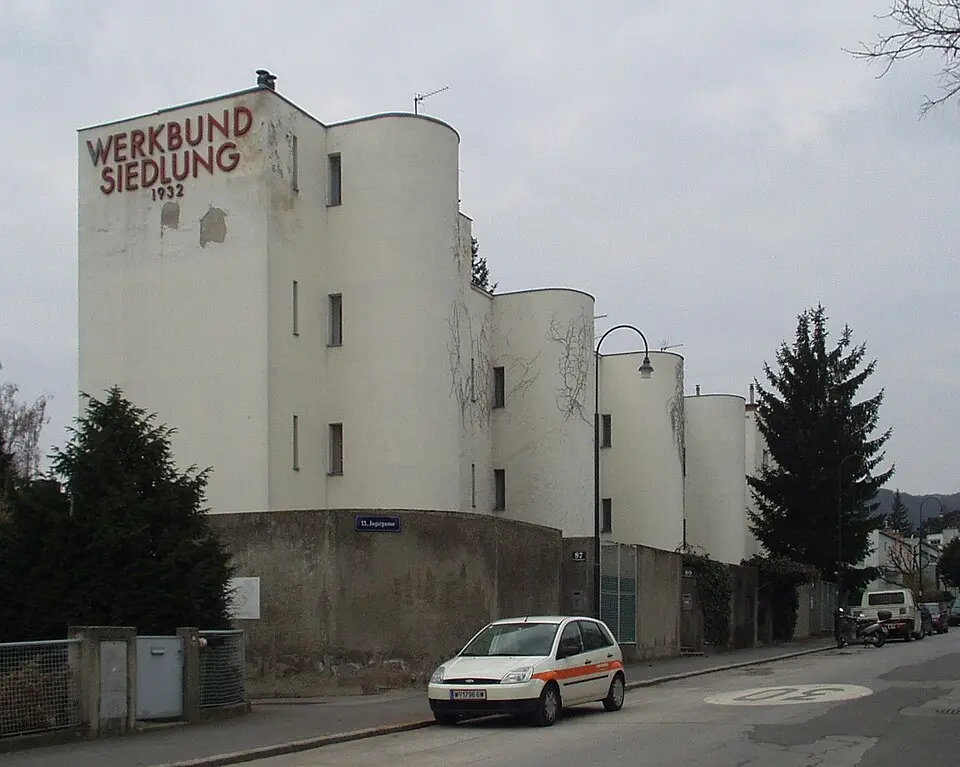
About Werkbundsiedlung
The Werkbundsiedlung in Vienna is a historic model housing estate in the 13th district, Hietzing, specifically in the Lainz neighborhood. It was built between 1930 and 1932 and officially opened on June 4, 1932. The model was the Weissenhof Estate in Stuttgart, built in 1927. The complex was created under the artistic direction of architect Josef Frank, a founding member of the Vienna Werkbund who stood for an undogmatic form of modernism. Frank was responsible for the overall spatial layout, while the painter László Gábor designed the color concept. A total of 31 architects from Austria and abroad worked on the original 70 single-family houses. When it opened, the estate was billed as the largest building exhibition in Europe. The concept emphasized economy in the tightest of spaces. Although the houses seem very small by today's standard apartment sizes, functional details, efficient design, and cleverly placed views give them a surprising sense of spaciousness.
The estate lies on the western edge of what was then the built-up city area, south of the Girzenberg and Roter Berg ridge, an outlier of the Vienna Woods. These hills were largely left undeveloped as a protected area, while the surrounding neighborhood is now mostly built up. The complex is a listed monument and is designated a protected building zone. After the opening, the model houses, furnished as showcases, could be viewed by the public during an international exhibition that drew 100,000 visitors. Because the economic situation was poor at the time, only a few houses could be sold; most were rented out and passed into the ownership of the City of Vienna in 1938. Six houses were destroyed by bombing in World War II and later replaced with new buildings, including one by Roland Rainer.
Today the estate is an important site in architectural history and has been restored several times. In the 1980s, Adolf Krischanitz renovated most of the remaining houses and built a small museum dedicated to the estate. Another comprehensive restoration was completed in 2019. In 2020, the Werkbundsiedlung received the European Heritage Label. You can visit the characteristic single-family houses, which are emblematic of early modernism. The complex shows how renowned architects and manufacturers gave shape to a new way of living. The estate is not only an ensemble of residential buildings but also a document of Vienna's architectural development and of international collaboration in the 20th century.
At a glance
- Category
- Sight › Historic sites
- Rating
- no reviews yet · write a review
- Address
- Veitingergasse 13
1130 Vienna, Austria - Phone
- —
- Website
- www.werkbundsiedlung.at.tf
- —
- Coordinates
- 48.18040° N · 16.26953° E
- Data quality
- confidence 0.89
- Identifier
- ID 678944f2-068…
Location & surroundings
Toggle layersRatings & comments
none yetNear Werkbundsiedlung
closest 5 per category · 2 kmSights
Hotels
Cocktail bars
More:Historic sites in Vienna (518)All sights in Vienna (661)
90 places within 2 km loaded.
You need a free account to leave reviews and photos – that keeps comments genuine and lets you edit them later.
Inspired by the Weißenhofsiedlung in Stuttgart and initiated by architect Josef Frank, the Werkbundsiedlung public estate housing project in the Lainz Municipality of Hietzing was built from 1930 to 1932 by numerous national and international architects of the time (amongst those famous names like Adolf Loos and Gerrit Rietvelt) and has fine examples of Bauhaus style architecture. This public estate housing complex consisted of 76 buildings of which 32 still exist.
Source: Wikivoyage, „Vienna/Hietzing“ · authors per page history · CC BY-SA 4.0