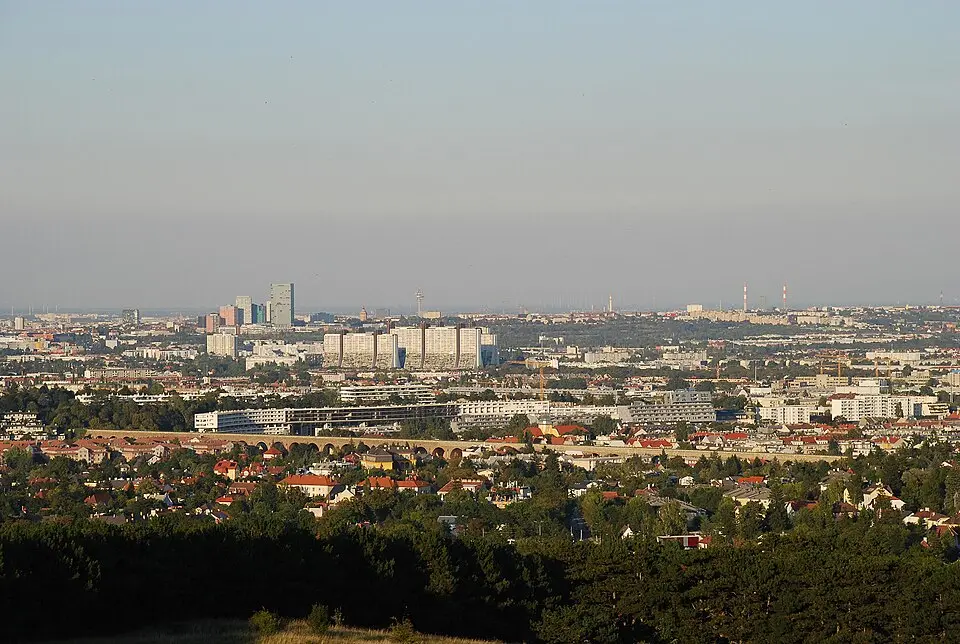
About Liesing
Liesing is Vienna's 23rd district and lies in the southwest of the capital. Covering more than 32 square kilometers (about 12.4 square miles), it is one of the largest districts in Vienna and stretches from the Vienna Woods in the west to the flatter Vienna Basin in the east. The area was established in 1938 as the 25th district, when several previously independent municipalities were merged. After World War II and the reversal of the 1938 territorial changes, the district took its present form in 1954 and became Vienna's 23rd district. The southern boundary is the state border with Lower Austria, while the districts of Hietzing and Meidling lie to the north and Favoriten to the northeast.
The district's landscape is geologically varied and reflects the history of how the Alps were formed. In the southwest, the steep cliffs of the limestone Vienna Woods, part of the Northern Limestone Alps, dominate. Here you'll find heights such as the Leopoldsdorf Forest, which consists of main dolomite. To the north lies the flysch zone, an area of gentle hills made up of stacked layers of sandstone and marl. One particular geological feature is the Antonshöhe, a limestone klippe that was thrust up from the depths and where radiolarite was already being mined for flint blades in the Neolithic period. In the east of the district, the terrain opens out onto the Vienna Basin, which is characterized by gravel, sand, and sandstone.
A defining element of the topography is the Liesingbach, which crosses the district from west to east. The "Reiche Liesing" picks up several tributaries in Kalksburg before joining the "Dürre Liesing" in Rodaun. In recent decades, parts of the heavily built-up stream course have been restored to a natural state in order to bring back its ecological function. Other waterways such as the Knotzenbach and the Petersbach rise on the heights of the Maurer Wald or flow through the eastern parts of the district. The district's highest point is the Eichkogel in the far southwest, while the lowest area lies in the Blumental on the border with Favoriten.
The district is divided into eight former municipalities that survive today as cadastral communities: Inzersdorf, Erlaa, Siebenhirten, Liesing, Atzgersdorf, Mauer, Rodaun, and Kalksburg. Each of these neighborhoods has its own character. Inzersdorf in the east is strongly shaped by industrial zones, while Erlaa is best known for the large Alt-Erlaa residential complex. The neighborhood that gives the district its name, Liesing, is home to the district office building and the municipal district authority. Mauer in the northwest takes in a large part of the Vienna Woods, while Rodaun and Kalksburg in the southwest have a high proportion of green space. This mix of old village centers and modern housing developments shapes the look of the district.
Liesing's history is closely tied to the development of Vienna and the political situation in Austria. Before incorporation, the villages formed a political unit under various feudal lords. In 1938, the district was created as part of the formation of "Greater Vienna." During the Nazi dictatorship, the district's Jewish residents suffered greatly; the synagogue in Atzgersdorf was destroyed during Kristallnacht. Numerous resistance fighters from the communist-oriented working class were murdered, and memorials and street names commemorate them today. After the war, the entire area was under Soviet occupation until 1955, which led to a special administrative situation that ended only with the reversal of the territorial changes in 1954.
In the 1960s, the district experienced strong population growth, which led to the construction of large housing developments between the old villages. Well-known examples include the Alt-Erlaa residential complex and the Maurerberg estate. At the same time, the Liesingbach was channelized, a change that was later partly reversed. Since 1995, Liesing has been connected to the city's transit network by the U6 subway line, which has significantly improved access to the western and southern parts of the city. The district is also an important industrial location, particularly in Inzersdorf, home to major manufacturing plants and the Vienna wholesale market.
Culturally, Liesing offers a wide range of sights. Historic buildings include Liesing Palace, Alterlaa Palace, and Rodaun Palace with the Hofmannsthal Schlössl. The Baroque Bergkirche in Rodaun houses valuable paintings by the artist Michelangelo Unterberger. One of the best-known architectural attractions is the Wotruba Church in Mauer, an impressive structure of cubic forms built to a design by the sculptor Fritz Wotruba. The Protestant Johanneskirche in Art Deco style and the neoclassical parish churches in Atzgersdorf, Inzersdorf, and Kalksburg are also architectural highlights of the district.
For film buffs, the Rosenhügel film studios in Mauer are of great importance. Built between 1919 and 1923, these studios were considered the most modern in Austria at the time and served as a shooting location for numerous classics of Austrian and international cinema, including works by Michael Haneke. The Liesing District Museum, housed in Atzgersdorf, is devoted to folklore, railway history, and the development of the eight old villages. Another cultural highlight is the 1st Vienna Chocolate Museum run by the Heindl company, which documents the history of chocolate making in the region.
The district's green lungs offer a variety of ways to relax. The Maurer Wald is an important recreational area close to the city, with extensive stretches of forest and meadow. Through the Gütenbachtor gate, you can walk straight into the Lainzer Tiergarten in the neighboring district of Hietzing. The Mizzi-Langer-Wand natural climbing wall near the Perchtoldsdorfer Heide is also a popular destination for athletes. In the eastern parts there are several parks, including the Draschepark in Inzersdorf, which was laid out on a former Baroque palace garden, and the Sterngarten on the Georgenberg, which serves as an open-air planetarium.
The district's cemeteries are also worth a visit and offer insight into local history. The Inzersdorf Cemetery is the largest, while the Kalksburg Cemetery lies among the vineyards and contains the grave of the poet Hugo von Hofmannsthal. The Mauer Cemetery is known for its historicist mausoleums. Since 2008, Inzersdorf has also been home to Austria's first Islamic cemetery. These places of remembrance and commemoration are important parts of the district's cultural heritage.
Liesing is a district with a rich history, a varied landscape, and a lively culture. The combination of urban residential areas, industrial sites, and extensive natural spaces makes it a unique part of Vienna. Here you can experience the city's history in its old village centers, admire modern architecture, and enjoy the nature of the Vienna Woods. The district is a place where past and present come together in a special way.
At a glance
- Category
- Sight › Historic sites
- Rating
- no reviews yet · write a review
- Address
- —
Vienna, Austria - Phone
- —
- Website
- www.samsung.com
- —
- Coordinates
- 48.13778° N · 16.28444° E
- Data quality
- confidence 0.82
- Identifier
- ID 7cea9e4c-827…
Location & surroundings
Toggle layersRatings & comments
none yetNear Liesing
closest 5 per category · 2 kmSights
Restaurants
Hotels
Cocktail bars
None within 2 km.
More:Historic sites in Vienna (518)All sights in Vienna (661)
84 places within 2 km loaded.
You need a free account to leave reviews and photos – that keeps comments genuine and lets you edit them later.