About Gasometers of Vienna
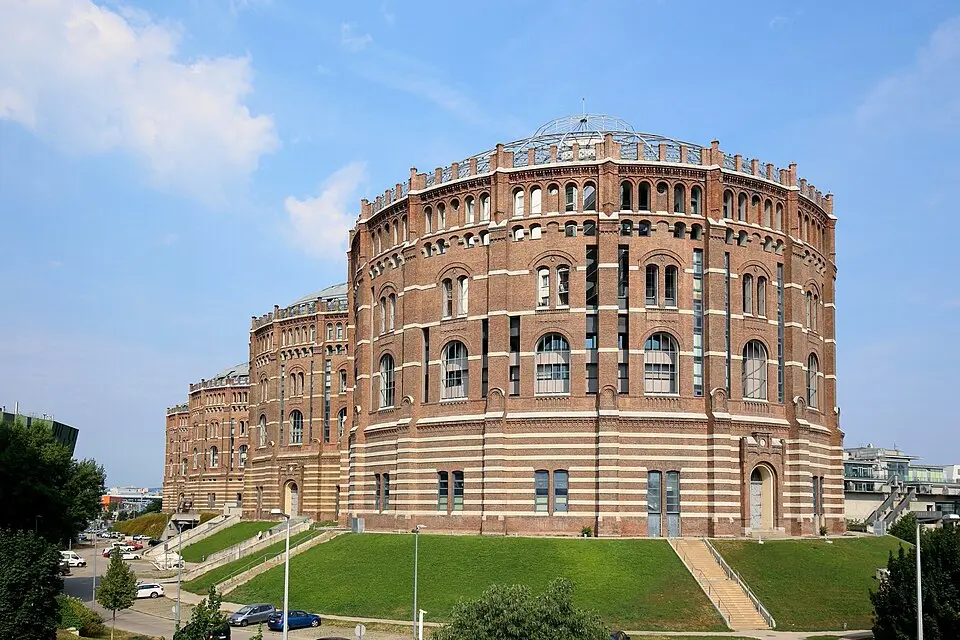
The Gasometers in Vienna's Simmering district are four imposing former gas holders that have been landmarks of the 11th district since they were built in 1896. Thanks to their enormous size, they were visible from far away and shaped the city skyline for a long time. Originally, they served as low-pressure storage tanks for town gas produced from coal, helping to balance fluctuations in supply across Vienna's gas network. The accompanying Simmering gasworks was, along with the Leopoldau gasworks, one of only two municipal gasworks around the turn of the century, and when it was built it was considered the largest of its kind in all of Europe. After gas production ceased in 1975 and the brick holders were placed under historic preservation protection in 1978, people began to consider a new use for them, which eventually led to a comprehensive revitalization project.
The historical significance of the site goes back to the time before municipal gas supply, when the Imperial Continental Gas Association supplied the city. After its contracts expired, Vienna decided to build its own plants. The Gasometers were constructed between 1896 and 1899 on the so-called Bürgerspitalsgrund, where market gardens and fields had previously stood. The official opening took place on October 31, 1899, and from that moment the new plant lit the lamps along the Ringstrasse for the first time. The four surviving cylindrical bell-type gas holders stood in water basins and were surrounded by a distinctive brick facade. They measure around 70 meters (230 feet) in height and roughly 60 meters (200 feet) in diameter, and each holder had a gas capacity of 90,000 cubic meters. A fifth, larger telescopic gas holder was added later but was demolished in 1981.
During World War II, the gasworks was repeatedly targeted by Allied bombing raids because of its strategic importance, and suffered heavy damage. After the Red Army occupied the site in April 1945 and operations were laboriously restored over the following years, gas supply in Vienna changed fundamentally. The switch from toxic town gas to natural gas in the 1970s made the large above-ground storage tanks obsolete, since natural gas can be stored more efficiently in underground reservoirs or smaller high-pressure containers. The old Gasometers were therefore decommissioned in 1966, and the history of gas production at the Simmering site finally came to an end in the late 1980s.
In the years after decommissioning, the huge, empty domed spaces served a variety of cultural and commercial purposes. Exhibitions were held here, including an anniversary exhibition of the Social Democratic Party, and the special acoustics of the cylindrical spaces made the Gasometers a popular venue for rave and techno events. This phase gave rise to the name "Gazometer" and made the site widely known in the music scene. Well-known artists such as Falco used the interiors and exteriors for music videos, and scenes for a James Bond film were also shot here. This use served as a bridge to the later comprehensive transformation.
The concept for the new use was developed through competitions and ultimately realized as a mixed-use development combining housing, offices, and entertainment. Four renowned architects, Jean Nouvel, Coop Himmelb(l)au, Manfred Wehdorn, and Wilhelm Holzbauer, each designed one of the four Gasometers individually. The conversion, carried out from 1999 to 2001, removed the technical innards, leaving only the historic exterior brick wall and the roof structure. Today the four buildings have a distinctive village-like character and are home to around 1,500 residents, who have developed into a lively residential community.
Gasometer A was designed by Jean Nouvel and contains around 120 apartments that curve in a ring along the shell wall. The apartments begin at a height of about 25 meters (80 feet) and are characterized by glass fronts and mirrored walls that let plenty of sunlight into the rooms. Gaps run between the residential blocks, making the historic facade with its tall windows visible. The lower levels house office floors and shops, while the subway station is located directly in front of the main entrance.
Gasometer B, designed by Coop Himmelb(l)au, is recognizable by a striking shield-shaped, 18-story addition. It contains a total of 254 apartments that hug the walls in an unbroken circle, leaving a light well in the center. A special feature is the large event hall with a capacity of 4,200 people, which fills an important gap in Vienna's event market. The lower part of the residential area also holds a student residence with 247 places, operated by the GPA, which offers numerous common areas such as fitness rooms and rehearsal rooms.
Gasometer C was redesigned by Manfred Wehdorn, who aimed for simplicity and maximum living comfort. The 92 apartments are spread over six floors and stepped back toward the top, which ensures better sunlight for the lower levels. A central design element is the inner courtyard with a large glass dome that brings sunlight to the shopping center below. A wide green strip with trees runs around the dome, realizing the concept of an arboretum and creating terraces and arcaded walkways.
Gasometer D, designed by Wilhelm Holzbauer, is the only Gasometer without a central inner courtyard. Instead, it features a residential tower in the basic shape of a circle with three rectangular arms, between which lie green spaces. This shape is meant to prevent residents from looking into each other's apartments. All 119 apartments have a small green area or a loggia. The lower part of the building houses the premises of the Vienna City and State Archives.
Today the entire complex is known as "Music City" and has moved away from the original concept of a large shopping center. After many shops closed, the focus shifted to music and culture. Gasometer B now houses the Electronic Music Academy and the Pop-Akademie Wien, while dance and music studios opened in Gasometer C. Gasometer D is home to a large music store. Despite initial difficulties in marketing the retail space, the site has developed into a lively center for living, culture, and music that attracts locals and tourists alike. Today the Gasometers stand as a symbol of the successful revitalization of industrial landmarks in Vienna.
At a glance
- Category
- Sight › Historic sites
- Rating
- no reviews yet · write a review
- Address
- Guglgasse 6
1110 Vienna, Austria - District
- Simmering
- Phone
- +4317436430
- Website
- www.wiener-gasometer.at
- office@wiener-gasometer.at
- Coordinates
- 48.18504° N · 16.42014° E
- Data quality
- confidence 0.79
- Identifier
- ID dc9b1011-b23…
Location & surroundings
Toggle layersRatings & comments
none yetNear Gasometers of Vienna
closest 5 per category · 2 kmSights
Restaurants
Museums
Hotels
More:Historic sites in Vienna (518)All sights in Vienna (661)
125 places within 2 km loaded.
You need a free account to leave reviews and photos – that keeps comments genuine and lets you edit them later.