About Gartenpalais Liechtenstein
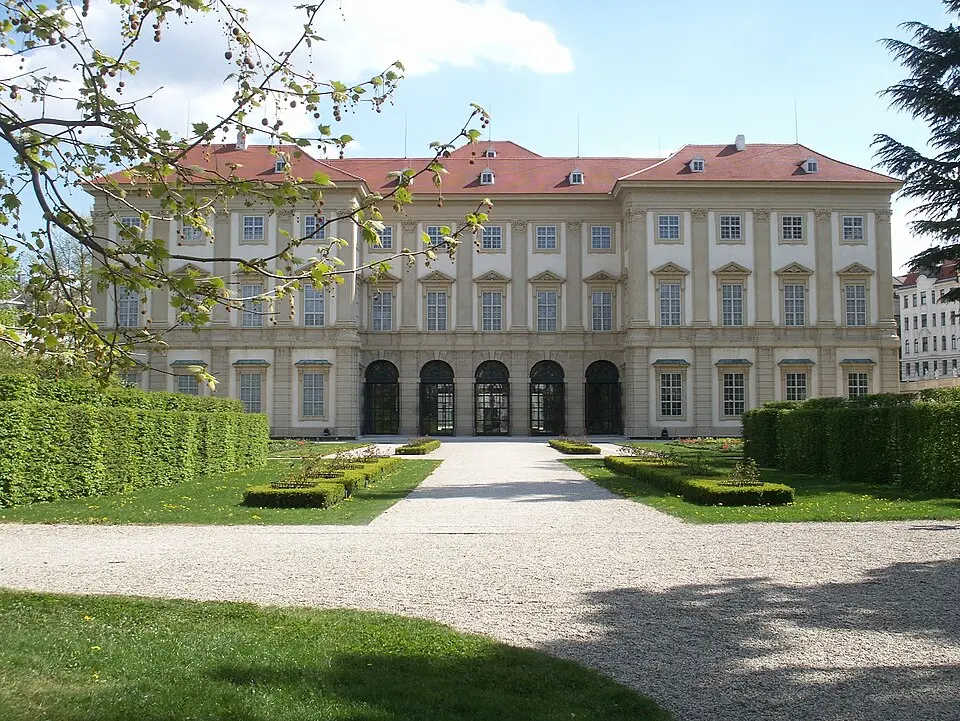
The Garden Palace Liechtenstein in Vienna's Alsergrund district is a magnificent example of Baroque architecture, located on Fürstengasse in the ninth district. Its origins go back to 1687, when Prince Johann Adam Andreas of Liechtenstein acquired a garden plot. In 1688, a competition was announced for the construction of the palace. The young Johann Bernhard Fischer von Erlach took part, but his design was rejected. The commission went first to Domenico Egidio Rossi and later to Domenico Martinelli. The building was conceived as a hybrid of town house and country house in the Roman style, with a clear, blocklike structure and an emphasized central projection, which suited the conservative taste of the patron. The facade and interior are richly decorated; the staircases are made of marble monoliths, and the door frames are crafted from white Salzburg marble.
The palace's artistic furnishings are of exceptional quality. On the ground floor you'll find frescoes by Johann Michael Rottmayr, while the ceiling paintings on the second floor (the first floor in European usage) are the work of Italian masters such as Andrea Pozzo and Antonio Bellucci. Among other works, Pozzo created the ceiling painting in the so-called Hercules Hall. The stucco work was carried out by Santino Bussi, who also decorated the vaults of the hall and the salons. The adjoining park was originally laid out as a classic Baroque garden and was later redesigned in the Neoclassical style in the 19th century. Today the grounds extend between the main building and the so-called Alserbach Palace, which originally served as a belvedere and was later replaced by a new building designed by Heinrich Ferstel.
After a long history as the home of the princely art collection and as the site of various museums, including the Museum of Modern Art, the palace housed the Liechtenstein Museum until the end of 2011. Because of declining visitor numbers, regular museum operations were discontinued. Since the beginning of 2012, the building has served primarily as an event venue. Part of the prince's private art collection is still housed in the gallery rooms, but it is shown only on special occasions or to groups that have registered in advance. Today, the forecourt area contains the administrative offices as well as a court winery, where wines and specialty products are sold.
At a glance
- Category
- Sight › Palaces
- Rating
- no reviews yet · write a review
- Address
- Fürstengasse 1
1090 Vienna, Austria - District
- Katastralgemeinde Alsergrund
- Phone
- +43131957670
- Website
- www.palaisliechtenstein.com
- office@palaisliechtenstein.com
- Coordinates
- 48.22236° N · 16.35974° E
- Data quality
- confidence 1.00
- Identifier
- ID 04bd2827-5e9…
Location & surroundings
Toggle layersFAQ about Gartenpalais Liechtenstein
quick answersWhat is the Liechtenstein Garden Palace in Vienna?
The Liechtenstein Garden Palace is a Baroque palace at Fürstengasse 1 in Vienna's Alsergrund, the ninth district. Its history begins in 1687, when Prince Johann Adam Andreas von Liechtenstein acquired a garden plot there. The building is designed as a hybrid of a town house and a country house in the Roman style, with a clear, block-like structure and an emphasized central projection.
Who built and furnished the Liechtenstein Garden Palace in Vienna?
The Liechtenstein Garden Palace was first built by Domenico Egidio Rossi and later by Domenico Martinelli. In the 1688 competition, the young Johann Bernhard Fischer von Erlach also submitted a design, but it was rejected. The frescoes on the ground floor are by Johann Michael Rottmayr, and the ceiling paintings on the first floor are by Andrea Pozzo and Antonio Bellucci, including Pozzo's ceiling painting in the Hercules Hall. The stucco work was carried out by Santino Bussi, and staircases made of marble monoliths and door frames of white Salzburg marble round out the interior.
Can you visit the Liechtenstein Garden Palace in Vienna today?
Regular museum visits are no longer offered at the Liechtenstein Garden Palace, as the Liechtenstein Museum there closed at the end of 2011 due to declining visitor numbers. Since the beginning of 2012, the palace in Vienna's Alsergrund has served primarily as an event venue. Part of the prince's private art collection still hangs in the gallery rooms, but it is only shown on special occasions or to groups that have registered in advance. In the forecourt area, there is a court cellar offering wines and specialty products.
What is known about the park of the Liechtenstein Garden Palace?
The park of the Liechtenstein Garden Palace in Vienna was originally laid out as a classic Baroque garden and redesigned in the Neoclassical style in the 19th century. It stretches between the main building and the so-called Alserbach Palace. The latter originally served as a belvedere and was later replaced by a new building by Heinrich Ferstel.
What can you see around the Liechtenstein Garden Palace in Vienna?
Around the Liechtenstein Garden Palace in Vienna's Alsergrund, several sights and museums are within walking distance. travelguide195 lists, among others, the Strudlhofstiege about 150 m away, the Schubert Fountain and the Palais Clam-Gallas about 330 m away each, and the Museum of the Johann Strauss Dynasty about 350 m away. A little farther, about 400 m away, you'll find the Endoscopy Museum, the Alsergrund District Museum, and the Thury-Hof. For a break, travelguide195 lists around 86 restaurants within 500 m.
Ratings & comments
none yetNear Gartenpalais Liechtenstein
closest 5 per category · 2 kmSights
Restaurants
Museums
Hotels
More:Palaces in Vienna (48)Sights in Katastralgemeinde Alsergrund (22)All sights in Vienna (661)
296 places within 2 km loaded.
You need a free account to leave reviews and photos – that keeps comments genuine and lets you edit them later.