About Naturhistorisches Museum
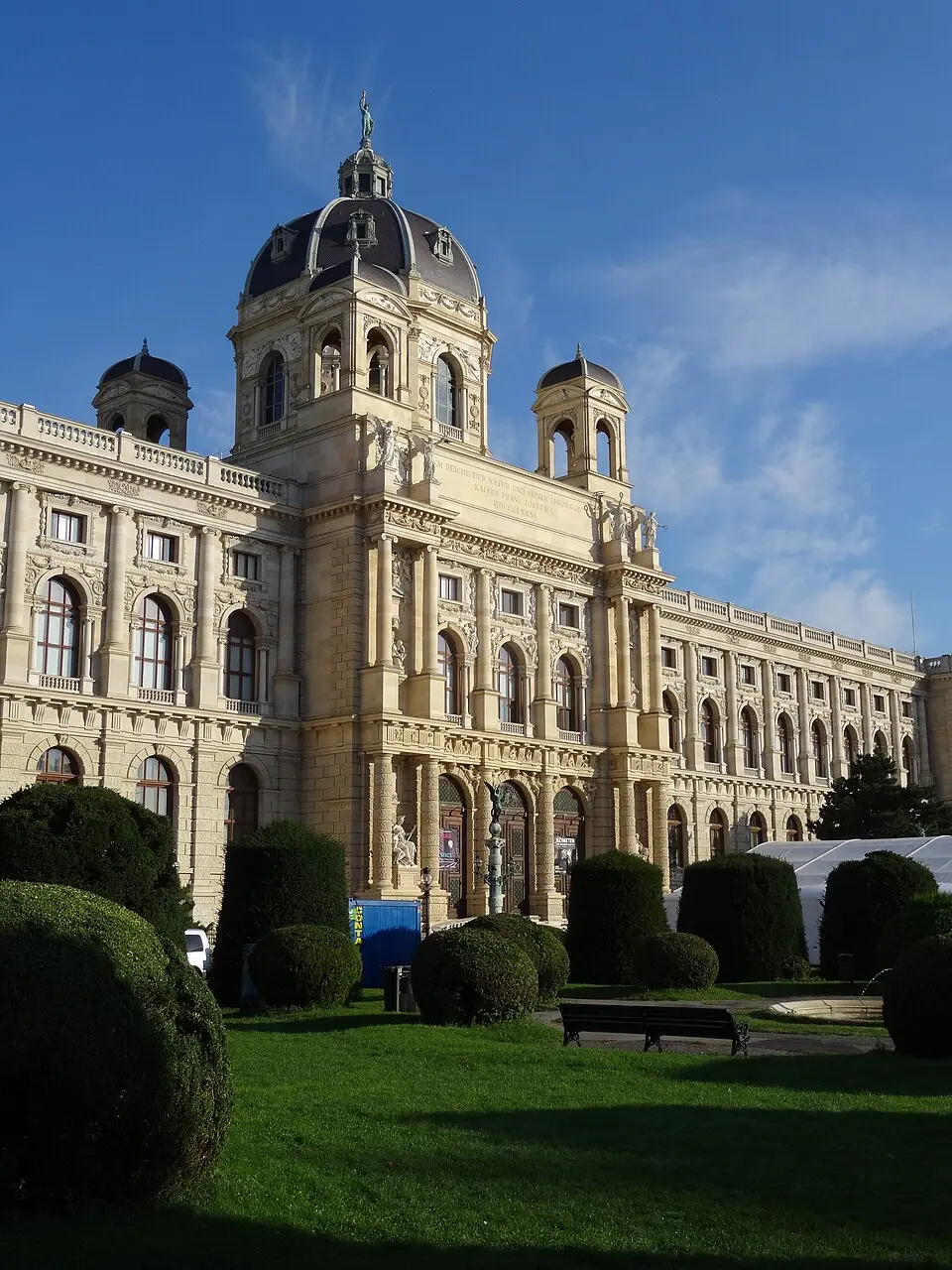
The Natural History Museum Vienna, or NHM for short, is one of the most important institutions of its kind in the world and stands on Maria-Theresien-Platz in the Austrian capital. One of the largest museums in Austria, it draws more than a million visitors a year who come to learn about the history of nature and the development of life. The roots of the museum go back to the 18th century, when Emperor Francis I Stephen of Lorraine, the husband of Maria Theresa, acquired an enormous collection of natural specimens. These holdings, which consisted of rare snails, corals, shells, as well as precious gemstones and minerals, formed the core of the later collection and were already being organized by scientific criteria at the time.
When the rooms in the Hofburg were finally no longer big enough to house the growing collection, a new building was planned as part of the construction of Vienna's Ringstrasse. In 1871, Emperor Franz Joseph I commissioned the architects Gottfried Semper and Carl von Hasenauer to build it, conceived as part of a planned Imperial Forum. The building opened with great ceremony in 1889 and housed the imperial collections, which were classified as state property at the time. After the end of the monarchy in 1918, the young Republic of Austria took over responsibility for the museum, which from 1920 was a federal museum under the supervision of the Ministry of Education.
The architecture of the building is a masterpiece of Neo-Renaissance style and extends between the Zweierlinie and the Burgring. The richly decorated facade symbolizes the historical development of our understanding of nature. Above the entrance rises a tall dome crowned by a bronze statue of the Greek sun god Helios, a symbol of the life-giving element in nature. Statues of the ancient elements stand at the corners of the attic, while the pediments show allegorical figures. Inside, the magnificent staircase is impressive, and the walls of the exhibition rooms are adorned with more than a hundred oil paintings depicting scenes from the world of science.
A central part of the museum is the Geology and Paleontology Department, which documents the history of the Earth and of life in impressive fashion. In the Paleozoic hall, you can marvel at a reconstructed Carboniferous forest featuring life-size models of animals such as giant dragonflies. The famous Dinosaur Hall presents skeleton reconstructions of large dinosaurs such as Allosaurus, Diplodocus, and Iguanodon. The exhibition is complemented by lifelike models, computer animations, and interactive stations that illustrate the lives of these prehistoric giants and their abrupt demise in an asteroid impact. Another highlight is the skeleton of a Prodeinotherium, a distant relative of today's elephants, on display in the Cenozoic department.
The Mineralogy and Petrography Department houses one of the oldest and largest meteorite collections in the world, with origins dating back to 1778. About 1,100 individual specimens are on display in the Meteorite Hall, including significant finds such as the Canyon Diablo meteorite, which created Barringer Crater in Arizona, and the Knyahinya meteorite, long considered the largest known stony meteorite. Particularly noteworthy is the collection of lunar rock, which since 1973 has included a fragment from the Apollo 17 mission. The NHM is also the only institution outside the United States to display three Apollo samples as a long-term loan from NASA, which gives it a unique international standing.
Another highlight of the mineral collection is an extraordinary bouquet of gemstones that Maria Theresa is said to have given to her husband. The bouquet consists of more than 2,100 diamonds and hundreds of other gemstones arranged into flowers and animals. The mineral collection itself is of international importance, as it contains many objects from deposits in the former territory of the Austro-Hungarian Monarchy and the Alpine region. The oldest mineral specimens can be traced back to the Renaissance cabinets of curiosities, underscoring the long tradition of natural science collecting in Vienna.
The Anthropology Department is devoted to the evolution of hominids and the origins of humankind. After the former Hall of Races was closed in 1996, the exhibition was completely redesigned and reopened in 2013. It presents human evolution not as a linear process but as a "family bush" that reflects the complexity and fragmentary nature of the fossil evidence. You can see fossils and soft-tissue reconstructions of Homo erectus, Neanderthals, and Homo sapiens, while the exhibition also highlights cultural development as an essential part of becoming human.
The zoology departments include one of the largest vertebrate collections in the world, with more than 800,000 specimens, among them fish, birds, and mammals. The entomology department, which deals with insects, holds an estimated ten million items, many of them historic type material from Austria and Europe. In the exhibition area, you can see large models of beetles such as the Hercules beetle and the stag beetle. In summer, you can also observe a living bee colony, which offers a direct look into the way these insects live. The invertebrate department shows, among other things, a display case of stony corals and the giant clam, about whose dangerous gripping force old rumors still circulate.
The Prehistory Department houses one of the largest archaeological collections in Europe, spanning the Paleolithic through the Migration Period. The best-known exhibit is probably the Venus of Willendorf, a figure about 29,500 years old, displayed in Hall 11. Other valuable finds from the Bronze and Iron Ages round out the picture of early human history. The historic Hallstatt salt mine also belongs to this department; thanks to the preserving effect of salt, numerous finds from before the Christian era have been recovered there.
Besides the classic permanent exhibitions, the museum also offers education and research programs. The Ecology and Environmental Education department organizes excursions and school projects, often in cooperation with the Petronell-Carnuntum National Park Institute. There you will find a model house built on building-biology principles, which demonstrates alternative energy methods such as solar technology and cork insulation. The museum is also actively involved in citizen science, where visitors can help search for kestrel nesting sites or document caves.
The Natural History Museum Vienna is therefore far more than a place for preserving old collections. It is a living center of science that draws visitors from around the world with its unique architecture, its extensive holdings, and its modern educational offerings. The combination of historical significance and current research makes it an indispensable part of the cultural heritage of Vienna and the world.
At a glance
- Category
- Museum › History museums
- Rating
- no reviews yet · write a review
- Address
- Burgring 7
1010 Vienna, Austria - District
- Innere Stadt
- Phone
- +431521770
- Website
- www.nhm-wien.ac.at
- info@nhm-wien.ac.at
- Coordinates
- 48.20574° N · 16.36054° E
- Data quality
- confidence 0.93
- Identifier
- ID a7e31c95-e85…
Location & surroundings
Toggle layersRatings & comments
none yetNear Naturhistorisches Museum
closest 5 per category · 2 kmSights
Restaurants
Museums
Hotels
More:History museums in Vienna (57)Museums in Innere Stadt (86)All museums in Vienna (308)
300 places within 2 km loaded.
You need a free account to leave reviews and photos – that keeps comments genuine and lets you edit them later.
This museum was erected as a mirror to its twin museum, the Museum of Fine Arts. It exhibits various minerals, meteorites, fossils, stuffed animals, and skeleton reconstructions of dinosaurs and other. It also includes an anthropological section, where you can see the beautiful Venus of Willendorf which is 25,000 years old. Most signs and explanations in the museum are only in German, and you will likely receive little sympathy for this from museum staff. Expect museum guards to rush you out at least 15 minutes before closing time.
Source: Wikivoyage, „Vienna/Innere Stadt“ · authors per page history · CC BY-SA 4.0