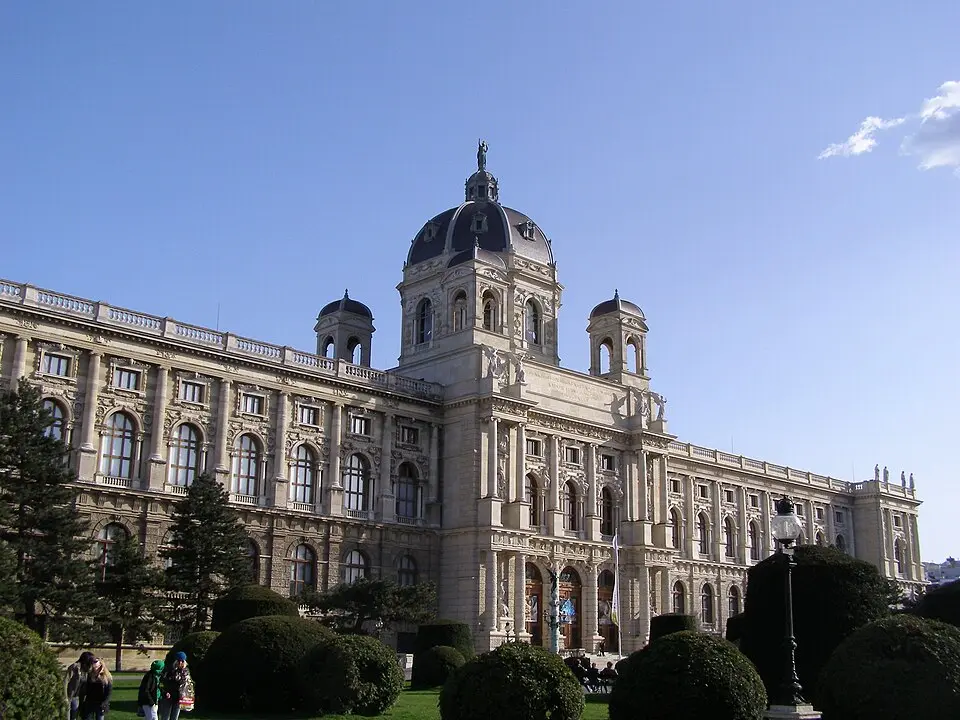
About Kunsthistorisches Museum Wien
The Kunsthistorisches Museum Vienna, often abbreviated as KHM, is one of the world's most important cultural institutions. It stands on Maria-Theresien-Platz in the Austrian capital and ranks among the largest museums anywhere. The building is an outstanding example of Neo-Renaissance architecture and was constructed between 1871 and 1891. Emperor Franz Joseph I commissioned the architects Gottfried Semper and Carl von Hasenauer to design it as part of the planned Imperial Forum. Together with the Natural History Museum opposite, the two buildings enclose the square, where the monument to Maria Theresa stands. This ensemble is part of the Historic Centre of Vienna World Heritage Site and is one of the most important large-scale Historicist buildings of the Ringstrasse era.
The museum's roots lie in the collections of the Habsburg dynasty. Particularly noteworthy are Ferdinand of Tyrol's collection of portraits and armor, the famous collection of Emperor Rudolf II, and the painting collection of Archduke Leopold Wilhelm. As early as 1833, the curator Joseph von Arneth called for all imperial collections to be brought together in a single building. The final impetus for construction came from Emperor Franz Joseph I, who, as part of the city's expansion after the demolition of the city walls, planned new prestigious buildings along the Ringstrasse. After an architectural competition in 1867, in which the site beyond the Ringstrasse was chosen, Semper and Hasenauer received the commission. Semper died in 1879, after which Hasenauer took over management of the construction alone. Building began on November 27, 1871, without much fanfare and was completed after a long construction period.
The building's architecture is richly decorated, and its sculptures tell the story of the arts. The facades are adorned with an extensive program of statues and reliefs created by artists such as Edmund Hellmer, Carl Kundmann, and Viktor Tilgner. On the attic story stand statues depicting important figures in art history. Two seated allegorical figures flank the entrance, representing painting and sculpture. Atop the dome stands a bronze statue of Pallas Athena, goddess of the arts and sciences, created by Johannes Benk. Inside the museum, too, visitors will find artful details, such as in the staircase hall, which is decorated with works by Gustav Klimt, Franz Matsch, and other painters of the era. The original lighting concept used double-glazed ceilings to capture natural daylight and avoid artificial gas lighting.
The official opening of the Imperial-Royal Kunsthistorisches Museum took place on October 17, 1891, presided over by Emperor Franz Joseph I, and it was open to the public from October 22 of the same year. Some collections, such as the arms collection and the library, had already opened earlier. Bringing together holdings from various imperial residences such as the Belvedere, the Hofburg, and Ambras Castle took another two years. Originally, the museum was organized into seven collections under three directorates, including the Egyptian Collection, the Collection of Antiquities, and the Picture Gallery. Over time the collection grew so large that the available space was no longer sufficient, leading to temporary exhibitions in other buildings such as the Theseus Temple in the Volksgarten.
After the end of World War I and the fall of the monarchy, the museum was placed under the protection of the young Republic of German-Austria in 1918. The transition went smoothly within the museum itself, but the following years were marked by diplomatic disputes. Successor states of the Habsburg Monarchy, as well as Italy and Belgium, laid claim to parts of Austria's art holdings. Especially dramatic was the incident in February 1919, when armed Italian units forcibly seized 62 paintings, an event that went down in history as the "art robbery." Through the Treaty of Saint-Germain, most of these claims were fended off, although Hungary prevailed in some cases after lengthy negotiations. In 1919 the House of Habsburg-Lorraine was dispossessed, and the collections passed into the ownership of the republic. The museum was subsequently renamed the "Kunsthistorisches Staatsmuseum Wien" and later the present-day Kunsthistorisches Museum.
The Nazi era brought dark chapters for the museum. After Austria's annexation into the German Reich, Jewish art collections, including those of the Rothschild family, were forcibly "Aryanized" and incorporated into the museums. This led to a considerable but unlawful increase in holdings. After World War II, returning these works to the heirs was a long and difficult process. Not until the 1990s, under international pressure and with the introduction of the Art Restitution Act of 1998, were most of the looted artworks, especially those of the Rothschild family, returned. Since then, the museum has carried out extensive provenance research to clarify the origins of its objects and continue coming to terms with the Nazi period.
Today the Kunsthistorisches Museum is a scientific institution under public law and Austria's largest museum research facility. Since 1999 it has had full legal capacity, the first federal museum to do so. The institution includes not only the main building on Maria-Theresien-Platz but also several affiliated collections at other locations. These include the Ephesus Museum, the Collection of Historic Musical Instruments, and the Hunting and Armory Collection in the Neue Burg, the Imperial Treasury in the Hofburg, the Austrian Theater Museum in Palais Lobkowitz, the Weltmuseum Wien, and the Imperial Carriage Museum at Schönbrunn Palace. There is also a branch at Ambras Castle in Innsbruck. This network offers a comprehensive look at the cultural history of the Habsburgs and beyond.
The KHM's collections are known worldwide for their quality and diversity. The Picture Gallery holds masterpieces by artists such as Jan van Eyck, Albrecht Dürer, Titian, Caravaggio, Rubens, and Jan Vermeer. Particularly noteworthy is the extensive collection of Pieter Bruegel the Elder, which, at twelve paintings, is the largest in the world. Well-known works include "Children's Games" and "The Tower of Babel." The Kunstkammer houses Benvenuto Cellini's famous Saliera, a jewel of the Renaissance that was stolen in 2003 and recovered in 2006. The Egyptian and Near Eastern Collection displays important finds such as the offering chamber of the mastaba of Kaninisut, while the Collection of Greek and Roman Antiquities features the Gemma Augustea and the Nagyszentmiklós Treasure. The Coin Cabinet and the Hunting and Armory Collection round out the offerings with historic coins, medals, and weapons, including Skanderbeg's helmet and the armor of Emperor Charles V.
The museum sees itself not only as a repository but also as a center for research and education. It operates a scientific laboratory for analytical methods and has an archive and a museum library that contribute to provenance research and documentation. Interdisciplinary collaboration is a core strength, reflected in various research projects in art history, Egyptology, archaeology, and numismatics. This scholarly work feeds directly into how the museum engages visitors, for example through interactive offerings such as X-ray images of paintings. With around 1.95 million visitors in 2024, the Kunsthistorisches Museum remains one of Vienna's most visited attractions and an indispensable destination for art lovers and history buffs. It combines the historic splendor of the Habsburg era with modern museum practice and offers an impressive look at the art and cultural history of humankind.
At a glance
- Category
- Museum › Art museums
- Rating
- no reviews yet · write a review
- Address
- Burgring 5
1010 Vienna, Austria - District
- Innere Stadt
- Phone
- +431525240
- Website
- www.khm.at
- info@khm.at
- Coordinates
- 48.20381° N · 16.36178° E
- Data quality
- confidence 1.00
- Identifier
- ID b2111c70-cf8…
Part of the tour
Vienna in a Day: Cathedral, Hofburg and Ringstrasse →Location & surroundings
Toggle layersRatings & comments
none yetNear Kunsthistorisches Museum Wien
closest 5 per category · 2 kmSights
Restaurants
Museums
Hotels
More:Art museums in Vienna (52)Museums in Innere Stadt (86)All museums in Vienna (308)
300 places within 2 km loaded.
You need a free account to leave reviews and photos – that keeps comments genuine and lets you edit them later.
One of the world's greatest art museums and in a palace that is a work of art itself. Serious art fans may wish to devote more than a day to its treasures. There is no other word to describe the Kunst other than mind-boggling. It contains a world-class exhibit of the Habsburgs' art collection, including Raphael, Titian, Caravaggio, Bosch, and Brueghel. The museum has an excellent collection of ancient Egyptian, Greek, and Roman art. The coin & medals collection is also exhaustive in its scope. The museum cafe is a bit pricey, but good, and in a beautiful setting. Hand-held photography is permitted.
Source: Wikivoyage, „Vienna/Innere Stadt“ · authors per page history · CC BY-SA 4.0