Ninh Bình: Karst Mountains, Rice Paddies and an Ancient Royal Capital
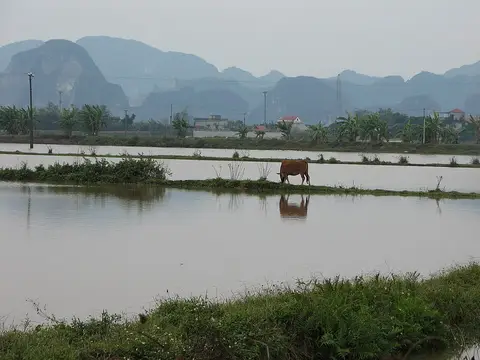
Travel guide · editorialA vacation in Ninh Bình means gliding by rowboat through caves and past rice paddies, with sheer limestone cliffs rising above them – often described as "Halong Bay on land." Since the merger with Hà Nam and Nam Định in 2025, the province also takes in textile towns, temples of the Trần kings and a coastline with bird sanctuaries.
Location and Landscape
The province lies about 56 miles (90 km) south of Hanoi on the southern edge of the Red River Delta. To the west, karst mountains rise up, stretching from the highlands of Hòa Bình all the way to the delta; in between lie flooded valleys, rivers and caves. To the east, the flat plain around Nam Định opens up and extends to the Gulf of Tonkin. To the north, the former province of Hà Nam, with Phủ Lý, adjoins it. The administrative seat is Hoa Lư, the name given since the reform to the area around the old town of Ninh Bình.
Sights in Ninh Bình
The Tràng An landscape complex has been a UNESCO World Heritage Site since 2014, the only mixed natural and cultural site in Vietnam. Rowers, often women from the surrounding villages, steer boats through water caves and past small temples; sets for the film "Kong: Skull Island" were built in a side valley. The boat tour at Tam Cốc is similar but smaller, and is at its most beautiful during the rice harvest in May and June. In the 10th and 11th centuries, Hoa Lư was the first capital of independent Vietnam, and the temples of the Đinh and Lê kings recall that era. From the Hang Múa viewpoint, reached by more than 500 steps, you can take in the whole landscape. The Bái Đính pagoda complex is considered the largest in the country, with bronze Buddhas and long galleries of arhat statues. Cúc Phương National Park, Vietnam's oldest, is home to primary forest, and a rescue center nurses endangered primates back to health. Near Kim Sơn stands Phát Diệm Cathedral, built in the late 19th century, a church of stone and wood in the style of a pagoda.
Nam Định and Hà Nam
Nam Định was the ancestral home of the Trần dynasty, which repelled the Mongols in the 13th century. At the Đền Trần temple festival at New Year, worshippers crowd around the seals said to bring good luck for the year. The city is also known for its colonial-era textile factories. In Xuân Thủy National Park at the mouth of the Red River, migratory birds rest in winter, including the spoon-billed sandpiper. In the former Hà Nam, the huge Tam Chúc pagoda sits on a lake among karst mountains.
Food and Drink
Ninh Bình is known for goat meat, dê núi, which is served grilled, steamed or as a salad with herbs, and for cơm cháy, crispy rice crust with meat sauce. Alongside Hanoi, Nam Định is considered the home of phở, and many of the capital's cooks come from this area. Bánh cuốn, steamed rice rolls, and mung bean cakes belong on every breakfast table.
Getting There and Best Time to Visit
Buses and trains from Hanoi reach Ninh Bình in about two hours, and many visitors come as day-trippers. If you stay, you can overnight in homestays in Tam Cốc and explore the area by bike. The best times to visit are late May to early June, when the rice turns golden yellow, and September through November. Winter is often overcast, and midsummer is hot with frequent thunderstorms.