Discover Hoa Lư: Karst Mountains and an Ancient Capital
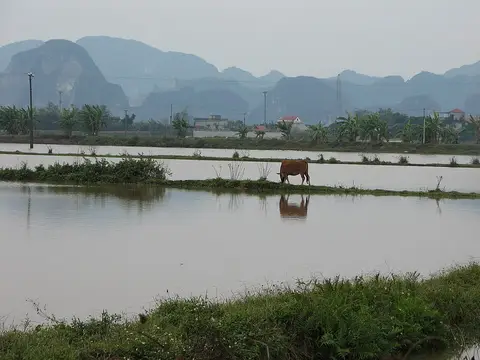
Travel guide · editorialLimestone peaks rise straight up from the rice paddies, and women row boats with their feet through caves: Hoa Lư, the center of the city of Ninh Bình, is the gateway to one of Vietnam's most impressive landscapes. A trip to Hoa Lư combines the country's first capital with boat rides through Tràng An and Tam Cốc.
Vietnam's First Capital
In 968, Đinh Bộ Lĩnh founded the capital of the independent Đại Việt here. The karst mountains provided natural protection, and walls linked the cliffs into a fortress. Until 1010, when Lý Thái Tổ moved the capital to Thăng Long, present-day Hanoi, the Đinh dynasty and the early Lê dynasty ruled from here. In 2014, UNESCO designated the Tràng An Landscape Complex, which includes the ancient capital, a World Heritage Site – one of the few mixed natural and cultural World Heritage Sites in Southeast Asia. With the 2025 administrative reform, the former city of Ninh Bình became Hoa Lư Ward, and Ninh Bình Province was merged with Hà Nam and Nam Định.
Sights in Hoa Lư
The ancient capital is home to the temples of Kings Đinh Tiên Hoàng and Lê Đại Hành, 17th-century wooden buildings on the site of the former palaces, with stone dragon carvings and quiet courtyards. At Tràng An, rowboats glide for about two to three hours through caves, under rock arches, and past temples on small islands. In Tam Cốc, the boat trip on the Ngô Đồng River passes through three caves and rice paddies that glow golden yellow in May and June. For a view from above, climb the roughly 500 steps to the Hang Múa viewpoint, where a stone dragon figure lies at the summit. The Bái Đính Pagoda, one of Vietnam's largest Buddhist complexes, impresses with long galleries lined with arhat statues and an enormous bronze bell.
Nature and Excursions
Herons and storks nest in the Thung Nham Bird Park and the Vân Long Nature Reserve, where rare Delacour's langurs also live on the cliff faces. The paths between Tam Cốc, Bích Động Pagoda, and the villages are easy to explore by bicycle. About 45 kilometers to the west lies Cúc Phương National Park, Vietnam's oldest national park, with centuries-old trees and a primate rescue center. The neo-Gothic stone cathedral of Phát Diệm, an impressive blend of a European church and Vietnamese pagoda architecture, makes a worthwhile side trip to the southeast.
Eating in Hoa Lư
The regional specialty is thịt dê, goat meat from the karst mountains, served grilled, steamed, or as a salad with herbs and sesame rice crackers. It's often paired with cơm cháy, crispy fried rice crust with meat sauce. Rice liquor is distilled in Kim Sơn. The restaurants in Hoa Lư and Tam Cốc range from simple goat-meat eateries to cafés with views of the rice paddies.
Getting There and Best Time to Visit
Ninh Bình lies about 100 kilometers south of Hanoi; buses and limousine minibuses take about two hours, and the train takes about as long. Many visitors come as a day trip from Hanoi, but spending a night in Tam Cốc is worth it to experience the landscape in the early morning. The best time to visit is May and June during the rice harvest, as well as in the fall. Winter is often gray and cool, while summer is hot and humid.