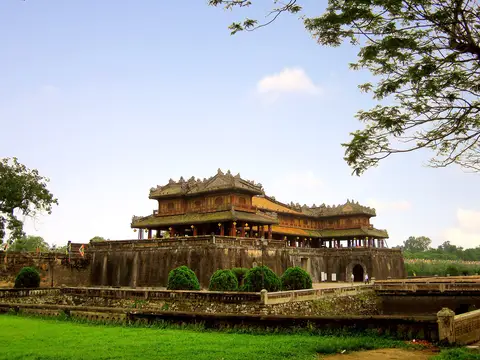
Hue: Imperial City on the Perfume River
Travel guide · editorialFrom 1802 to 1945, Hue was the capital of the Nguyễn emperors, Vietnam's last dynasty, and it has kept a certain dignity from that era. A vacation in Hue takes you into a walled citadel, to imperial tombs in pine-covered hills, and to a river where dragon boats glide past with music in the evening.
Between Mountains and Lagoons
Since early 2025, Hue has been a centrally governed city and encompasses the entire former Thừa Thiên Huế Province. The area stretches from the Trường Sơn mountain range on the Laotian border to a long coastline with the Tam Giang Lagoon, one of the largest lagoons in Southeast Asia. Right through the middle flows the Hương, the Perfume River, whose name is said to derive from blossoms that fall into the water upstream. To the south, the Hải Vân Pass marks the border with Đà Nẵng; at its foot lie Lăng Cô Bay and the deep-water port of Chân Mây. Thuận An at the river mouth is the city's local beach.
Sights in Hue
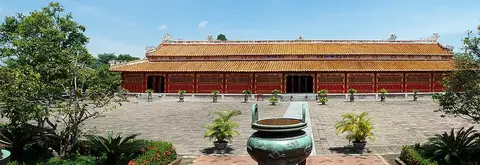
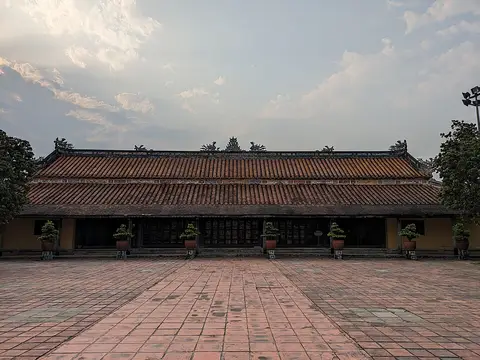
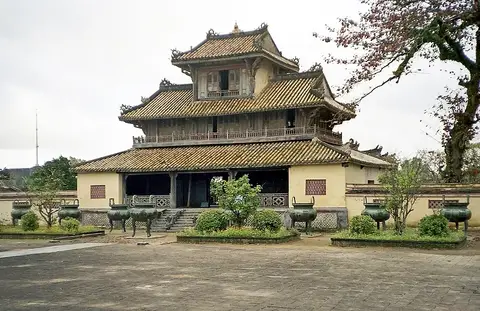
The Citadel on the north bank, built on the Chinese model with French fortress elements, has been a UNESCO World Heritage Site since 1993. Behind the Meridian Gate lies the Imperial City with the Hall of Supreme Harmony, where the emperors held audiences. Much of it was destroyed during the Tet Offensive in 1968, but it has been carefully reconstructed over the years. The Thiên Mụ Pagoda with its seven-story tower stands on a hill above the river; on its grounds you'll find the light-blue Austin in which the monk Thích Quảng Đức drove to Saigon in 1963 to set himself on fire in protest. Upriver lie the emperors' tomb complexes: Tự Đức with lakes and pavilions, Minh Mạng strictly symmetrical in a park, and Khải Định with a mix of concrete, glass mosaic, and European stylistic elements. In the garden-house district of Kim Long, you can visit old town houses, known as nhà vườn.
Coast and Bạch Mã
On the Tam Giang Lagoon, fishermen haul in their nets in the light of the setting sun, and in villages such as Thanh Toàn stands a covered wooden bridge with a tiled roof dating from the 18th century. Lăng Cô has a sweeping beach set against forested mountains. In Bạch Mã National Park, a former French hill station at 1,450 meters, hiking trails lead to waterfalls and villa ruins.
Eating and Drinking
Hue's cuisine is considered the most refined in the country, because the court cooks prepared dozens of small dishes for the emperors. Bún bò Huế, a spicy beef soup with lemongrass, is the best-known culinary export. Also look for bánh bèo, steamed rice cakes served in small dishes, bánh khoái, a crispy pancake, and cơm hến, rice with small river clams. The city also has a strong vegetarian tradition rooted in its monasteries.
Getting There and Best Time to Visit
Phú Bài Airport (HUI) lies about 15 kilometers to the south and is served from Hanoi and Saigon; Đà Nẵng is about two and a half hours away by car or train. The best time to visit is between February and April. Summers get very hot, and from September to December monsoons and typhoons bring heavy rain and flooding. The Huế Festival, with performances of court music and theater in the Citadel, also takes place regularly.