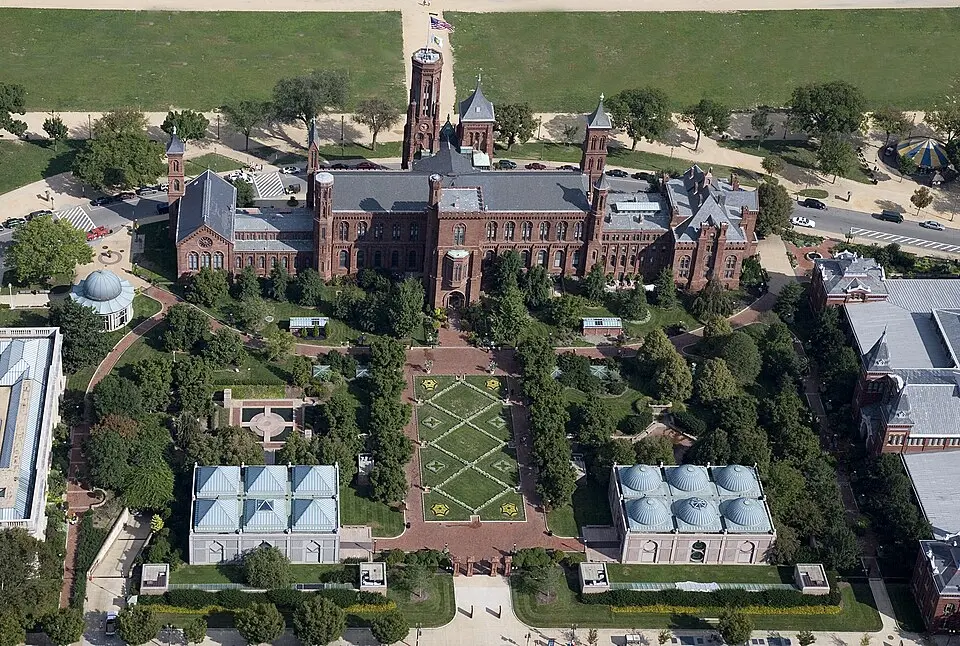
About Smithsonian Institution
The Smithsonian Institution in Washington, D.C., is one of the most important research and educational institutions in the United States. It was founded in 1846 by an act of the U.S. Congress, funded by the bequest of the British scientist James Smithson. The foundation's central mission is the increase and diffusion of knowledge. Today the complex comprises nineteen museums and galleries as well as the National Zoo, making it the largest museum complex in the world. One notable feature that draws many visitors is free admission to all of its facilities. The institution manages more than 142 million objects, both natural and human-made, and serves as the cultural memory of the entire American people.
The history of the institution is closely tied to the development of its buildings. The Smithsonian Institution Building, often called the Smithsonian Castle, opened in 1858 and originally housed the first exhibitions. As the collections grew steadily, more buildings were added over time, including the Arts and Industries Building, which opened in 1881, and the National Museum of Natural History, which opened in 1910. Today eleven museums and galleries stretch along the National Mall, the large green strip between the Washington Monument and the Capitol. Other facilities are located elsewhere in Washington, D.C., while the Cooper Hewitt, Smithsonian Design Museum and the George Gustav Heye Center are based in New York. A three-story underground complex also houses two museums and the S. Dillon Ripley Center, with an international gallery and seminar rooms.
Beyond exhibiting art and history, the Smithsonian Institution is an active research center. It supports expeditions and excavations as well as scientific work in fields such as astronomy, astrophysics, ethnology, and environmental research. This includes its own facilities such as the Smithsonian Astrophysical Observatory, which together with the Harvard College Observatory forms the Harvard-Smithsonian Center for Astrophysics, as well as a biopark and an archive of American art. The institution also publishes the standard reference work "Handbook of North American Indians" and, since acquiring the record label Folkways Records in 1986, has operated the Smithsonian Folkways label, which safeguards the documentation of folk music.
In recent years the institution has also been at the center of political debates. Since 2025, the current U.S. administration has been putting pressure on the Smithsonian, leading to personnel changes and the removal of certain artworks. Museums have also been instructed to submit detailed reports on their exhibitions and collections. Despite these tensions, the institution remains an important place for education and culture. Since 2019, the Smithsonian has made its entire collection available digitally under the open CC0 license, which has greatly expanded global access to the objects. Oversight of the foundation rests with a Board of Regents, whose members include the Vice President of the United States, and roughly two-thirds of its budget comes from federal funds.
At a glance
- Category
- Museum › Museums (general)
- Rating
- no reviews yet · write a review
- Address
- 950 Independence Ave SW
20560 Washington, USA - District
- Ward 2
- Phone
- (202) 633-1000
- Website
- www.si.edu
- publicaffairsasia@si.edu
- Coordinates
- 38.88792° N · -77.02551° E
- Data quality
- confidence 0.96
- Identifier
- ID d77f645c-01a…
Location & surroundings
Toggle layersRatings & comments
none yetNear Smithsonian Institution
closest 5 per category · 2 kmSights
Museums
Hotels
More:Museums in Ward 2 (79)All museums in Washington (238)
278 places within 2 km loaded.
Don't miss in Washington
All sights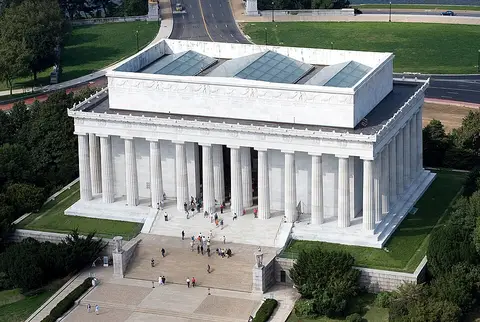 Monuments01
Lincoln Memorial
2 Lincoln Memorial Cir NW · Washington● Website● Phone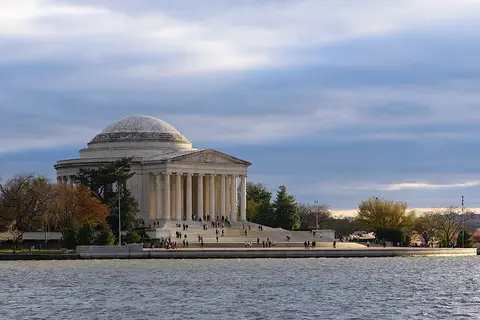 Monuments02
Thomas Jefferson Memorial
16 E Basin Dr SW · Washington● Website● Phone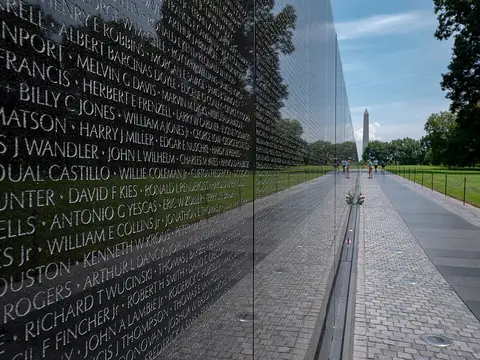 Monuments03
Vietnam Veterans Memorial
5 Henry Bacon Dr NW · Washington● Website● Phone Historic sites04
You need a free account to leave reviews and photos – that keeps comments genuine and lets you edit them later.