
District of Columbia: Washington, the Nation's Capital
Travel guide · editorialThe District of Columbia is not a state but a territory created specifically for the nation's capital, and today the city of Washington and the District are one and the same. A trip to the District of Columbia takes you to the centers of American political power, to world-class memorials, and to museums that almost all offer free admission.
Location and Cityscape
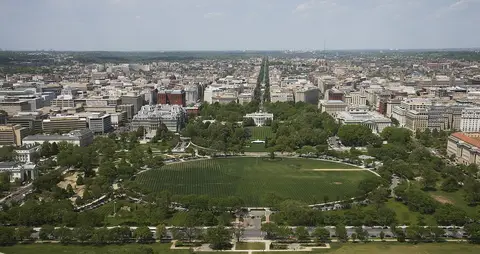
The District lies on the north bank of the Potomac River, nestled between Maryland and Virginia. In 1790, Congress designated the area as the seat of the federal government, and Congress has met here since 1800. The French engineer Pierre L'Enfant designed a city plan with diagonal grand avenues, traffic circles, and sweeping sight lines that is still recognizable today. Because a 1910 law limits buildings to a certain height, there are no skyscrapers—the Washington Monument remains the striking centerpiece of the skyline.
Sights in Washington
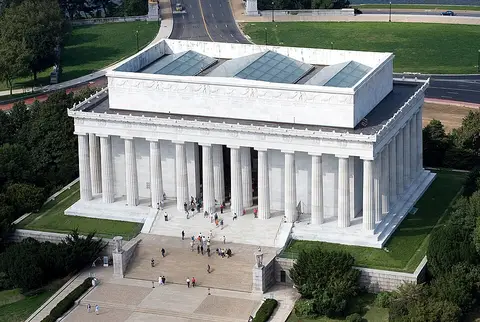
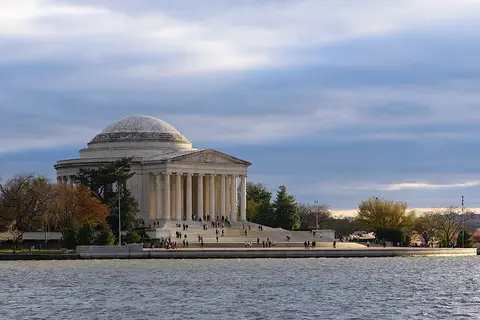
The National Mall, a two-mile green corridor, connects the Capitol with the Lincoln Memorial. Along the way you'll find the Washington Monument, the World War II Memorial, the black granite wall of the Vietnam Veterans Memorial, and, at the Tidal Basin, the memorials to Thomas Jefferson, Franklin D. Roosevelt, and Martin Luther King Jr. You can view the White House from the outside; tours of the interior must be requested well in advance. The Capitol and the magnificent Library of Congress, by contrast, are easily accessible. The museums of the Smithsonian Institution are a reason to visit in themselves: the Air and Space Museum with its space capsules and the aircraft of aviation pioneers, the Natural History Museum with the Hope Diamond, and the National Museum of African American History and Culture, one of the most moving museums in the country. Add to that the National Gallery of Art, with works from Leonardo to Rothko.
Neighborhoods and Daily Life
Away from the monuments, Washington shows a very different face. Georgetown, older than the capital itself, has cobblestone streets, brick row houses, and the Chesapeake and Ohio Canal. Around U Street, once known as "Black Broadway," Duke Ellington and Ella Fitzgerald performed; jazz clubs and live music are still found here today. Dupont Circle and Adams Morgan are lively neighborhoods with bars and embassies, and the Wharf on the Washington Channel is a new waterfront entertainment district. At Eastern Market on Capitol Hill, neighbors and vendors gather on weekends. Just across the river in Virginia lie Arlington National Cemetery and the Pentagon. The neighborhood of Anacostia, east of the river of the same name, is home to Frederick Douglass's residence, and in Shaw and along 14th Street, many restaurants and bars have opened in recent years.
History and Politics
In 1814, British troops burned down the Capitol and the White House, and during the Civil War the city was ringed by fortifications. In 1963, Martin Luther King Jr. delivered his "I Have a Dream" speech in front of the Lincoln Memorial. To this day, residents do not have full voting rights in Congress, which the slogan "Taxation without representation" on the license plates alludes to. In 2026, the city was especially focused on the 250th anniversary of the Declaration of Independence.
Food and Drink
A local original is the half-smoke, a coarsely seasoned smoked sausage served with chili at Ben's Chili Bowl on U Street. Washington has one of the largest Ethiopian communities outside Africa, so injera with lentil and meat dishes is a firm fixture of the city's cuisine. Add to that crab cakes from nearby Chesapeake Bay and the sweet-and-spicy mumbo sauce served with fried chicken.
Getting Around and Best Time to Visit
International flights usually land at Dulles, domestic flights at Reagan National, which is close to the city; Baltimore (BWI) is also an option. Union Station is a rail hub with trains to New York and Boston. In the city, the Metro, buses, and bike rentals are more practical than a car. The best times to visit are spring, when the Japanese cherry trees bloom at the Tidal Basin during the National Cherry Blossom Festival in late March or early April, and fall. Summer is hot and humid.