About USS Intrepid
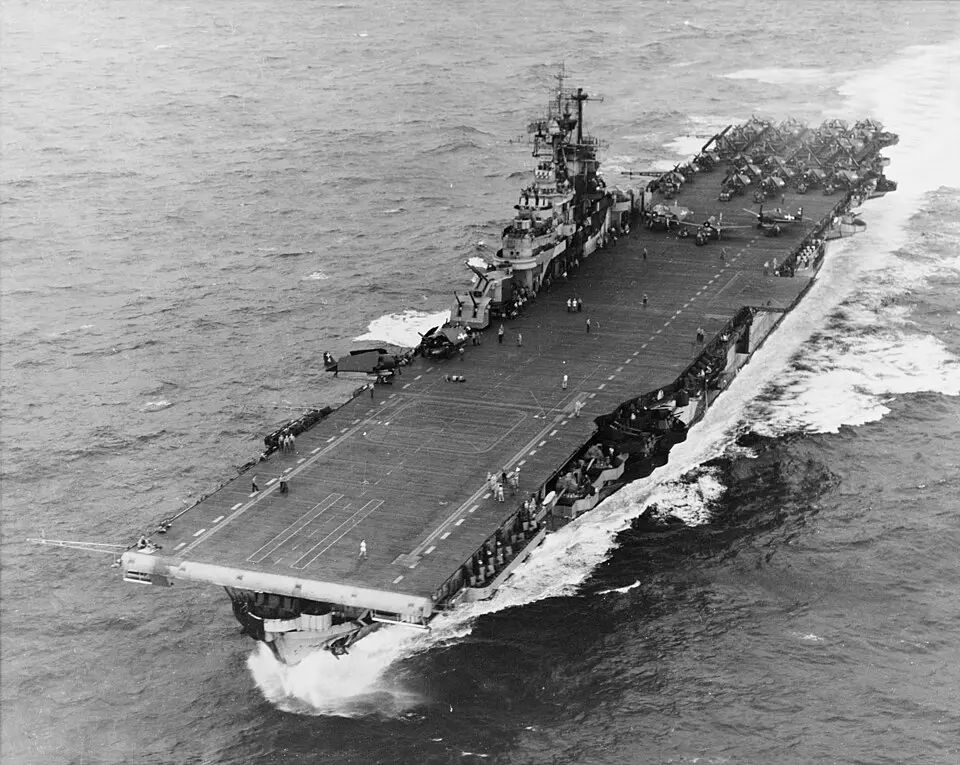
The USS Intrepid, an Essex-class aircraft carrier of the United States Navy, is best known today as a museum ship in New York Harbor. Operating as the Intrepid Sea, Air & Space Museum, the historic warship is moored at Pier 86 on the west side of Manhattan. The ship, whose name means bold or fearless, has lived through a eventful history that runs from intense combat in World War II to civilian recovery missions for the space program. Thanks to its extraordinary resilience, the crew affectionately called it The Tough Old Lady, while its adversaries in the Pacific regarded it as a ghost ship because of its ability to survive even heavy hits.
The carrier's construction began on December 1, 1941, in Newport News, Virginia, where its keel was laid. After the launch in April 1943, the ship was handed over to the Navy in August of that year. On the very day of the handover, the first aircraft landed on deck, flown by Commander Jackson. After a brief inspection by a vice admiral, Air Group 8 reported for duty in October 1943. The Intrepid spent its first months on strategic combat exercises in the Caribbean, focusing on the rapid launching, landing, and rearming of fighter aircraft. The carrier then passed through the Panama Canal to reach the Pacific Ocean, where it joined Fast Carrier Task Force 8.
In the Pacific, the Intrepid took part in numerous battles starting in 1944. One early operation was Operation Flintlock against the Marshall Islands, where the carrier's aircraft attacked Japanese positions on Roi-Namur. The ship later took part in the bombardment of Truk Atoll. During this operation, the Intrepid was hit by a Japanese torpedo that damaged the port-side quarters below the waterline and disabled the steering gear. Despite this severe damage, the captain managed to bring the ship back to Pearl Harbor using makeshift means, including a sail rigged on the forward deck for stabilization, and it was repaired there.
The remaining war years were marked by operations in the Philippine Sea and off Okinawa. The Intrepid's aircraft flew heavy attacks on Japanese airfields, coastal batteries, and bases in the Philippines, Palau, and Formosa. The fighting was especially fierce during the landings on Leyte and Okinawa. Here the carrier was repeatedly the target of Japanese kamikaze attacks. In one such attack in October 1944, a Japanese plane crashed directly onto the flight deck, and the bomb it carried exploded in the pilots' ready room. Despite severe injuries and fatalities on board, the fire was extinguished and the carrier was able to continue the fight.
The Intrepid also remained in action during the Battle of Okinawa in the spring of 1945. The carrier's air group attacked Japanese positions on the island as well as bases on Kyushu, Shikoku, and Honshu to protect the landing forces. During this phase, the Intrepid's pilots also helped sink the Japanese battleship Yamato, scoring several bomb hits on the giant vessel. The constant threat of suicide attackers demanded the utmost vigilance from the crew, and refueling of the ships often took place under full combat conditions to give the Japanese no time for coordinated attacks.
After the end of World War II and Japan's surrender in August 1945, the Intrepid served in Operation Magic Carpet, which brought U.S. servicemen home from the Pacific. The ship was decommissioned in 1947 but modernized in the early 1950s. Under the SCB-27 program, the carrier received a stronger flight deck, a new bridge, and its first steam catapult. Later, at the New York Navy Yard, the bow was enclosed and an angled flight deck was added, which significantly improved the ship's landing capabilities.
The Intrepid played a special role in the history of space exploration. It served as the primary recovery carrier for NASA's Mercury program. During the flight of Mercury-Atlas 7 in May 1962, the capsule carrying astronaut Scott Carpenter splashed down outside the planned zone. The Intrepid dispatched helicopters that rescued the astronaut after three hours in the water. The ship later took on this role for the Gemini program as well. On the Gemini 3 mission in March 1965, the capsule carrying astronauts Gus Grissom and John Young likewise did not land exactly at the intended spot, but was successfully recovered by the Intrepid.
During the Vietnam War, the Intrepid was deployed off the coast of Vietnam from 1966 to 1969. The carrier's aircraft mainly flew interdiction missions over South Vietnam. In a remarkable feat, the crew managed to launch nine A-4 Skyhawks and six A-1 Skyraiders within seven minutes to respond to enemy attacks. Some of these aircraft shot down Soviet-built MiG-17 fighters flown by the North Vietnamese. After the war, the Intrepid took on duties in the Atlantic, where it monitored Soviet fleet movements, among other things, and took part in NATO exercises.
In the 1970s, the ship was increasingly sent to northern waters. In 1973, the Intrepid sailed north of the Arctic Circle, reaching one of the northernmost positions for a U.S. aircraft carrier of that era. It visited ports in Denmark and Norway, which led to diplomatic discussions, since Denmark had declared a nuclear-free zone while U.S. ships were equipped with nuclear weapons. In March 1974, the Intrepid was finally decommissioned for good.
Thanks to the initiative of Zachary Fisher and the Intrepid Museum Foundation, the ship was saved from the scrapyard and brought to New York. It opened in August 1982 as the Intrepid Sea, Air & Space Museum. Since 1986, the ship has been recognized as a National Historic Landmark and is listed on the National Register of Historic Places.
Today, visitors can tour the USS Intrepid as a museum ship. The ship offers insight into the history of the U.S. Navy and space exploration. On board, alongside the original flight deck, you will find various exhibits documenting its operations in World War II and the Vietnam War as well as the NASA recovery missions. The Intrepid thus stands as a symbol of courage, technological progress, and international cooperation in the service of science and security.
At a glance
- Category
- Museum › Aviation museums
- Rating
- no reviews yet · write a review
- Address
- Pier 86, W 46th St
10036 New York, USA - District
- Manhattan
- Phone
- +12122450072
- Website
- www.intrepidmuseum.org
- —
- Coordinates
- 40.76482° N · -74.00080° E
- Data quality
- confidence 0.97
- Identifier
- ID d13e547b-291…
Location & surroundings
Toggle layersRatings & comments
none yetNear USS Intrepid
closest 5 per category · 2 kmSights
Restaurants
Museums
Hotels
More:Museums in Manhattan (486)All museums in New York (683)
300 places within 2 km loaded.
Don't miss in New York
All sights Historic sites01
Empire State Building
20 W 34th St · New York● Website○ Phone Monuments02
9/11 World Trade Center Memorial Monument
180 Greenwich St · New York○ Website● Phone Historic sites03
New York Stock Exchange
11 Wall St · New York● Website● Phone Historic sites04
You need a free account to leave reviews and photos – that keeps comments genuine and lets you edit them later.