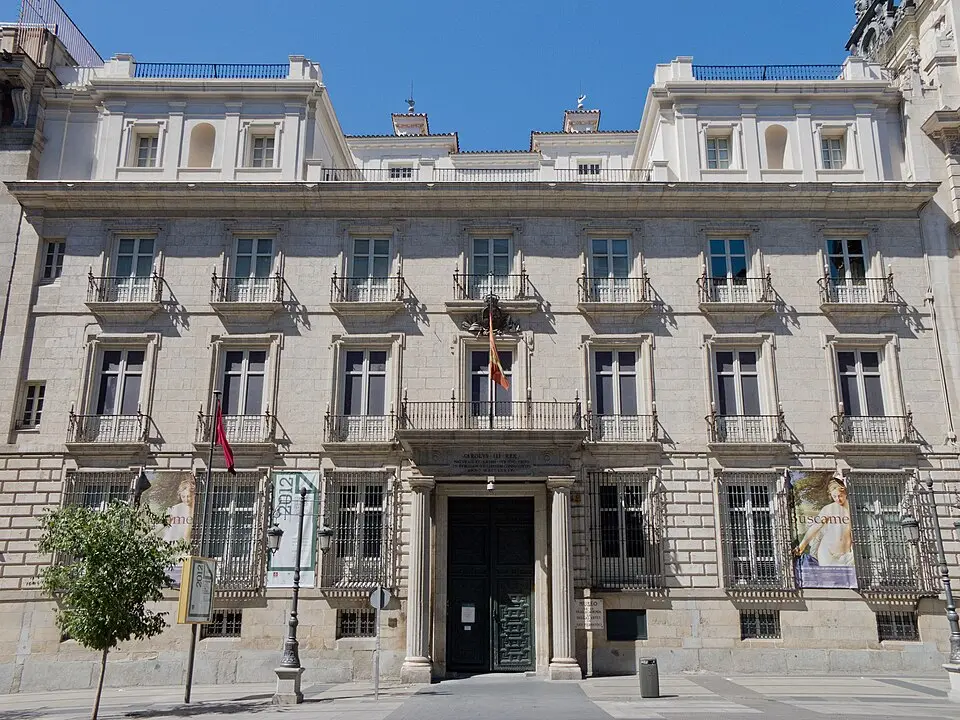
About Palacio de la Equitativa
The Palacio de la Equitativa, originally known as the Palacio de Goyeneche, is a significant urban palace on Calle de Alcalá in Madrid. The building was designed in 1720 by the architect José Benito de Churriguera for the industrialist and financier Juan de Goyeneche and, after Goyeneche's death in 1725, completed by Churriguera's brother Alberto de Churriguera. The architecture shows an interesting blend of Baroque elements at the entrance and a strictly classical façade. After its builder's death, the palace served various government purposes, including as the seat of the Royal Tobacco Monopoly and the Royal Cabinet of Natural History. In 1773, King Charles III acquired the building to serve as the new home of the Real Academia de Bellas Artes de San Fernando, as its old location had become too small.
To adapt the building to its new purpose and to the Neoclassical style of the day, the king had the façade remodeled by Diego de Villanueva, who toned down the original Baroque splendor in favor of a plainer, Neoclassical appearance. Today the building houses the academy and its museum. On the upper floors, which were recently redesigned by the artist Gustavo Torner, you can explore numerous new exhibition rooms that were previously used by the Ministry of Finance. The interior includes historic rooms such as libraries, oratories, and studios that recall the building's original function as an art academy. One particular highlight is the large ceremonial hall, which was created in a former inner courtyard during the extensive restoration between 1973 and 1985 under the direction of Fernando Chueca Goitia.
The palace has been protected as a National Monument since 1971 and reflects the close connection between art and science in 18th-century Spain. Above the main entrance, an inscription recalls Charles III's intention to unite the arts and sciences under one roof. The original plan was to move the natural history cabinet to a separate building, but the outbreak of the War of Independence in 1808 prevented this. As a result, the academy and the natural science collections remained together until the end of the 19th century. Today, with its rich history and varied exhibitions, the building offers a deep insight into Spain's cultural development.
At a glance
- Category
- Sight › Historic sites
- Rating
- no reviews yet · write a review
- Address
28014 Madrid, Spain- District
- Centro
- Phone
- —
- Website
- —
- —
- Coordinates
- 40.41747° N · -3.70007° E
- Data quality
- confidence 0.90
- Identifier
- ID c92c91b5-e37…
Location & surroundings
Toggle layersRatings & comments
none yetNear Palacio de la Equitativa
closest 5 per category · 2 kmSights
Restaurants
Museums
Hotels
More:Historic sites in Madrid (466)Sights in Centro (203)All sights in Madrid (606)
300 places within 2 km loaded.
Don't miss in Madrid
All sights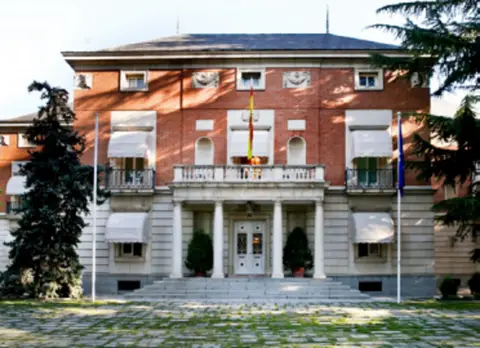 Historic sites01
Palacio de la Moncloa
Avenida Puerta de Hierro, s/n · Madrid● Website● Phone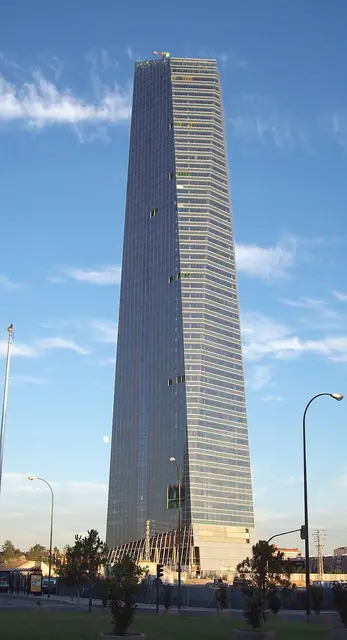 Historic sites02
Torre de Cristal
Paseo de la Castellana, 259 · Madrid● Website● Phone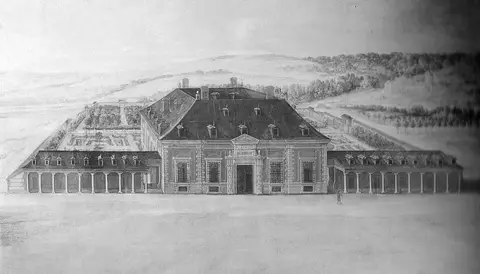 Historic sites03
Palacio de la Zarzuela
Carretera Del Pardo S/N · Madrid● Website● Phone Historic sites04
You need a free account to leave reviews and photos – that keeps comments genuine and lets you edit them later.