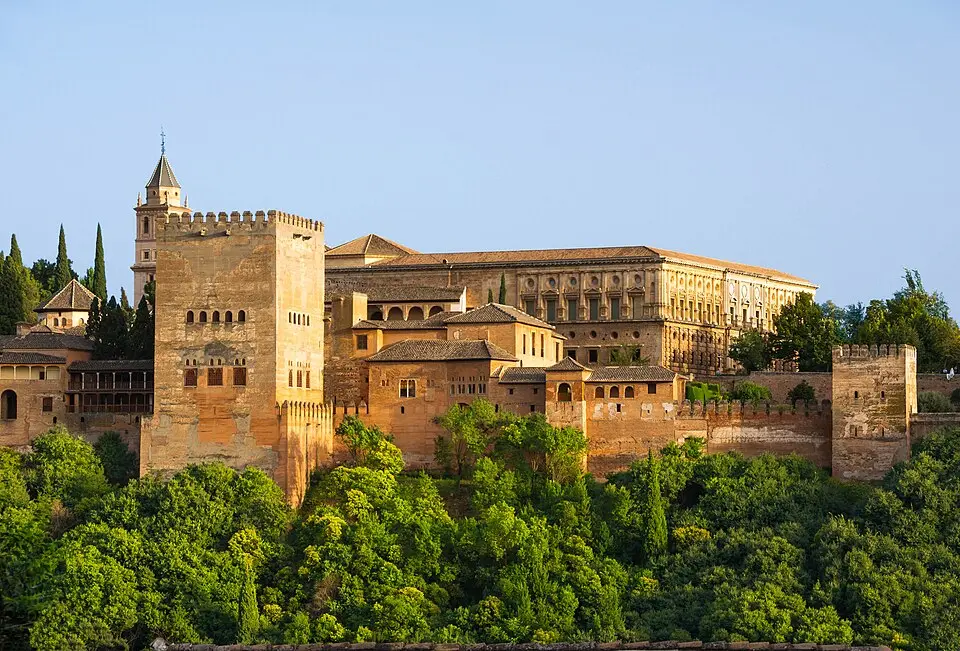
About Museo de la Alhambra
The Alhambra in Granada is one of Europe's most significant and most visited attractions and has been a UNESCO World Heritage Site since 1984. This sprawling fortress complex on Sabikah Hill is regarded as an outstanding example of the Moorish style in Islamic art. The name probably derives from the reddish color of the outer walls, which from a distance look like fire or rust, earning the fortress the nickname "the Red Castle." The complex stretches about 740 meters (2,430 feet) in length and is up to 220 meters (720 feet) wide. It combines historic sites from different eras and cultures into a complex ensemble made up of the fortified citadel, the palaces of the Nasrid dynasty, the former city, and the Generalife summer palace.
The history of the site reaches back to pre-Roman times, when the hill was already settled. After the conquest of the Iberian Peninsula, the Moors built a fortress here that was documented in the 9th century as the Elvira Fortress. In the 11th century, the Jewish vizier of King Badis built a fortress of his own to protect himself from the city's population. The decisive change came in the 13th century, when Muhammad I, the first ruler of the Nasrid dynasty, moved his residence to Granada and ordered the construction of today's citadel. The Nasrids ruled the Emirate of Granada until 1492, when the fortress fell to the Catholic Monarchs.
The heart of the complex is formed by the Nasrid Palaces, which served as the seat of government and private quarters of the Moorish rulers. Here you will find magnificent courtyards such as the Court of the Myrtles and the famous Court of the Lions. The latter is designed in the style of a Persian paradise garden and contains a marble fountain supported by twelve stone lions. The walls of these rooms are decorated with delicate arabesques and Arabic inscriptions in stucco, while the insides of the domes are adorned with elaborate muqarnas structures. In the throne room of the Comares Tower, located in the citadel, the ruler's throne once stood, from which the emirs could survey their land.
Beyond the palaces, the Generalife summer palace lies outside the actual fortress walls. This area was originally known as the "garden of the mystic" and served as a place of rest and recreation. A walkway beneath cypress trees leads to the gardens, where water features and pavilions can still be admired today. The Acequia Courtyard in the Palacio de Generalife is especially known for its artful water installations, which helped cool the air during the hot season. The gardens and pavilions were laid out and further expanded under various rulers, including Ismail I, Yusuf I, and Muhammad V.
In the 16th century, King Charles V planned to make Granada the seat of government of the Spanish kingdom and had the architect Pedro Machuca build a grand Renaissance palace. This two-story, cube-like structure around a circular courtyard was never completed, however, as the kingdom's interests shifted after the discovery of America. Today, the Palace of Charles V houses the Museum of Fine Arts and the Alhambra Museum. At the building's northeast corner is an octagonal chapel that may have been inspired by the Palatine Chapel in Aachen. Reliefs on the west portal show contemporary battle scenes based on designs by Machuca.
Since the 19th century, the Alhambra has developed great cultural influence, not least thanks to the American writer Washington Irving, who lived there and wrote his famous Tales of the Alhambra. Artists and scholars such as John Frederick Lewis and François-René de Chateaubriand made the complex known worldwide as an iconic work of Nasrid architecture and ornamentation. The Alhambra's tile mosaics even inspired the Dutch artist M. C. Escher to create his geometric works. Musically, the site has been immortalized in compositions such as the étude Recuerdos de la Alhambra by Francisco Tárrega for classical guitar and the movement En el Generalife from Manuel de Falla's Nights in the Gardens of Spain.
Today, the Alhambra is a place where history, architecture, and nature merge. You can explore the ruins of the old city walls, the foundations of the original buildings in the medina, and the surviving palace areas. Over the centuries the complex has been restored several times, and early, anachronistic interventions from the 19th century were later corrected in order to preserve its original character. The Alhambra remains a fascinating testament to Islamic culture in Europe and a source of inspiration for art, literature, and music.
At a glance
- Category
- Museum › Museums (general)
- Rating
- no reviews yet · write a review
- Address
- Alhambra - Palacio de Carlos V
18009 Granada, Spain - District
- Centro
- Phone
- +34958027929
- Website
- www.alhambra-patronato.es
- museoalhambra.redes.pag@juntadeandalucia.es
- Coordinates
- 37.17670° N · -3.58975° E
- Data quality
- confidence 0.99
- Identifier
- ID 2d9d43dc-903…
Part of the tour
Granada in One Day: Alhambra, Old Town and Albaicín →Location & surroundings
Toggle layersRatings & comments
none yetNear Museo de la Alhambra
closest 5 per category · 2 kmRestaurants
Museums
Hotels
More:All museums in Granada (47)
248 places within 2 km loaded.
Don't miss in Granada
All sights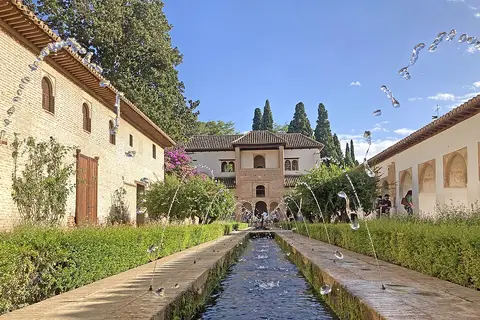 Historic sites01
Generalife
Palacio y Jardines del · Granada● Website● Phone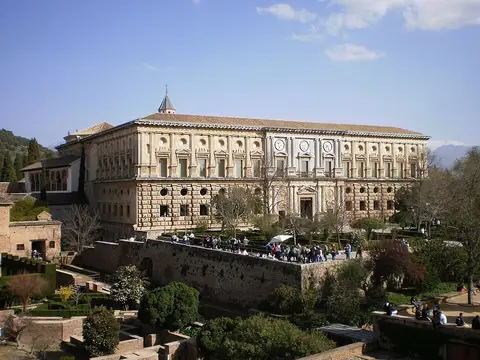 Palaces02
Palace of Charles V
C. Real de la Alhambra, s/n · Granada● Website● Phone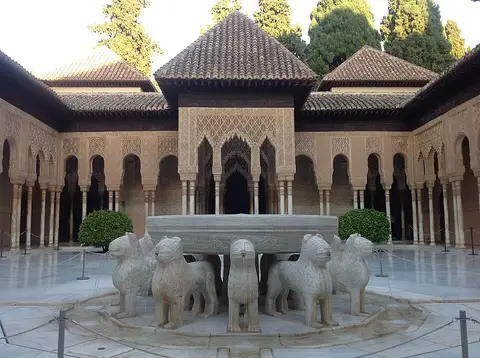 Historic sites03
Patio de Los Leones
C. Real de la Alhambra, s/n · Granada● Website● Phone Monuments04
You need a free account to leave reviews and photos – that keeps comments genuine and lets you edit them later.
Islamic art is famous for its extensive use of geometric patterns and symmetry groups, and this palace especially so: its intricately tiled designs are said to include all 17 of the mathematically distinct wallpaper patterns. This accomplishment, possibly unique in world architecture, attracted M.C. Escher to Granada to see it.
Source: Wikivoyage, „Mathematics tourism“ · authors per page history · CC BY-SA 4.0 · as of 7/4/2023