Oaxaca: Mezcal, Markets, and the Pacific Coast
Travel guide · editorialIf you're planning a vacation in Oaxaca, you're heading to the Mexican state with the greatest cultural diversity: Zapotecs, Mixtecs, and about a dozen other Indigenous peoples live here, and their languages can still be heard daily in the markets. Between the colonial capital in the Central Valleys and the surf beaches on the Pacific lie mountain ranges, cloud forests, and agave fields.
Mountains, Valleys, and a Long Stretch of Coastline
Oaxaca is almost as big as Portugal and is cut through by the Sierra Madre del Sur and the Sierra Norte. The Central Valleys around the capital sit at roughly 5,100 feet (1,550 meters), which means mild days and cool nights. In the Sierra Norte, hikers make their way between villages like Benito Juárez and Cuajimoloyas through pine and oak forests managed by community cooperatives. In the east, the land narrows to the Isthmus of Tehuantepec, where strong winds sweep across the plain and wind farms shape the landscape. Far to the north, around Tuxtepec, the climate turns tropical and humid, with rivers and fields of pineapple and sugarcane.
Oaxaca City and the Towns of the Valleys
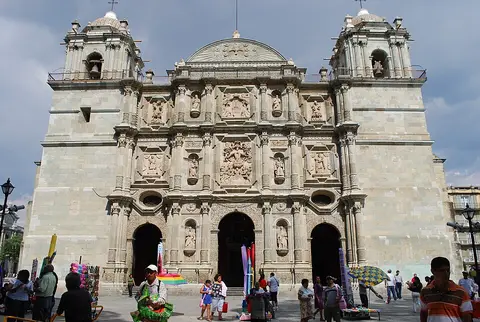
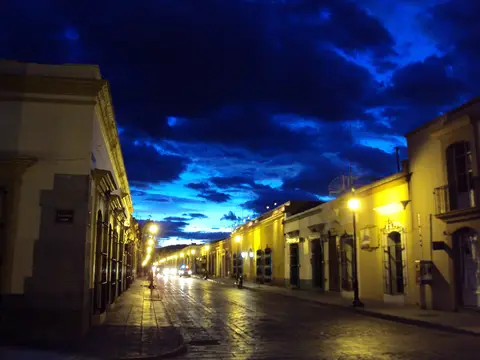
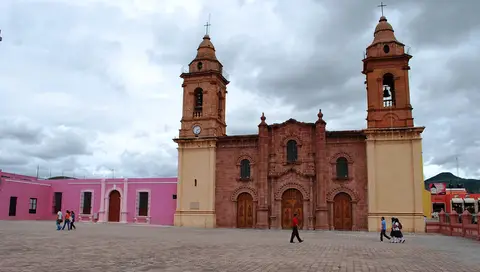
The capital, officially Oaxaca de Juárez, is a UNESCO World Heritage Site. Its center of green cantera stone, the Baroque church of Santo Domingo with its gilded interior, and the adjoining Ethnobotanical Garden are among the most important sights in Oaxaca. In the evenings, marimba groups play around the Zócalo, and in the Benito Juárez and 20 de Noviembre market halls, people eat, haggle, and laugh. In the surrounding villages, almost every one has its own craft: Teotitlán del Valle weaves wool rugs with natural dyes, San Bartolo Coyotepec makes black pottery, and in San Martín Tilcajete, brightly painted wooden figures called alebrijes are carved. The Sunday market in Tlacolula is one of the liveliest in the country.
Monte Albán, Mitla, and Hierve el Agua
High above the city sits Monte Albán, the political center of the Zapotecs for more than a thousand years. From the flattened mountaintop with its pyramids, ball court, and the enigmatic Danzantes reliefs, the view stretches across all three valleys. Mitla, about 28 miles (45 kilometers) to the east, impresses with geometric stone mosaics fitted together without mortar. Not far away are the petrified waterfalls of Hierve el Agua, mineral limestone deposits that hang over a cliff like frozen cascades. On the way, in Santa María del Tule, stands an ahuehuete tree considered one of the thickest in the world.
The Pacific Coast: Puerto Escondido and Huatulco
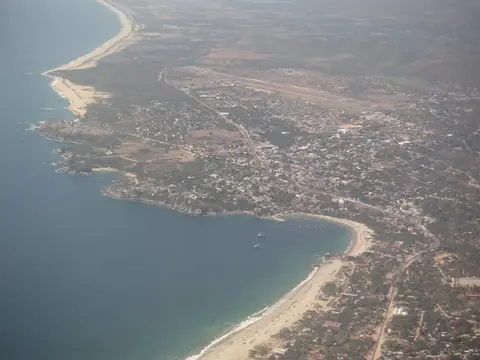
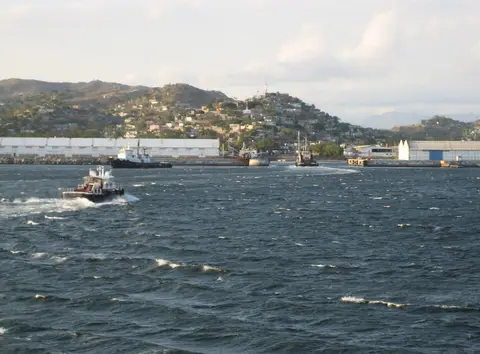
The coast is among the most popular Oaxaca destinations. Puerto Escondido is known for Playa Zicatela, whose powerful surf draws surfers from around the world; in the Brisas de Zicatela neighborhood, small hotels and cafés line the street. The bays of Carrizalillo and Puerto Angelito are quieter. Farther west, bioluminescent algae glow in the water of the Manialtepec Lagoon at night. Huatulco to the east was planned as a resort town, but it also includes a national park with nine bays. In between lie Mazunte, with its sea turtle center, and Zipolite, one of the few clothing-optional beach destinations in Mexico. Salina Cruz and Juchitán on the isthmus, by contrast, are working and port towns where traditional Tehuana dress and the large festivals known as velas shape everyday life.
Food, Mezcal, and the Guelaguetza
Oaxaca is considered Mexico's culinary capital. The seven kinds of mole are famous, from the nearly black mole negro to the yellow amarillo. Then there are tlayudas, large crispy tortillas with bean paste, quesillo, and tasajo, as well as toasted grasshoppers, known as chapulines. Hot chocolate is frothed with water and cinnamon. Around Santiago Matatlán, which calls itself the mezcal capital of the world, family-run distilleries make the agave spirit in clay or copper stills. In July, the capital celebrates the Guelaguetza, when delegations from all parts of the state show off their dances; at the end of October and the beginning of November come the Day of the Dead celebrations, with decorated cemeteries.
Getting There and the Best Time to Visit
Oaxaca's airport has several flights a day from Mexico City, and the coast can be reached via Puerto Escondido and Huatulco. The highway from Oaxaca to Puerto Escondido has cut travel time considerably, though mountain roads are still winding. Long-distance buses reliably connect the capital with Puebla and Mexico City. The best time to visit is between October and April, when it's dry; the rainy season from June to September brings green valleys, but also thunderstorms and, on the coast, possible hurricanes.