Baja California Sur: Desert, Whales, and Los Cabos
Travel guide · editorialA vacation in Baja California Sur means desert that drops straight into the sea: cacti reach down to turquoise coves, and in winter gray whales come to calve in the lagoons. The state of Baja California Sur covers the southern half of the peninsula and stretches from the rock arch at Cabo San Lucas to the Vizcaíno Desert.
A Peninsula Between Two Seas
Baja California Sur is one of the most sparsely populated regions in Mexico. To the west, the Pacific crashes against long, wild beaches; to the east lies the Gulf of California, which Jacques Cousteau called the world's aquarium. In between, mountain ranges such as the Sierra de la Giganta and the Sierra de la Laguna, with pine and oak forests, run down the peninsula. The north is dominated by the Vizcaíno Desert, a biosphere reserve. Rain is rare, usually arriving only as tropical storms in late summer.
Los Cabos and La Paz
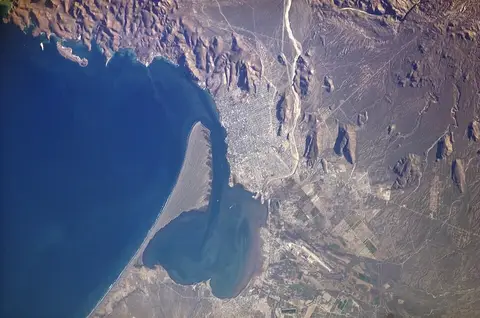
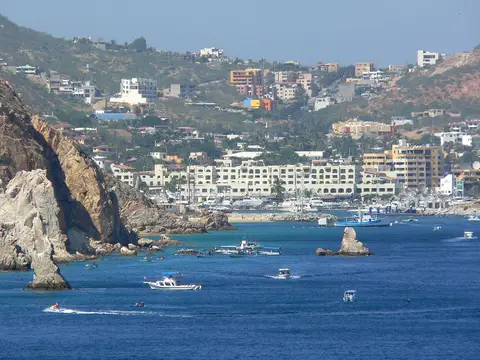
At the southern tip, Cabo San Lucas and San José del Cabo together form Los Cabos, one of Mexico's biggest resort destinations. Cabo San Lucas is loud and lively, with a marina, bars, and sportfishing boats. Its landmark is El Arco, a rock arch at Land's End, where the Pacific and the Gulf meet; next to it lies Playa del Amor. San José del Cabo is quieter, with a colonial mission, art galleries, and the Thursday Art Walk. Between the two towns, the Corridor stretches along the coast with luxury resorts and golf courses. The state capital, La Paz, lies about a two-hour drive to the north on a sheltered bay. Its malecón (waterfront promenade) is ideal for a stroll, and Balandra and El Tecolote beaches are among the most beautiful in the country.
Things to See in Baja California Sur
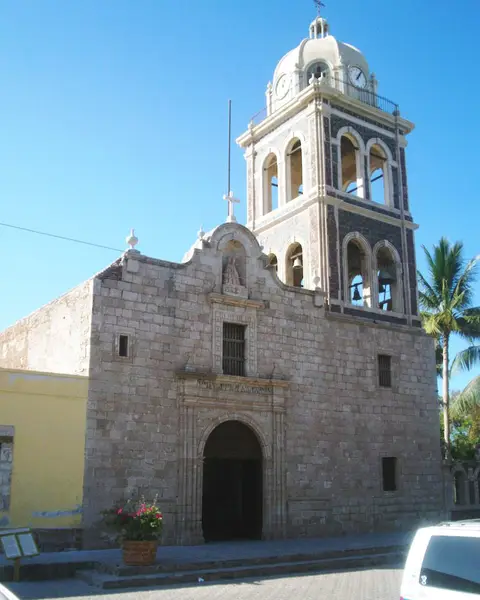
Boats leave La Paz for Isla Espíritu Santo, a protected area where you can snorkel with sea lions; between October and March, whale sharks swim in the bay. Cabo Pulmo National Park in the east protects one of the few coral reefs in the Gulf, where fish populations have recovered impressively since fishing was banned. In the Ojo de Liebre and San Ignacio lagoons, gray whales come so close to the boats from January to April that you can touch them. Loreto, California's oldest mission settlement, founded in 1697, sits beside a marine national park. In the Sierra de San Francisco, cave paintings depict people and animals at life size; they are a UNESCO World Heritage Site. Todos Santos on the Pacific coast is an artists' town with surf beaches.
History and Daily Life
The peninsula was first Christianized by Jesuits, who founded a chain of missions beginning in the late 17th century; many of the native peoples died of introduced diseases. The region remained isolated for a long time, and Baja California Sur did not become its own state until 1974. With the construction of the Transpeninsular Highway, tourism began to grow, and today it is the most important source of income alongside fishing, salt production in Guerrero Negro, and agriculture around Ciudad Constitución.
Food and Drink
The cuisine lives off the sea: fish tacos with fried fish, cabbage, and crema; chocolate clams, which are grilled; ceviche; and spiny lobster. Machaca, a dried meat dish, is typical, and wine is still grown in the mission towns. Damiana, an herbal liqueur, comes from the region. In Todos Santos and La Paz, there is a growing scene of restaurants using ingredients from nearby organic farms.
Getting There and Best Time to Visit
San José del Cabo airport is the main one, with direct flights from North America and occasionally from Europe. La Paz and Loreto have smaller airports, and ferries run from La Paz to Mazatlán and Topolobampo. The Transpeninsular Highway is well suited to road trips. The best time to visit is between November and May, when it is pleasantly warm and dry and the whales are here. In midsummer it gets very hot, and from August to October hurricanes are a threat. Divers, on the other hand, particularly value late summer, when the water in the Gulf is at its warmest and clearest. If you explore the peninsula by car, don't underestimate the long distances: between some towns there is no gas station or cell service for over a hundred kilometers, and night driving is not advisable because of free-roaming cattle.