About Palazzo Ducale
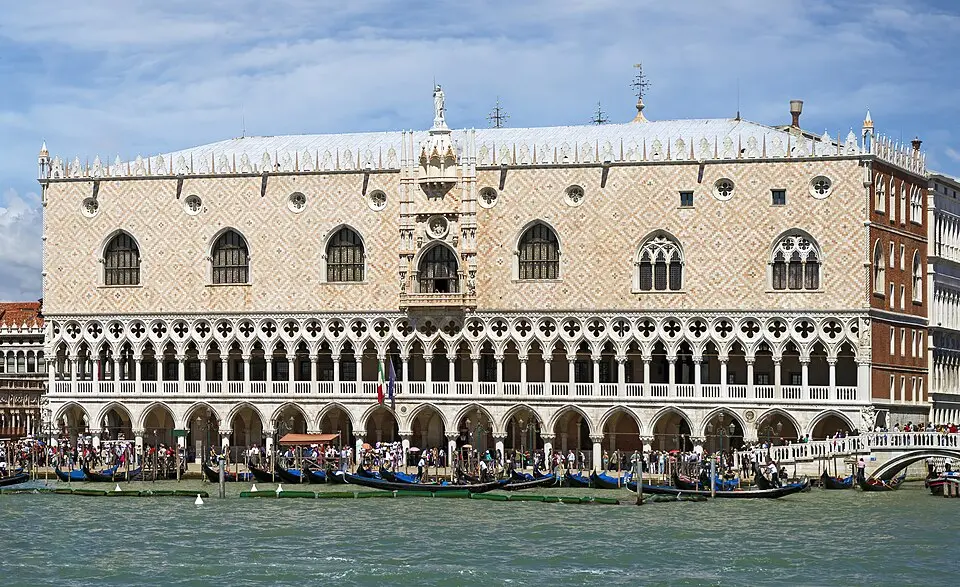
The Doge's Palace in Venice is far more than just a historic building. It is the architectural and political heart of the former maritime republic. Since the ninth century, it served as the seat of the doge, the head of state, as well as of the central organs of government and justice. As an administrative center, the palace embodied the immense power and wealth of Venice, which was one of the most influential powers in the Mediterranean for centuries. The façade facing the lagoon is considered one of the most significant secular buildings of the Gothic era and bears witness to the city's unique architectural craftsmanship. Here, you experience a fascinating blend of state pageantry, religious symbolism, and artful decoration that still testifies to the palace's splendor today.
The history of the site reaches back to the early days of the republic. Originally, a popular assembly known as the Arengo gathered here to elect the doge by acclamation. After this assembly was stripped of its power, the palace became the meeting place of the Great Council, from which the members of all other governing bodies were recruited. The first buildings on this spot, erected next to St. Mark's Basilica, are difficult to date historically. Archaeological finds point to medieval structures, but the exact form of the early doge's residence remains unclear. What is certain is that the square, with the church and the palace, formed the political and religious center of the lagoon.
An essential component of today's complex was built under Doge Sebastiano Ziani in the late twelfth century. This palace consisted of three wings enclosing a courtyard. The east wing housed the doge's quarters, while the south wing, facing the Bacino San Marco, contained the assembly hall for the Great Council. Because the number of Great Council members grew sharply in the fourteenth century, the meeting hall had to be enlarged. This led to the decision to remodel the palace extensively, creating the monumental form seen today.
The remodeling began under Doge Bartolomeo Gradenigo and was driven forward largely by his successor, Andrea Dandolo. Dandolo had previously been responsible for state representation as a procurator and laid the groundwork for the concept of the new palace. Construction started on the south wing, which opens onto the lagoon. The design, whose architect cannot be identified with certainty, was completed around 1443. The work dragged on until 1465, however, partly due to the outbreak of the plague in 1348. This section was completed with Guariento di Arpo's famous painting "Coronation of the Virgin."
The architecture of the Doge's Palace is unique in Western history. It combines elements of Gothic style with Eastern influences that arose from Venice's trade with the Orient. The crown of battlements and the pink-and-white diamond pattern on the upper story, for example, draw on motifs from Islamic art, especially Seljuk stylistic elements. The ogee arches of the loggias also have their models in Eastern building traditions. This mixture of Gothic structure and colorful, Byzantine-influenced ornament gives the building its fairy-tale character, which has enchanted generations of travelers.
A central entrance to the palace is the Porta della Carta, the so-called Paper Gate. This portal was built between 1438 and 1442 by the master builders Giovanni and Bartolomeo Bon and bridges the gap between St. Mark's Basilica and the palace. The name probably derives from the fact that official government announcements were posted here or citizens' petitions were submitted. The gate is richly decorated with sculptures that reflect the republic's political self-image. Figures of the cardinal virtues, such as fortitude, temperance, prudence, and charity, created by Antonio Bregno, stand in the niches. Above the entrance sits Justitia, or Justice, as a symbol of the wise government of the Serenissima.
Inside the palace, the Arco Foscari, also called the Androne Foscari, leads from the gate to the courtyard. This corridor-like passage with a groin vault shows the architectural shift from Gothic to Renaissance. It leads directly to the Scala dei Giganti, the Giants' Staircase. The staircase is named after two colossal sculptures depicting the Roman gods Mars and Neptune. They were created in 1567 by Jacopo Sansovino and symbolize Venice's military strength on land and at sea. The staircase served as the ceremonial route for the doge and is now an important stop on the tour through the former living and official quarters.
The palace courtyard was once freely accessible to the public and served as a place for official acts, festivals, and even tournaments. Today it is paved with slabs of trachyte and Istrian stone. Beneath the ground lie old cisterns that once supplied water. From here, you can enter the various wings of the palace, which hold the doge's rooms as well as the halls of the courts and offices. A particular eye-catcher is the Cappella San Nicolò, the doges' private chapel. It was built in the early sixteenth century and blends perfectly in style with the palace façade.
The interiors of the Doge's Palace are famous for their opulent decoration. The walls and ceilings are adorned with stucco, gilded carvings, and large history paintings on which Venice's most important painters worked. In the Anticollegio, ambassadors and guests once waited for their audience. Probably the most impressive room is the Hall of the Great Council, which at 54 meters (177 feet) long is the largest unsupported hall in Europe. Here, the nobles gathered to pass laws and elect the doge. The rear wall is taken up by Tintoretto's enormous painting "Paradise," created after a fire in the late sixteenth century and now considered one of the largest oil paintings in the world.
Besides the ceremonial halls, the palace also houses the notorious prisons. On the ground floor are the so-called Pozzi, damp cells that were often underwater during floods. On the upper floor are the Piombi, the lead chambers, which lay beneath the lead-covered roof and became known for their extreme heat. These cells were intended for state prisoners and traitors. The site became famous through Giacomo Casanova, who described his escape from one of these cells in his memoirs. The prisons are connected by the Bridge of Sighs to the adjacent New Prison, a bridge said to have gotten its name from the last sighs of the condemned before they were taken to their cells.
Today, the Doge's Palace is part of the Venetian Civic Museums and a major draw for tourists. After the end of the republic and various changes of rule, the palace was extensively restored in the late nineteenth century to protect it from decay. In the process, some original columns were replaced with copies; the originals are now displayed in the Museo dell'Opera di Palazzo. The palace gives visitors a deep insight into the history, politics, and art of the Venetian Republic. The combination of architectural splendor, historic paintings, and the dark history of the prisons makes it an unforgettable experience that brings the complexity and glory of the former maritime republic to life.
At a glance
- Category
- Museum › Art museums
- Rating
- no reviews yet · write a review
- Address
- San Marco, Sestiere San Marco, 1
30124 Venice, Italy - District
- San Marco
- Phone
- +390412715911
- Website
- palazzoducale.visitmuve.it
- info@fmcvenezia.it
- Coordinates
- 45.43368° N · 12.34040° E
- Data quality
- confidence 1.00
- Identifier
- ID eb8adfb8-8ce…
Location & surroundings
Toggle layersRatings & comments
none yetNear Palazzo Ducale
closest 5 per category · 2 kmSights
Restaurants
Museums
Hotels
More:Art museums in Venice (42)Museums in San Marco (25)All museums in Venice (135)
265 places within 2 km loaded.
Don't miss in Venice
All sights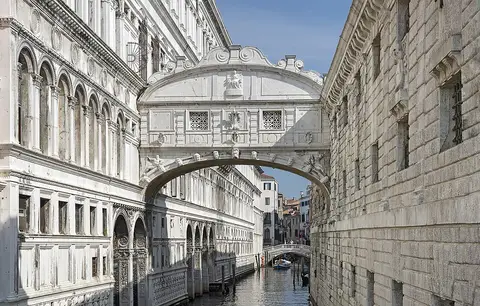 Monuments01
Ponte dei Sospiri
San Marco, Sestiere San Marco, 1 · Venice● Website● Phone Palaces02
Ca' D'Oro
Ca' D'Oro Venezia · Venice● Website● Phone Historic sites03
Venezia Santa Maria Gloriosa Dei Frari
No address · Venice○ Website○ Phone Monuments04
You need a free account to leave reviews and photos – that keeps comments genuine and lets you edit them later.
Don't miss the guided tour named Secret Itinerary , which will let you discover the part of the palace where the city's administration worked, as well as Casanova's jail and the wonderful five hundred year old roof structure. A MUVE museum.
Source: Wikivoyage, „Venice/San Marco“ · authors per page history · CC BY-SA 4.0