About Orecchio di Dionisio
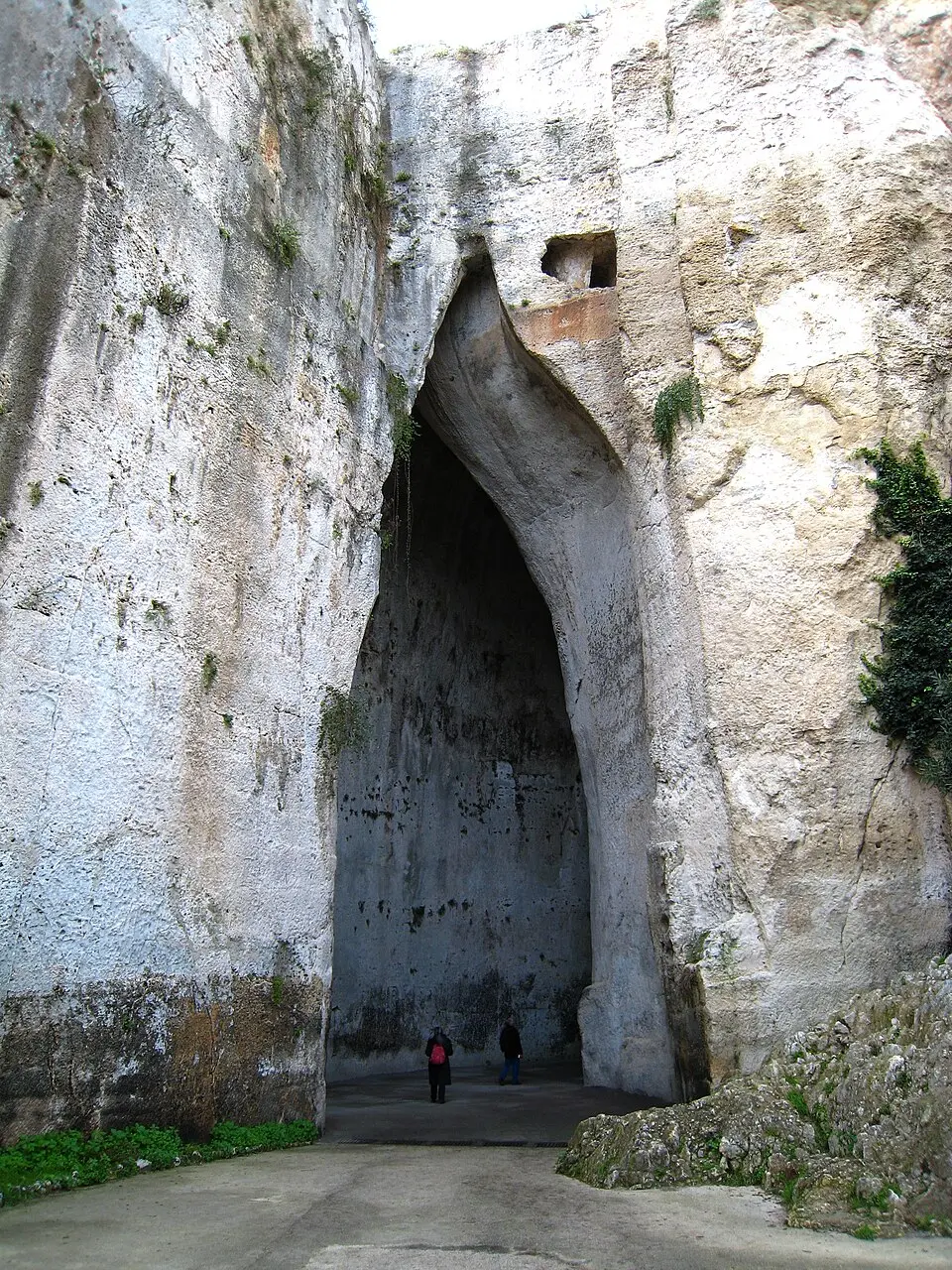
The Orecchio di Dionisio, or Ear of Dionysius in English, is a striking limestone cave cut into the Temenites Hill in the Sicilian city of Syracuse. The cave, which got its name in 1608 from the painter Caravaggio, closely resembles a human ear in shape. It is about 23 meters (75 feet) high and extends 65 meters (213 feet) deep into the rock, winding horizontally in an S-curve and tapering vertically to a teardrop shape. The site was originally built in Greco-Roman times as a water reservoir, with a tunnel that was first dug and later widened. After earthquake damage, it lost this function. The grotto is famous for its extraordinary acoustics, which make even quiet sounds echo clearly. Legend has it that the tyrant Dionysius I used the place as a prison, so that the way sound carried would let him eavesdrop on his prisoners' conversations or amplify their screams. Today you can tour the cave and experience its characteristic echo effect for yourself.
At a glance
- Category
- Sight › Historic sites
- Rating
- no reviews yet · write a review
- Address
- Viale Giulio Emanuele Rizzo 10
96100 Syracuse, Italy - Phone
- +390931464657
- Website
- www.comune.siracusa.it
- —
- Coordinates
- 37.07624° N · 15.27625° E
- Data quality
- confidence 0.98
- Identifier
- ID be6d193d-0f6…
Part of the tour
Syracuse in One Day: Neapolis, Paolo Orsi, and Ortigia →Location & surroundings
Toggle layersFAQ about Orecchio di Dionisio
quick answersWhat is the Orecchio di Dionisio in Syracuse?
The Orecchio di Dionisio, or "Ear of Dionysius," is a limestone cave in Syracuse, Sicily, that was artificially carved into the Temenites Hill. The cave is about 23 meters (75 feet) high and extends roughly 65 meters (213 feet) deep into the rock, winding horizontally in an S-curve while tapering upward into a teardrop shape. It got its name in 1608 from the painter Caravaggio, because its shape resembles a human ear.
What was the Orecchio di Dionisio originally used for?
The Orecchio di Dionisio in Syracuse was built as a water reservoir in Greek and Roman times. To create it, workers first dug a tunnel, which was later widened. After earthquake damage, the cave no longer served as a water reservoir.
Why is the Ear of Dionysius in Syracuse famous for its acoustics?
The Ear of Dionysius in Syracuse has extraordinary acoustics that make even quiet sounds echo clearly. According to legend, the tyrant Dionysius I used the cave as a prison so he could eavesdrop on his prisoners' conversations or amplify their screams through the way sound carries. When you visit, you can try out the distinctive echo effect for yourself.
What can you see around the Orecchio di Dionisio?
Around the Orecchio di Dionisio in Syracuse, you'll find several ancient sites of the Neapolis Archaeological Park. travelguide195 lists, among others, the Latomia del Paradiso about 60 meters away, the Greek Theater (Teatro Greco) about 100 meters away, the Via dei Sepolcri about 200 meters away, the Ara di Ierone about 230 meters away, and the Anfiteatro Romano about 330 meters away. A bit farther out, you'll find the Tecnoparco Archimede, a science museum about 270 meters away, as well as the Arco Augusteo and the Villa Reimann, each less than 500 meters away.
Are there tours and restaurants near the Orecchio di Dionisio?
Yes, the Orecchio di Dionisio in Syracuse is part of the tour "Syracuse in One Day: Neapolis, Paolo Orsi and Ortigia." For a break, travelguide195 lists around 6 restaurants within 500 meters of the cave at Viale Giulio Emanuele Rizzo 10.
Ratings & comments
none yetNear Orecchio di Dionisio
closest 5 per category · 2 kmSights
Restaurants
Museums
Hotels
More:Historic sites in Syracuse (73)All sights in Syracuse (93)
172 places within 2 km loaded.
Don't miss in Syracuse
All sights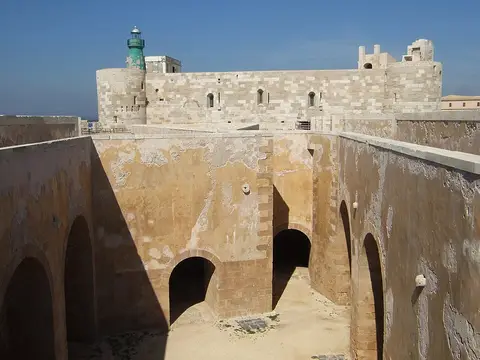 Castles01
Castello Maniace
Piazza Federico di Svevia, 5 · Syracuse○ Website● Phone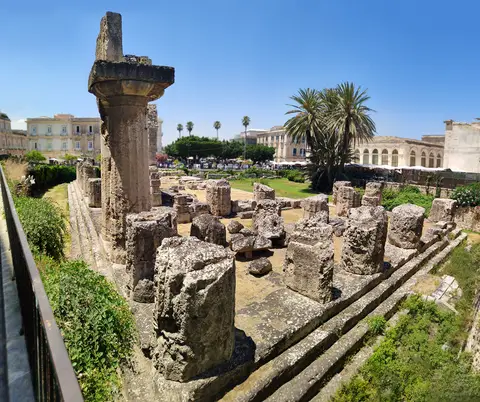 Monuments02
Temple of Apollo (Apollonion)
Via dell'Apollonion · Syracuse● Website● Phone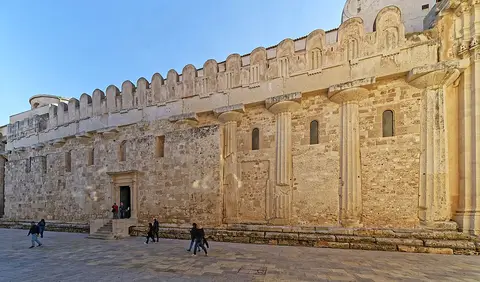 Historic sites03
Temple of Athena
Piazza Duomo, 5 · Syracuse○ Website● Phone Palaces04
You need a free account to leave reviews and photos – that keeps comments genuine and lets you edit them later.
From the entrance, follow the driveway to descend into a great bosky hollow. These are the ancient stone quarries, worked on from the sixth century BC. Two grottos or galleries burrow into the rockface. Largest is Orecchio di Dionisio or "Ear of Dionysius". Some grotto! - its dimensions are worthy of the gothic nave of a city cathedral. The name arises from its acoustics: the legend says that the tyrant Dionysios could stand outside and listen to whispered conversations of those imprisoned therein. Difficult to believe this, once you've savoured the distorted echoing babble of tourists. The second and smaller is Grotto dei Cordari ie the cave of cordwainers or ropemakers. Dark, not particularly straight, far from dry, so it's not obvious why they would work here. At the very north end of the quarries are Necropoli Grotticelle - which supposedly contains Archimedes' tomb, but the site of this is unknown. It's probably easier to view from the street after leaving the park.
Source: Wikivoyage, „Syracuse (Italy)“ · authors per page history · CC BY-SA 4.0 · as of 4/4/2018