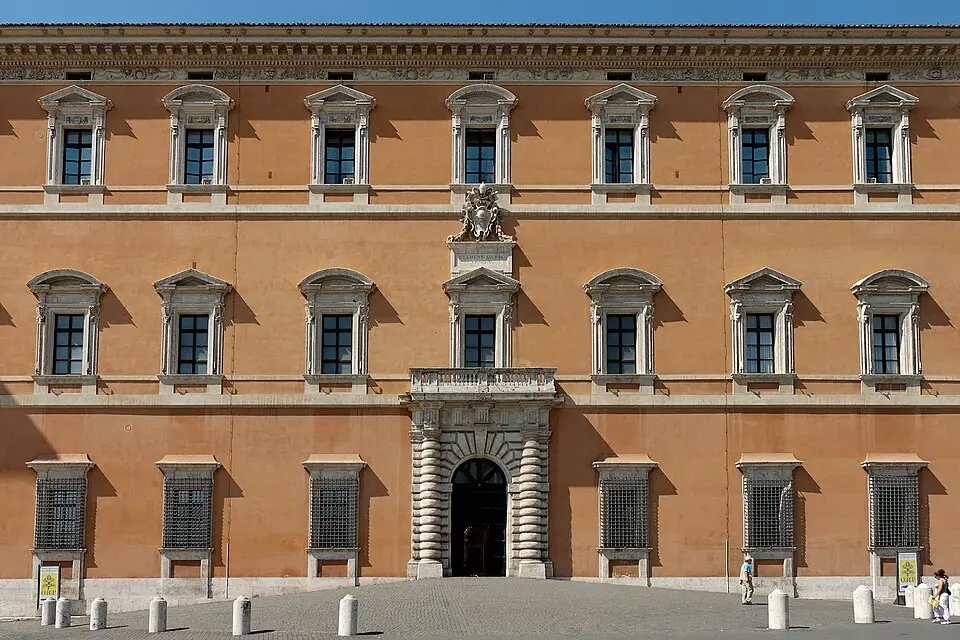
About Palazzo Del Laterano
The Lateran is a historically significant complex in the Monti district in the center of Rome, and it has been the official seat of the popes since the time of Emperor Constantine. Geographically, it lies about three miles (five kilometers) southeast of the Vatican on the left bank of the Tiber. The site includes a wide range of buildings, among them the ancient papal archbasilica of San Giovanni in Laterano, its baptistery, the 16th-century Lateran Palace, and the remains of the medieval papal palace. The latter includes the famous Scala Santa, the papal chapel Sancta Sanctorum, and the Leonine Triclinium. The largest obelisk in Rome also stands on this square. The Lateran Basilica is not only one of the seven pilgrim churches but also the cathedral of the Diocese of Rome.
The history of the site reaches back to pre-Christian antiquity. It was named after the Roman family of the Plautii Laterani, whose property was confiscated in AD 65 under Emperor Nero after a family member took part in the Pisonian conspiracy. Later, in 161, Emperor Marcus Aurelius had a palace built here. At the end of the 2nd century, Emperor Septimius Severus returned parts of the estate to a descendant of the family. At the beginning of the 4th century, the quarters of Emperor Maxentius's elite troops stood on the site, near the Aurelian Wall.
After Constantine defeated Maxentius in 312, he ordered the barracks razed as part of a damnatio memoriae. On this spot he had a monumental basilica built for the Christian community, along with a baptistery. As early as 313, Constantine's wife Fausta handed over her private house on the property to the Bishop of Rome, Miltiades, for a council, although this house did not become part of the later palace complex. The Lateran Basilica lay inside the city walls, unlike St. Peter's Basilica and St. Paul Outside the Walls, which were built outside the city over the tombs of the apostles. For this reason, the Lateran Basilica served as the cathedral and still bears the honorary title of mother and head of all the churches of the city of Rome and of the world. It was originally dedicated to Christ the Savior; later, St. John the Baptist was added as patron.
In the Middle Ages and the early modern period, the complex went through highs and lows. In the 5th century, the buildings were repeatedly plundered by Germanic tribes, and in 896 they were badly damaged by an earthquake before being repaired. Several important councils were held here, including the First Lateran Council in 1123 and the Fourth in 1215. Until 1309, the medieval papal palace stood next to the church; its remains can still be found today in the Sancta Sanctorum chapel and the Holy Stairs. There was fierce rivalry between the clergy at the Vatican and at the Lateran over relics and precedence. With the popes' return from their Avignon exile in 1377, however, the palace at the Vatican became the preferred residence, as its proximity to the tomb of Peter better underscored the popes' claim to universal leadership.
The present-day Lateran Palace, which directly adjoins the basilica, was built in the 16th century under Pope Sixtus V as a papal summer residence. Today it houses Vatican offices and is partly open to the public. The Lateran Treaty between the Holy See and the Kingdom of Italy was signed here in 1929, securing for the Lateran the status of an extraterritorial possession. In 1993, the palace was badly damaged by a car bomb, which was understood as a warning to Pope John Paul II after he had preached against the Mafia. The damage to the facade and the side entrance, however, was repaired quickly.
The Lateran Basilica itself was renovated by Francesco Borromini beginning in 1646 for the Holy Year of 1650. The pope demanded that the original floor plan of the five-aisled basilica be retained. Borromini embedded colossal columns in piers that extend the full height of the interior, and carried the rhythmic articulation of the side walls over to the facade. The facade is distinguished by a convex entrance portal that forms a counterpoint to the large concave window opening. The baptistery, probably the oldest in Christendom, was built around 315 by Constantine, probably as a round structure, and was later converted into an octagon under Pope Sixtus III. It is considered the prototype of all baptisteries.
A special highlight for visitors is the Church of SS. Salvatore della Scala Santa, which stands diagonally opposite the basilica in front of the remains of a Roman aqueduct. It holds the oldest surviving remains of the medieval papal palace, including parts of the former dining hall. The complex comprises the Holy Stairs, the papal chapel Sancta Sanctorum, the Chapel of St. Sylvester, and the Leonine Triclinium. The latter was moved to its present location in the 19th century; the mosaics fell off in the process and had to be restored based on a 17th-century engraving. The Triclinium dates from the time of Pope Leo III, and its mosaics show scenes such as the handing of the keys to Peter and the bestowal of the pallium.
The papal chapel Sancta Sanctorum is one of the oldest remains of the palace and was once the private chapel in which Rome's most important relics were kept, including the head relics of the apostles Peter and Paul. The chapel received its present appearance under Pope Nicholas III at the end of the 13th century. The frescoes depict scenes from the lives of saints, and the presbytery is decorated with mosaics in the Roman style. Above the altar hangs a nearly life-size image of Christ enthroned, which is considered not to have been made by human hands and which was carried in processions through Rome from the 8th century on. The reliquaries once kept here can now be seen in the rooms of the Vatican Library, while the relics themselves remain in the chapel, which is under the care of the Passionist brothers.
The Holy Stairs, which lead to the chapel, are said to come from the palace of Pontius Pilate and to be the steps Jesus climbed during his trial. According to legend, they were brought from Jerusalem to Rome in 326 by St. Helena, Constantine's mother. The stairs were originally the entrance to the Lateran Palace and were moved to their present location in the 16th century and covered with a new structure. Since 1723, the marble steps have been covered with walnut wood to protect them from wear. At certain steps, viewing windows have been left open through which alleged traces of Christ's blood can be seen. Pilgrims who climb the stairs on their knees while praying can receive an indulgence.
On the Piazza San Giovanni in Laterano stands the largest and oldest known obelisk in Rome. It was made in the 15th century BC for the pharaoh Thutmose III and brought to Rome in 357, where it was first erected on the spina of the Circus Maximus. After an earthquake broke it apart, it was excavated in 1587 and set up at its present location in front of the basilica. The obelisk is linked by a Baroque sightline to the Church of Santa Maria Maggiore and forms an impressive terminus to the square. The entire Lateran complex thus offers visitors a deep insight into the history of Christianity, the history of the papal residence, and the architectural development of Rome over the centuries.
At a glance
- Category
- Sight › Monuments
- Rating
- no reviews yet · write a review
- Address
- Piazza di San Giovanni in Laterano
00184 Rome, Italy - District
- Roma I
- Phone
- —
- Website
- www.vicariatusurbis.org
- —
- Coordinates
- 41.88663° N · 12.50531° E
- Data quality
- confidence 0.68
- Identifier
- ID 4f8ab918-33b…
Location & surroundings
Toggle layersFAQ about Palazzo Del Laterano
quick answersWhat is the Palazzo del Laterano in Rome?
The Palazzo del Laterano is part of the Lateran, a historically significant complex on Piazza di San Giovanni in Laterano in central Rome that has been the official seat of the popes since the time of Emperor Constantine. The site includes the Archbasilica of San Giovanni in Laterano, the Baptistery, the 16th-century Lateran Palace, and the remains of the medieval papal palace. The Lateran lies about three miles (five kilometers) southeast of the Vatican on the left bank of the Tiber.
What is the history of the Lateran in Rome?
The history of the Lateran in Rome dates back to pre-Christian antiquity, and it takes its name from the Roman family of the Plautii Laterani. Emperor Nero confiscated their property in AD 65, and in 161 Emperor Marcus Aurelius had a palace built here. After his victory over Maxentius in 312, Constantine had Maxentius's barracks razed and built a monumental basilica and a baptistery in their place. Until 1309, the medieval papal palace stood next to the church.
Why is the Lateran Basilica in Rome so important?
The Basilica of San Giovanni in Laterano, next to the Palazzo del Laterano, is the cathedral of the Diocese of Rome and bears the honorary title "Mother and Head of All Churches of the City of Rome and of the World." It is one of Rome's seven pilgrimage churches and was originally dedicated to Christ the Savior, with St. John the Baptist added as a patron later. Several important church councils took place at the Lateran, including the First Lateran Council in 1123 and the Fourth in 1215.
What can you see around the Palazzo del Laterano?
Around the Palazzo del Laterano in Rome, several sights are within walking distance. travelguide195 lists the Vatican Historical Museum at about 108 feet (33 meters), the Sotterranei di S. Giovanni in Laterano at about 154 feet (47 meters), and the Lateran Obelisk, the largest obelisk in Rome, at about 164 feet (50 meters). A little farther, at about 460 to 525 feet (140 to 160 meters), you'll find the Oratorio di San Silvestro in Palatio, the Scala Santa, and the Triclinium Leoninum.
Are there restaurants near the Palazzo del Laterano?
Yes, there are plenty of places to eat around the Palazzo del Laterano in Rome. travelguide195 lists about 73 restaurants within 500 meters (about 1,640 feet) of Piazza di San Giovanni in Laterano.
Ratings & comments
none yetNear Palazzo Del Laterano
closest 5 per category · 2 kmSights
Restaurants
Museums
Hotels
More:Monuments in Rome (235)Sights in Roma I (642)All sights in Rome (1,312)
300 places within 2 km loaded.
Don't miss in Rome
All sights Historic sites01
The Dome at San Pietro Basilica
No address · Rome○ Website○ Phone Historic sites02
Roman Forum
Via della Salara Vecchia, 5/6 · Rome● Website● Phone Historic sites03
Restauro Fontana di Trevi
Piazza di Trevi, 91 · Rome● Website○ Phone Monuments04
You need a free account to leave reviews and photos – that keeps comments genuine and lets you edit them later.