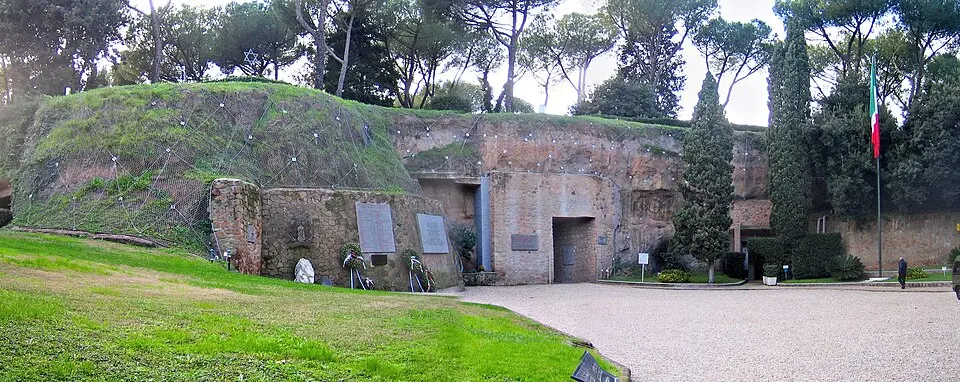
About Fosse Ardeatine
The Fosse Ardeatine, or Ardeatine Caves, is a memorial site in the south of Rome that commemorates one of the worst crimes of the German occupation. In the Quartiere Ardeatino on Via Ardeatina, near the Catacombs of Callixtus, there are two short, interconnected sandstone caves. These tunnels were originally used for the underground extraction of pozzolana, a volcanic rock used in construction. The exact date when commercial quarrying ended is not recorded. Today the site is known above all as the scene of the massacre of March 24, 1944, in which 335 Italian civilians, including 75 Jewish hostages, were shot by the Wehrmacht and the SS.
The background to the crime was a bomb attack carried out the day before, on March 23, 1944, on Via Rasella. A group of the Roman Resistance, which belonged to the Communist Party and had been approved by the National Liberation Committee, detonated a bomb hidden in a garbage cart along with a prepared mortar shell. The target was the 11th Company of the "Bozen" Police Regiment, a South Tyrolean unit that was on its way to guard duty that day with loaded weapons. The explosion killed 33 soldiers and two Italian civilians. The attack was deliberately timed for the 25th anniversary of the founding of the Fascist combat leagues, which the German officers may have interpreted as a provocation.
In retaliation for the soldiers killed, the German officers in charge, Field Marshal Albert Kesselring, Colonel General Eberhard von Mackensen, and Lieutenant General Kurt Mälzer, decided on a drastic reprisal. SS-Obersturmbannführer Herbert Kappler, commander of the Security Police and SD in Rome, proposed shooting ten Italian hostages for every German killed. Because the number of prisoners held in the Security Service's jails was not enough, 50 more inmates were taken from Roman prisons and penal camps. The people still missing were recruited from among the Jews awaiting deportation. In total, 335 men were selected, consisting exclusively of boys and men.
The execution took place in the Ardeatine Caves, which Kappler chose as the site. The prisoners were driven to the site on trucks with their hands tied behind their backs. There they had to kneel down in groups of five and were shot in the back of the neck on command. The shootings lasted from about 2 p.m. until around 7 p.m. When the piles of bodies grew too high, the next victims had to lie down on top of those already killed. After the killings were finished, the caves were blown up to destroy evidence. The massacre was officially announced only the following day.
The victims were a cross-section of Roman society. The 335 people murdered included political prisoners, intellectuals, workers, civil servants, officers, artists, professors, doctors, and priests. The youngest victim was only 15 years old, the oldest 74. Many of the victims were related to one another, which deepened the horror of the tragedy. To date, 326 of the victims have been identified. The names of the dead are inscribed at the memorial to honor their individual lives and fates.
After the war, the site was transformed into a major memorial. The first architectural competition in Rome after the war was for the Fosse Ardeatine. The architects Nello Aprile, Cino Calcaprina, Aldo Cardelli, Mario Fiorentino, and Giuseppe Perugini designed the present mausoleum, also called the Sacrario. A monumental slab of concrete and stone, resting on six slender brackets, frames the sarcophagi arranged in parallel rows. The half-light inside is meant to recall the lighting in the caves. In front of the entrance stands the statue "I Martiri" by Francesco Coccia, symbolizing the sacrifice of the dead. Bronze plaques and gates, including works by Mirko Basaldella, complete the complex, which opened on March 24, 1949.
Above the memorial, in a stone pine grove, is a museum of the Italian Resistance. The events of 1944 are interpreted here as a symbol of the German occupation of Italy. Prosecuting the perpetrators proved difficult and protracted. While some of those chiefly responsible, such as Alfred Jodl and Herbert Kappler, stood trial or fled, others went unpunished for a long time. Not until the late 1990s were Erich Priebke and Karl Hass sentenced to life imprisonment, which was converted to house arrest because of their advanced age. Historical research has shown that German and Italian authorities in the 1950s and 1960s deliberately helped to hinder the investigation of the crimes in order to avoid diplomatic tensions.
Today many people visit the Fosse Ardeatine every year to remember the victims. The site is an important part of historical memory in Rome and serves as a warning against the atrocities of National Socialism. The combination of the original caves, the architecturally designed mausoleum, and the museum gives visitors the chance to understand the history of the massacre and of the Resistance in Rome. The memorial stands for the dignity of the victims and the importance of confronting the past.
At a glance
- Category
- Sight › Monuments
- Rating
- no reviews yet · write a review
- Address
- Via Ardeatina, 174
00147 Rome, Italy - District
- Roma VIII
- Phone
- +39065136742
- Website
- mausoleofosseardeatine.it
- info@mausoleofosseardeatine.it
- Coordinates
- 41.85721° N · 12.51047° E
- Data quality
- confidence 0.97
- Identifier
- ID 65999dca-a22…
Location & surroundings
Toggle layersRatings & comments
none yetNear Fosse Ardeatine
closest 5 per category · 2 kmSights
Restaurants
Museums
Hotels
More:Monuments in Rome (235)Sights in Roma VIII (60)All sights in Rome (1,312)
165 places within 2 km loaded.
Don't miss in Rome
All sights Historic sites01
The Dome at San Pietro Basilica
No address · Rome○ Website○ Phone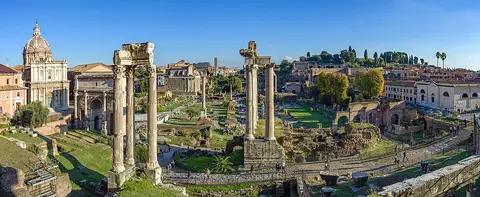 Historic sites02
Roman Forum
Via della Salara Vecchia, 5/6 · Rome● Website● Phone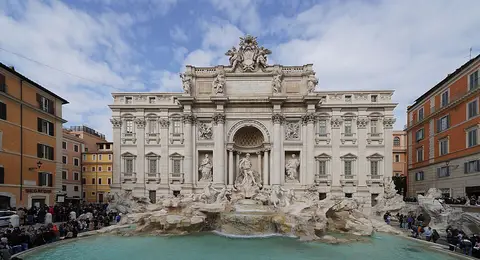 Historic sites03
Restauro Fontana di Trevi
Piazza di Trevi, 91 · Rome● Website○ Phone Monuments04
You need a free account to leave reviews and photos – that keeps comments genuine and lets you edit them later.
This was the site of the slaughter in 1944 of 335 Italians, including many Jews from the Ghetto, in retaliation for a Partisan attack on German troops in Rome. The caves where the massacre took place are now a National Monument and Memorial Cemetery and can be visited daily.
Source: Wikivoyage, „Rome/South“ · authors per page history · CC BY-SA 4.0