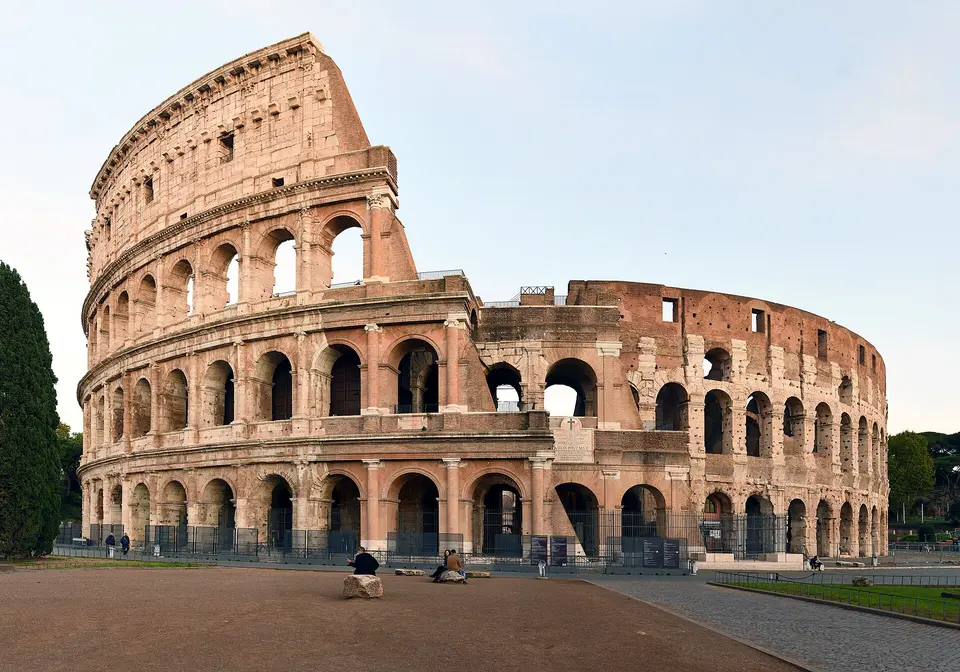
About Ancient Rome
Rome is far more than just a European metropolis; it is the historic heart of the ancient Roman Empire, whose influence on Western civilization extends to the present day. The history of this city and the state that grew out of it spans more than a thousand years, from its uncertain beginnings in the eighth century B.C. to the fall of the western half of the empire in the early Middle Ages. What today is seen as a tourist destination with countless ruins and museums was once the starting point of an expansion that swept across the entire Mediterranean and connected cultures from Britain to Mesopotamia. The site itself, set on infertile and partly marshy ground, owed its early rise not to agriculture but to its strategic position on important trade routes such as the Via Latina and the Via Salaria. This geographic position allowed the city to gain economic importance early on and to grow from a local settlement into a powerful city-state that stood under Etruscan influence.
The early centuries of Roman history are shaped by legend and uncertain sources. The traditional account dates the founding to 753 B.C., a date that goes back to the scholar Marcus Terentius Varro. Whether the city was actually ruled by kings, as later tradition claims, is disputed among historians. What is certain, however, is that around 500 B.C. Rome broke free of Etruscan rule and became an independent center of power in Italy. Culturally, the Romans were strongly influenced by the Etruscans and, through them, by the Greeks. From this period come elements such as the Latin alphabet, which emerged from the Greek-Etruscan script, as well as religious practices and funeral rituals that found an exaggerated form in the later gladiatorial games. The myth of Aeneas, the Trojan hero who came to Latium, later served as a national epic and tied Roman identity to Greek antiquity.
The transition to the Republic, traditionally dated to 509 B.C., marked the beginning of a new political era. The Roman state developed into a complex mixture of monarchic, aristocratic, and democratic elements. The Roman Forum, the central heart of the city, served as a venue for political debate, religious ceremonies, and social gatherings. Here the Senate, the popular assemblies, and the magistrates assembled, including the consuls, who held supreme executive power. Society was strictly hierarchical, with the patrician families at the top and the plebeian citizens, who were able to expand their rights only after long struggles for political equality. Slaves, regarded as "speaking tools," formed the lowest class, though they had the possibility of gaining their freedom. This social structure and the system of patronage shaped Rome's social life for centuries.
Rome's expansion began in the fifth century B.C. with the conquest of central Italy. Despite serious setbacks, such as the defeat at the Allia by the Gauls, Rome built an extensive network of alliances with Italic tribes and established strategic colonies. By the third century B.C., the Republic had become the dominant power on the Italian peninsula. The conflict with Carthage, which led to the Punic Wars, was a turning point in history. In the Second Punic War, the Carthaginian general Hannibal succeeded in penetrating deep into Italy and inflicting a devastating defeat at Cannae. Even so, Rome was able to hold its alliance system together and ultimately defeated the Carthaginians under Scipio. This victory secured Rome's supremacy in the western Mediterranean and brought enormous wealth from silver mines in Hispania and from war reparations.
At the same time, Rome intervened in the conflicts of the Hellenistic kingdoms in the East. After victories over Macedon and the Seleucid Empire, Rome became the de facto dominant power in the eastern Mediterranean. The conquest of Greece and the destruction of Carthage in the Third Punic War in 146 B.C. sealed Rome's rise to world power. The Mediterranean became "mare nostrum," Rome's inner sea. In the new provinces, taxes were collected by private companies, which led to economic exploitation but also to an increase in coinage and in the number of slaves. This economic dynamism contributed to a flowering of culture and art, while at home the republican order gradually eroded under social tensions and political assassinations.
The crisis of the Republic culminated in a series of civil wars that destroyed the old constitution. The reform attempts of the Gracchi failed against the resistance of the Senate, and the conflicts between the Populares and the Optimates escalated. Gaius Julius Caesar, who conquered Gaul and introduced the Julian calendar, was appointed dictator for life before he was assassinated in 44 B.C. His death did not lead to the restoration of the Republic but to further fighting. Octavian, later Emperor Augustus, defeated Mark Antony and Cleopatra at the Battle of Actium in 31 B.C. Egypt thereby fell to Rome, and the entire Mediterranean came under Roman control. Augustus established the Principate, a form of rule that maintained the republican facade but in practice amounted to one-man rule.
Under Augustus and his successors, the empire enjoyed a period of peace and stability known as the Pax Romana. Borders were secured, roads expanded, and administration made more efficient. Culture reached a golden age, and Roman civilization spread across the provinces. Society became more fluid, as members of new classes could rise into the senatorial and equestrian orders. Under Emperor Trajan in A.D. 117, the empire reached its greatest extent, stretching from Scotland to Nubia and from Portugal to Mesopotamia. Emperor Hadrian consolidated the empire, built border fortifications such as Hadrian's Wall, and promoted cultural flourishing, which also favored the spread of Christianity.
Late antiquity brought profound changes. After the imperial crisis of the third century, marked by usurpations and external threats, Diocletian reformed the administration and created the Tetrarchy. Constantine the Great ended the Tetrarchy, granted privileges to Christianity, and founded Constantinople as a new capital. The empire's focus shifted increasingly eastward. In the West, imperial authority disintegrated, and the Migration Period ultimately led to the fall of the Western Empire in A.D. 476. The Eastern Empire transformed into the Byzantine Empire.
Today, Rome is a place where visitors can experience this fascinating history. The ruins of the Roman Forum, the Colosseum, and other ancient sites bear witness to the grandeur of the empire. Museums and archaeological parks offer insights into the daily life, art, and politics of antiquity. The city itself is a living testament to Roman culture, whose legacy continues to resonate in the language, law, and art of Europe. Latin, the official language of the empire, shaped the Romance languages and is still present in many fields of science today. Roman law forms the foundation of modern civil law. Rome thus remains not only a historic site but a living part of European identity, inviting visitors on a journey through the centuries.
At a glance
- Category
- Sight › Monuments
- Rating
- no reviews yet · write a review
- Address
- —
Rome, Italy - District
- Roma I
- Phone
- —
- Website
- —
- —
- Coordinates
- 41.89000° N · 12.48000° E
- Data quality
- confidence 0.81
- Identifier
- ID c95f0319-544…
Location & surroundings
Toggle layersRatings & comments
none yetNear Ancient Rome
closest 5 per category · 2 kmSights
Restaurants
Museums
Hotels
More:Monuments in Rome (235)Sights in Roma I (642)All sights in Rome (1,312)
300 places within 2 km loaded.
Don't miss in Rome
All sights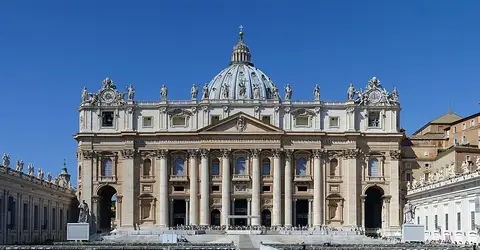 Historic sites01
The Dome at San Pietro Basilica
No address · Rome○ Website○ Phone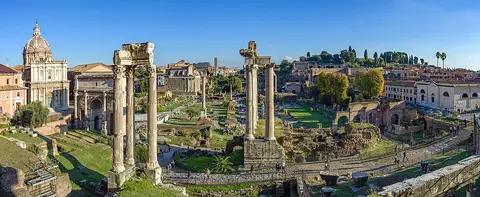 Historic sites02
Roman Forum
Via della Salara Vecchia, 5/6 · Rome● Website● Phone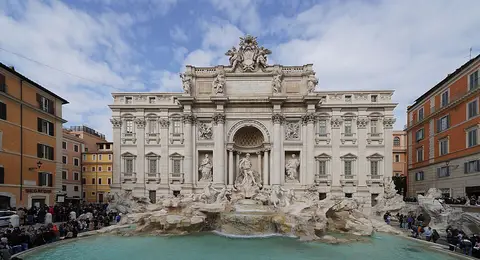 Historic sites03
Restauro Fontana di Trevi
Piazza di Trevi, 91 · Rome● Website○ Phone Monuments04
You need a free account to leave reviews and photos – that keeps comments genuine and lets you edit them later.