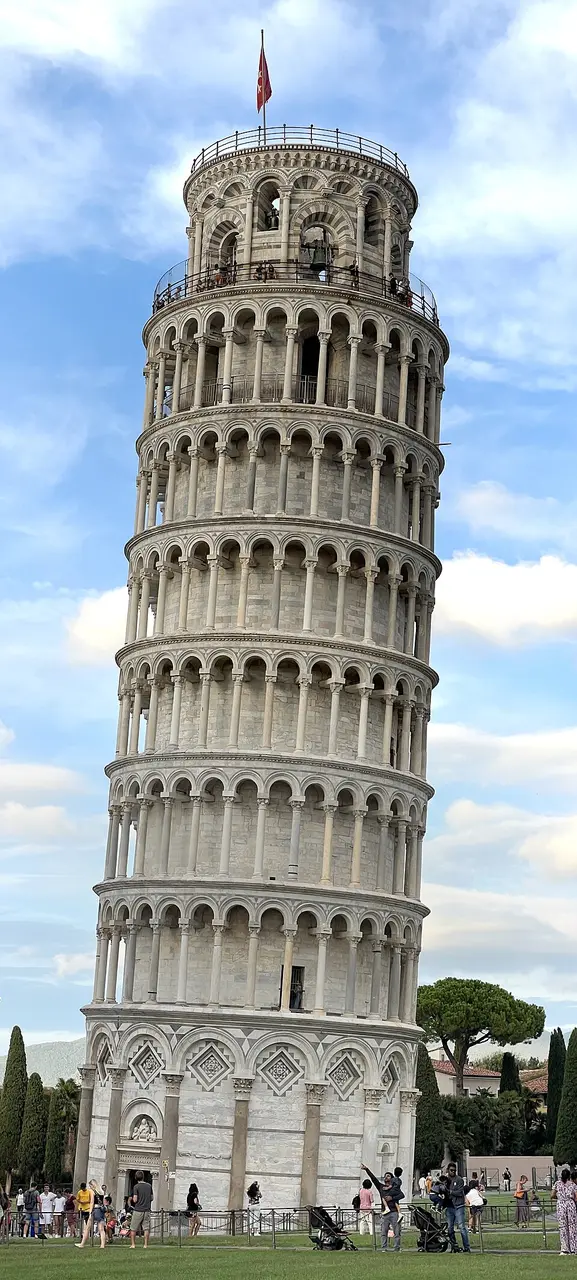
About La Torre Pendente, Pisa
The Leaning Tower of Pisa, known in Italian as the Torre pendente, is considered the world's most famous leaning structure and is the unmistakable landmark of the Tuscan city. Originally conceived as a freestanding bell tower for the neighboring cathedral, construction began in 1173. After just a few years, when the third floor had been reached, the structure began to tilt toward the southeast because of the soft ground of clayey mud and sand beneath it. This lean led to a construction pause of roughly a century. The floors added later were built at a smaller angle of tilt to maintain balance, but the bell chamber was not completed until 1372. Today the tilt is about four degrees, which amounts to a displacement of just under four meters at the top, on a total height of around 56 meters.
Architecturally, the campanile impresses with its elegant cylindrical form of white Carrara marble, which differs markedly from the square towers of central Italy. The structure rests on a spiral-shaped foundation of rubble stone and mortar. Each of the floors opens onto a colonnaded gallery made up of thirty columns each. Inside, a staircase leads up to the uppermost viewing terrace, whose design inspired the architect Brunelleschi in creating the lantern of the Florence Cathedral dome. Besides serving as a bell tower, the building also historically served as a refuge for the clergy in times of danger, with the openings in the walls making it possible to insert floors and timber framing as needed.
The history of the tower is closely tied to the question of its stability. After it was temporarily closed to visitors in 1990 due to the risk of collapse, extensive restoration work began. This included, among other things, fitting steel bands to secure load-bearing marble surfaces and placing heavy lead weights as a counterweight. The decisive step was ultimately the so-called soil extraction method, in which earth beneath the higher side of the foundation was removed in order to gently straighten the tower. After thirteen years of this work, which reduced the tilt from 5.5 to under four degrees, the tower reopened to the public in December 2001.
Today, visitors can climb the tower in small groups and enjoy a sweeping view over the Piazza del Duomo from the upper platform. The entire ensemble of tower, cathedral, baptistery, and Camposanto was recognized as a UNESCO World Heritage Site in 1987. Inside hang seven bells, which for structural reasons are no longer rung by hand but are struck by electromagnetic hammers. Although the tower is not the most tilted building in the world, it remains a fascinating testament to medieval craftsmanship and modern engineering, drawing millions of tourists every year.
At a glance
- Category
- Museum › History museums
- Rating
- no reviews yet · write a review
- Address
- Piazza dei Miracoli
56126 Pisa, Italy - District
- Santa Maria
- Phone
- —
- Website
- www.opapisa.it
- —
- Coordinates
- 43.72250° N · 10.39636° E
- Data quality
- confidence 0.86
- Identifier
- ID 51d1de96-d8e…
Part of the tour
Pisa in One Day: From the Leaning Tower to the Arno →Location & surroundings
Toggle layersRatings & comments
none yetNear La Torre Pendente, Pisa
closest 5 per category · 2 kmSights
Restaurants
Museums
Hotels
233 places within 2 km loaded.
You need a free account to leave reviews and photos – that keeps comments genuine and lets you edit them later.