About Cattedrale di San Ranieri
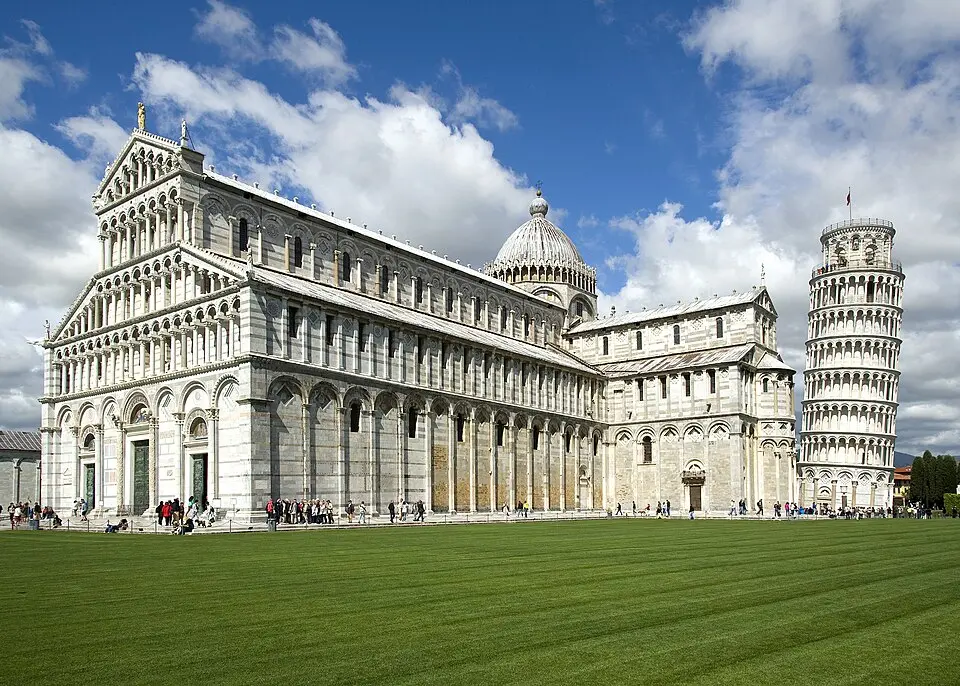
Pisa Cathedral, officially the Cattedrale di Santa Maria Assunta, is the cathedral of the Archdiocese of Pisa and stands on the broad lawn of the Piazza del Duomo. The poet Gabriele d'Annunzio dubbed this square the Piazza dei Miracoli, or Square of Miracles. Besides the cathedral, it is home to the Baptistery, the Camposanto Monumentale, and the world-famous Leaning Tower. Although construction stretched over more than two centuries, the complex reads as one cohesive architectural ensemble thanks to the uniform use of Carrara marble and a consistent facade design. The cathedral is considered one of the monumental buildings of Christian history and served for centuries as a model for later cathedrals in cities such as Florence and Siena.
The cathedral's history begins in 1063, when Buscheto di Giovanni Giudice started construction on alluvial ground outside the old city walls. The project was financed with the spoils Pisa had won that same year from the Saracens in the capture of treasure ships off Palermo. With this building, Buscheto founded what is known as Pisan Romanesque, a variation of the Romanesque style unique in Europe that also shaped other churches in the city, such as San Paolo a Ripa d'Arno and San Frediano. The cathedral's cross-shaped floor plan was new to Italy at the time, since earlier churches had mostly been basilicas without a transept. The soft ground caused the building, like the neighboring campanile, to sink slightly on its eastern side. The elliptical dome over the crossing of the five-aisled basilica with its three-aisled transept was not added until 1380, in the Gothic style.
The west facade, designed by Rainaldo at the end of the 12th century, is an architectural masterpiece and served as a model throughout Tuscany. It is 35.5 meters wide and 34.2 meters high. Above the seven blind arches on the ground floor, with its three portals, rise four galleries carrying a total of 52 columns. A Madonna and Child by Andrea Pisano sits atop the gable, flanked by angels and evangelists created by pupils of Giovanni Pisano. The central portal is dedicated to the life of Mary. In the left arch of the facade is the tomb of the cathedral's first master builder, Buscheto, set into an ancient reused sarcophagus. The present bronze doors from the 17th century replace the original doors by Bonanno Pisano, which were destroyed in a fire in 1595. On the south aisle, however, the restored original door by Bonanno Pisano from 1186 still survives: the Porta di San Ranieri, which depicts scenes from the life of Christ.
Inside the cathedral, a double row of massive granite columns with capitals dominates the space. Above them run alternating black-and-white Byzantine arcades that strongly recall mosque-like structures. A central work of art is the hexagonal pulpit by Giovanni Pisano, created between 1302 and 1311 and resting on eleven supports. These supports bear allegories of the seven liberal arts and the Christian virtues, as well as figures such as the Archangel Michael and the hero Hercules. The nine relief panels are divided by figures of prophets and saints. The apse semi-dome holds a mosaic begun by Francesco di Simone and completed by Cimabue in 1302, showing Christ enthroned with Mary and John. The apse is entirely painted with frescoes by Beccafumi, Sogliani, and Sodoma. Above the high altar hangs a bronze crucifix by Giambologna, flanked by six angels bearing candelabra.
Other significant works of art inside include the tomb of Emperor Henry VII by Tino di Camaino from 1315, as well as altarpieces by Antonio Sogliani and Andrea del Sarto. The gilded coffered ceiling dates from the 17th century and was made after the great fire of 1595. The cathedral's organs were built by the firm Mascioni in 1980. The main organ has 74 stops and two glockenspiels, spread across four manual divisions and pedal, while a smaller mechanical choir organ is also by Mascioni. On the cathedral's exterior walls you will find many seemingly unrelated markings, indicating that building materials from antiquity or from conquered cities were reused.
Two well-known legends are tied to the cathedral. In the nave hangs a bronze lamp by Vincenzo Possenti from 1587, which gave rise to the story that Galileo Galilei discovered the laws of pendulum motion here. Historically, though, this is doubtful, since Galileo had already published his findings around 1584. Another legend concerns a stone on a pillar between the north aisle and the west facade, covered with many black dots. The story goes that this stone came from the devil, and anyone who counts the dots twice in a row will get a different result each time. These myths underscore the mystical and historical aura that has surrounded the cathedral for centuries.
At a glance
- Category
- Sight › Monuments
- Rating
- no reviews yet · write a review
- Address
- Piazza dei Miracoli
Pisa, Italy - District
- Santa Maria
- Phone
- +39050560547
- Website
- —
- —
- Coordinates
- 43.72262° N · 10.39486° E
- Data quality
- confidence 0.90
- Identifier
- ID dc5f6059-1c3…
Part of the tour
Pisa in One Day: From the Leaning Tower to the Arno →Location & surroundings
Toggle layersRatings & comments
none yetNear Cattedrale di San Ranieri
closest 5 per category · 2 kmSights
Restaurants
Museums
Hotels
More:Sights in Santa Maria (48)All sights in Pisa (97)
234 places within 2 km loaded.
Don't miss in Pisa
All sights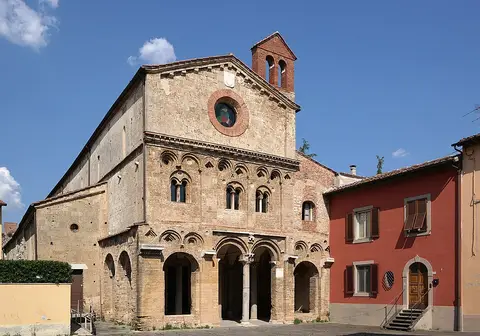 Historic sites01
Church of San Zeno
Largo S. Zeno · Pisa● Website○ Phone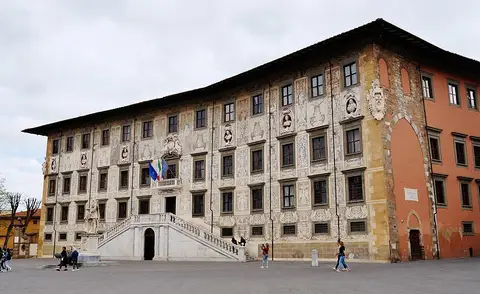 Palaces02
Palazzo della Carovana
Scuola Normale Superiore di Pisa - Classe di Scienze Matematiche Fisiche e Naturali, P.za dei Cavalieri, 7 · Pisa● Website● Phone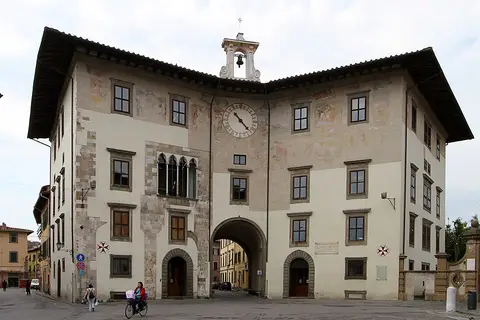 Historic sites03
Palazzo dell'Orologio
P.za dei Cavalieri · Pisa● Website● Phone Monuments04
You need a free account to leave reviews and photos – that keeps comments genuine and lets you edit them later.