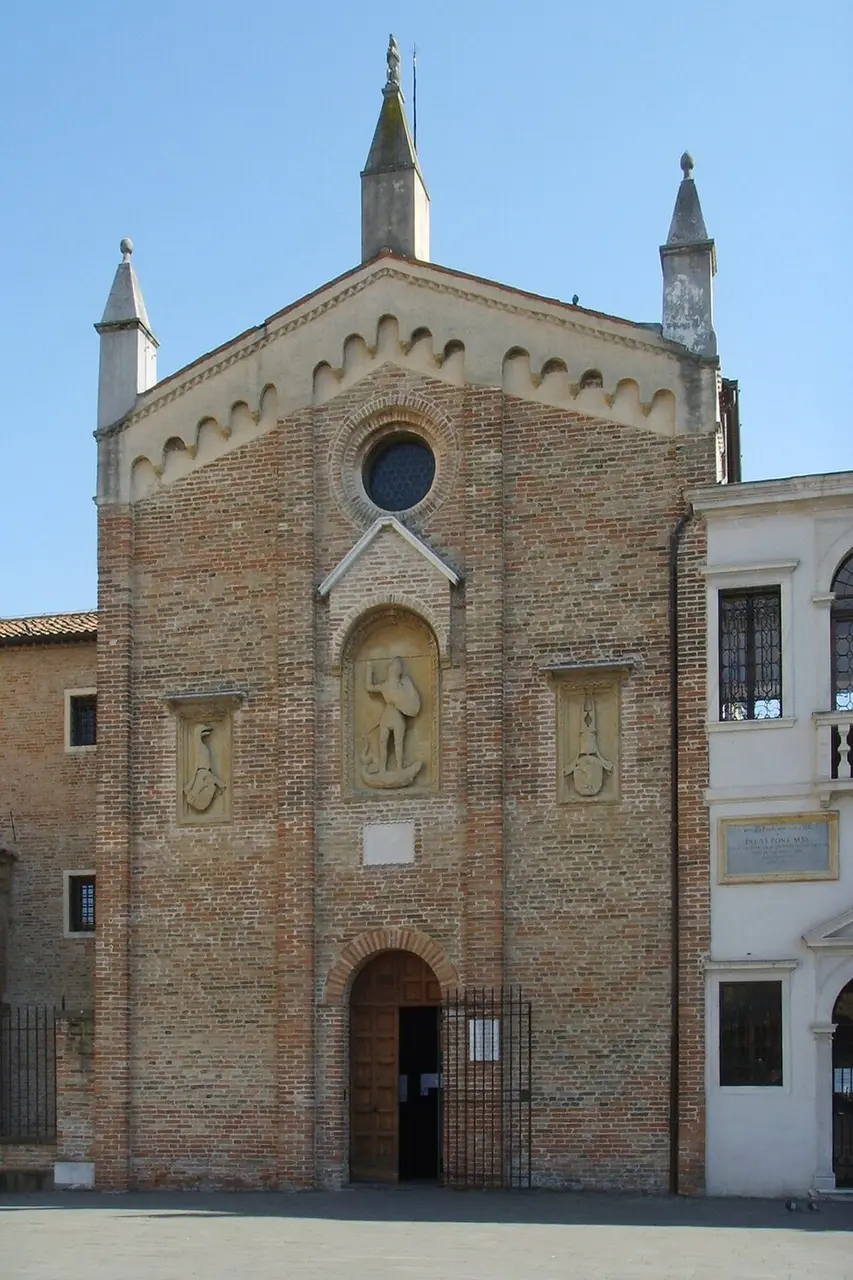
About Oratorio San Giorgio
The Oratorio San Giorgio is a Gothic Catholic prayer hall in Padua, located on the same square as the imposing Basilica di Sant'Antonio. Originally built in 1376 by the Marquis Raimondino de' Lupi as a freestanding family chapel and burial vault, the building now houses one of the most important fresco cycles of the 14th century. The brick façade is plain and features three bas-reliefs depicting Saint George, a dragon, and a shield. Inside, a small barrel-vaulted ceiling decorated with stars dominates the space, along with a tiled floor. Although the architecture appears simple, illusionistic frescoes suggesting columns and arches create the impression of a more complex spatial structure. This technique, known as quadratura, served as a frame for the actual wall paintings and remained popular in later periods such as the Renaissance and the Baroque.
The walls are covered with a total of twenty-two narrative frescoes, completed in 1384 by Altichiero da Zevio and his collaborators, including Jacopo d'Avanzi and Sebeto da Verona. These works depict scenes from the lives of Saint George, Saint Catherine of Alexandria, Saint Lucy, and Jesus Christ. Especially well known is the painting on the altar wall showing the Crucifixion, with Christ surrounded by angels and Mary kneeling in mourning beneath the cross. The entrance wall shows scenes from the childhood of Jesus, including the Annunciation, the Adoration of the Shepherds, and the Flight into Egypt. The northeast wall is devoted to Saint George, who gave the oratory its name, and shows, among other things, the famous legend of the dragon slayer as well as scenes of his martyrdom.
The opposite wall features depictions of Saint Catherine and Saint Lucy. Catherine is shown at her execution by beheading, while Lucy stands before a judge and is later bound to a pyre, from which she escapes unharmed thanks to divine intervention. The cycle was whitewashed during the Napoleonic Wars and not rediscovered until 1837, which caused considerable damage to the works. Despite this damage, the oratory today is part of the UNESCO World Heritage site "Padua's 14th-Century Fresco Cycles," recognized in 2021 for its exceptional monumental painting. Here, visitors get a rare glimpse into the narrative art and religious iconography of the late Gothic period.
At a glance
- Category
- Sight › Historic sites
- Rating
- no reviews yet · write a review
- Address
- Piazza Del Santo 11
Padua, Italy - Phone
- 394 9875 5235
- Website
- www.museionline.info
- —
- Coordinates
- 45.40159° N · 11.87950° E
- Data quality
- confidence 0.77
- Identifier
- ID 0ec12167-8e5…
Part of the tour
Padua in a Day: Piazzas, Palazzi and the Santo →Location & surroundings
Toggle layersRatings & comments
none yetNear Oratorio San Giorgio
closest 5 per category · 2 kmSights
Restaurants
Museums
Hotels
More:Historic sites in Padua (75)All sights in Padua (87)
242 places within 2 km loaded.
Don't miss in Padua
All sights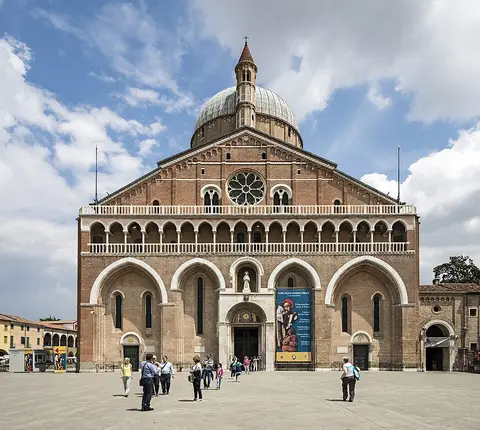 Historic sites01
Basilica di Sant'Antonio
Piazza del Santo, 11 · Padua● Website● Phone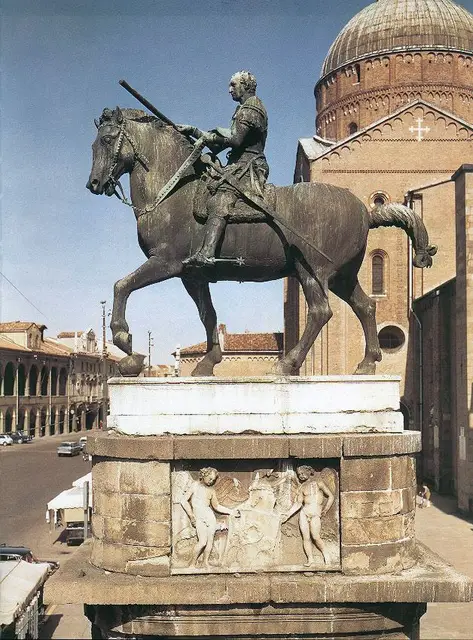 Monuments02
Monumento Equestre Al Gattamelata
Padova Suites C20, Piazza del Santo, 19 · Padua● Website○ Phone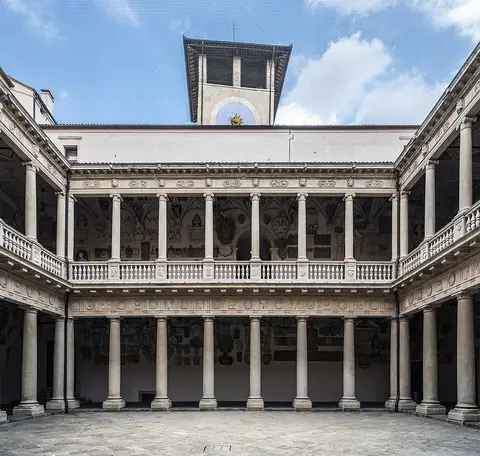 Historic sites03
Palazzo Bo
Via VIII Febbraio, 2 · Padua● Website● Phone Historic sites04
You need a free account to leave reviews and photos – that keeps comments genuine and lets you edit them later.
A beautiful, frescoed, and generally empty hall on the south side of the piazza next to the Basilica di Sant'Antonio. The paintings were done by two of Giotto's students, and though they are not as magnificent as those in the Capella degli Scrovegni, you can sit down and gaze at them undisturbed for as long as you like.
Source: Wikivoyage, „Padua“ · authors per page history · CC BY-SA 4.0