About Vari Cave
The Vari Cave, also known as the Cave of the Nympholept, lies northeast of Vari in Attica, on a southern spur of Mount Hymettus at an elevation of nearly 300 meters. From Vari, the site can be reached on foot in about an hour. In classical antiquity, the cave served as a sanctuary for Apollo, Pan, and the nymphs and was in use from the sixth to the second century B.C. After a long period of neglect, it was reoccupied in the fourth century A.D. and finally abandoned in the sixth century. The archaeological excavations took place in 1901 under the direction of Charles Heald Weller. A special feature of this site is that it is unique in Greece, as it has rock reliefs and sculptures carved into the stone. The marble votive tablets found here are now on display in the National Archaeological Museum of Athens.
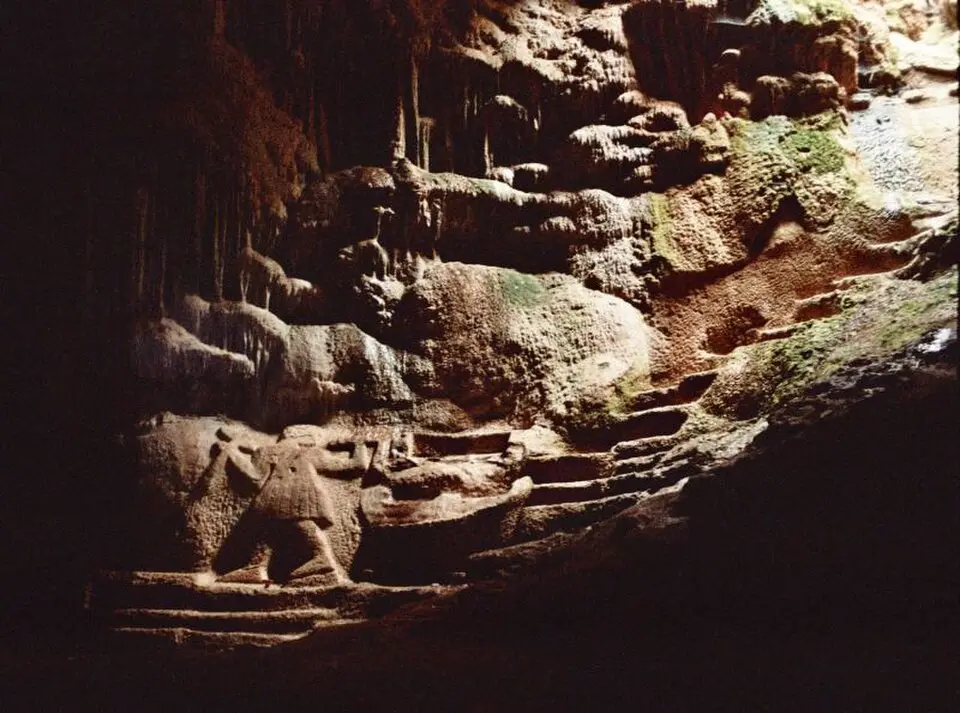
The entrance to the cave leads vertically downward and consists of a staircase cut into the rock. From a landing platform, further steps lead to the two main chambers, which are separated by a large rock wall. The larger chamber contains a shrine dedicated to Pan that imitates the facade of a temple. A headless seated figure and an object in the shape of an omphalos are also carved into the rock here. Deeper inside the cave lies a shrine to Apollo Hersus, next to which is the rock relief of the dedicator Archedemus, who is depicted as a stonemason with his tools. The inscriptions and finds suggest that the sanctuary was originally established by Archedemus of Thera, who called himself a nympholept.
The site's significance is underscored by its connection to the gods Pan and Apollo and to the nymphs; it was one of the five caves of Pan near ancient Athens. While earlier interpretations assumed later use as a Christian sanctuary, since Christian oil lamps were found and pagan reliefs had been destroyed, more recent research favors a different interpretation. According to this view, the cave and its association with Plato, whose parents made offerings here, may also have been visited by pagan Platonists in the late Roman Empire in order to continue their religious practices. The destruction of the sculptures could thus have taken place at the end of the cave's renewed use, not at the beginning.
At a glance
- Category
- Sight › Historic sites
- Rating
- no reviews yet · write a review
- Address
- —
Athens, Greece - District
- Cheroma
- Phone
- —
- Website
- odysseus.culture.gr
- —
- Coordinates
- 37.85833° N · 23.80167° E
- Data quality
- confidence 0.78
- Identifier
- ID 72971255-24f…
Location & surroundings
Toggle layersRatings & comments
none yetNear Vari Cave
closest 5 per category · 2 kmRestaurants
None within 2 km.
Museums
None within 2 km.
Cocktail bars
None within 2 km.
More:Historic sites in Athens (406)Sights in Cheroma (17)All sights in Athens (497)
5 places within 2 km loaded.
You need a free account to leave reviews and photos – that keeps comments genuine and lets you edit them later.