About Acropolis Apartment
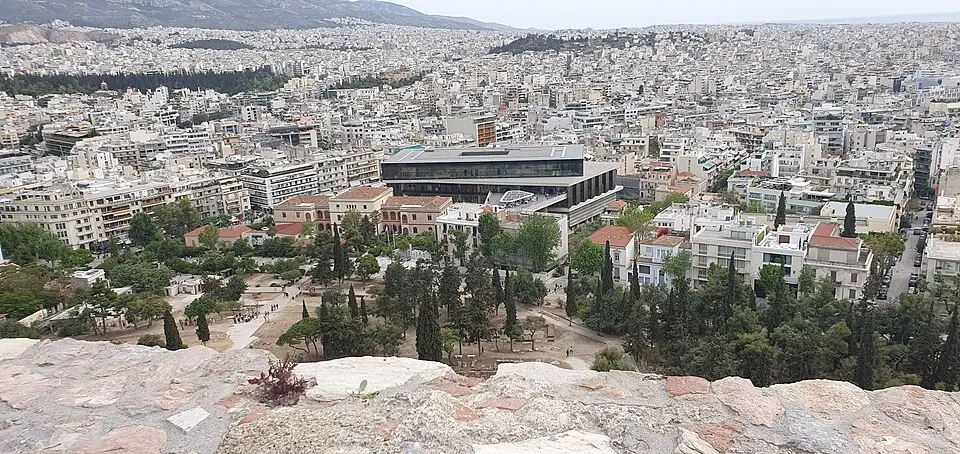
The Acropolis Museum in Athens is a major cultural center devoted exclusively to displaying finds and objects discovered on the rock of the Acropolis. The modern building stands at the foot of the historic hill and was designed by the architects Bernard Tschumi and Michalis Fotiadis. The new museum was officially opened on June 20, 2009. In its first three and a half years of operation, it already welcomed more than five million visitors, a sign of the enormous popularity of the site and the high regard in which tourists and art lovers hold it.
The history of museum displays on the Acropolis goes back to the 19th century. After the first excavations in 1863, it quickly became clear that a protected space was needed for the finds. With financial support from Demetrios Bernardakis, a Greek living in Russia, the first museum was built directly on the rock under the direction of the architect Panagiotis Kalkos. As this building eventually became too small, Patroklos Karantinos built a second museum in a hollow of the hill in 1937. This structure, in the style of classical modernism, consisted of a concrete skeleton filled in with stone so that it blended discreetly into the landscape. Because space there was limited, the building could not be expanded. Today this historic building is no longer used as a museum; it is slated to be converted into an administrative office with a public café.
The new building at the foot of the Acropolis was the result of years of planning and several competitions. In 1974, Greek Prime Minister Konstantinos Karamanlis voiced the wish for a new museum, which Minister of Culture Melina Mercouri took up in the 1980s. She secured the site of the former Makrygiannis Barracks as the location and linked the project to the demand for the return of the Elgin Marbles, which are housed in the British Museum in London. After several rounds of bidding, Bernard Tschumi won the competition. His design stood out because it took into account a large archaeological excavation site beneath the building. The building is engineered to be extremely earthquake-resistant and rests on sliding pendulum bearings that decouple it from the ground. The surroundings were planted with olive trees and bitter orange trees, and a metro station was built directly in front of the museum.
Inside the museum, visitors will find a comprehensive collection of around 300 statues and frieze fragments as well as about 4,000 smaller objects from the Archaic period, classical antiquity, and late antiquity. Highlights include famous works such as the Kritios Boy, the Peplos Kore, and the Blond Head from the Acropolis. A central point of the exhibition is the Parthenon Frieze Hall. The building's third floor was designed to match the exact dimensions and orientation of the Parthenon so that the frieze can be displayed in its original order and length. Since a large share of the originals remains in the British Museum, the gaps in the frieze are filled with distinctly lighter plaster casts, while the missing caryatid of the Erechtheion has not been replaced. For conservation reasons, the interior temperature is kept constant at 23 degrees Celsius (73 °F) to protect the delicate artifacts.
The museum's architecture has been the subject of various debates. While some critics fault its lack of architectural connection to its surroundings and compare the glass facade to a display case, others praise the clear design and the chance to view the sculptures in natural light. The building uses materials such as concrete, glass, and marble that reflect mathematical logic and Greek clarity. Despite initial complaints from local residents over the loss of their view of the Acropolis, and plans to demolish two listed buildings nearby that were halted by the Council of State, the museum has become firmly established. It has won multiple international awards, including recognition as one of the best museums in the world by the British newspaper The Times and in Tripadvisor reviews. The museum also offers digital collections in several languages that provide an in-depth look at the history and the artifacts.
At a glance
- Category
- Sight › Historic sites
- Rating
- no reviews yet · write a review
- Address
- Διονυσίου Αρεοπαγίτου 17
117 42 Athens, Greece - Phone
- +302109242868
- Website
- www.acropolis-apartment.blogspot.com
- acropolis.aaprtment@gmail.com
- Coordinates
- 37.96945° N · 23.72809° E
- Data quality
- confidence 0.66
- Identifier
- ID 478ca4ba-067…
Location & surroundings
Toggle layersRatings & comments
none yetNear Acropolis Apartment
closest 5 per category · 2 kmSights
Restaurants
Museums
Hotels
More:Historic sites in Athens (406)All sights in Athens (497)
300 places within 2 km loaded.
You need a free account to leave reviews and photos – that keeps comments genuine and lets you edit them later.